At 1 Year, Real-world Agent DCB Outcomes Reassure Despite Patient Complexity
Notably, one-third of cases involved off-label use in de novo lesions.

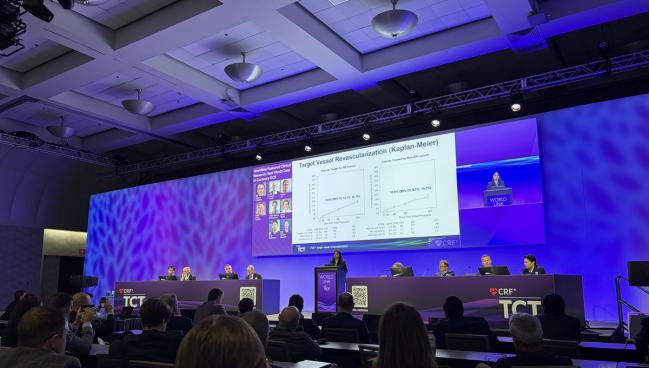
SAN DIEGO, CA—Patients treated with the Agent drug-coated balloon (DCB; Boston Scientific) have encouraging outcomes at 1 year despite many having comorbidities and one-third being treated off-label in de novo lesions, according to real-world registry data.
The paclitaxel-coated device was the first DCB approved by the US Food and Drug Administration to treat in-stent restenosis (ISR) in 2024 based on the AGENT IDE trial, and clinical use has swiftly expanded. Thirty-day data from the AGENT Post-Approval study showed that almost one in five patients undergoing PCI for ISR lesions were receiving DCBs.
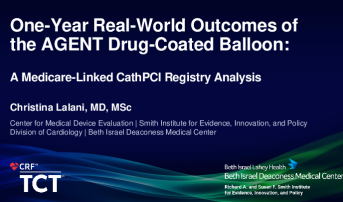
The new findings, which uniquely merge Medicare claims data with the CathPCI Registry, are “really reassuring,” said Christina Lalani, MD (Beth Israel Deaconess Medical Center, Boston, MA), who presented the findings yesterday at TCT 2026. “The other big takeaway is that the high [rate] of off-label use . . . is enlightening and very interesting, and I think probably speaks to the need for these therapies potentially for de novo disease or better therapies for small lesions, bifurcation lesions, [and] long lesions,” she told TCTMD.
Currently, there are no DCBs approved by the FDA for use in de novo lesions.
The registry analysis involved 25,924 procedures in 24,814 patients (mean age 68.9 years; 72.1% male) between April 2024 and December 2025. Among them, 33.1% were performed in non-ISR lesions. Non-ISR lesions tended to be treated with smaller-diameter and shorter devices than ISR lesions. In total, the population had a heavy burden of diabetes (55.6%), cerebrovascular disease (23.8%), peripheral vascular disease (19.7%), prior MI (57.6%), prior CABG (28.0%), and heart failure (46.0%).
Several differences stood out between the real-world cohort and the AGENT IDE participants.
Compared with patients treated in the AGENT IDE trial, the subset of registry patients treated for ISR were slightly older on average (69.4 vs 68.4 years); had longer mean lesion lengths (26.1 vs 12.8 mm); were more often white (84.4% vs 74.4%); and more often had diabetes (57.2% vs 51.0%), prior MI (63.8% vs 49.7%), and prior stroke or TIA (25.6% vs 14.2%).
Within the registry, patients treated for non-ISR versus ISR more often presented with chronic coronary syndrome (28.9% vs 21.9%), unstable angina (4.6% vs 2.4%), and STEMI (6.1% vs 2.4%) and less frequently had NSTEMI (30.4% vs 35.4%). The LAD was the most common target-vessel location for both groups (48.6% vs 42.2%).
Chronic total occlusions were also more common in the registry’s non-ISR cohort (10.3% vs 5.8%), and about one-third of patients in each were deemed to have complex lesions (B2/C). Bifurcations were more common in the non-IRS group (20.9% vs 12.7%), which also had slightly longer mean lesion lengths (29.1 vs 26.1 mm). Rates of moderate-to-severe calcification were similar in the non-ISR and ISR groups (14.9% vs 16.3%), with non-ISR lesions being less often treated with intraprocedural devices like atherectomy (8.4% vs 12.6%), specialty balloons (26.6% vs 43.3%), and intravascular lithotripsy (17.1% vs 19.6%). About half of cases in each group were performed using IVUS or OCT guidance.
“The characteristics of the patients receiving Agent in routine practice are unsurprising, and I think demonstrate the cohorts where Agent could be potentially beneficial—like patients with diabetes, for example, are patients who are more likely to have ISR in general,” Lalani commented.
In-hospital outcomes were infrequent overall, with all-cause mortality reported in 1.3% of the non-ISR patients and 0.8% in the ISR group. Respective rates of MI were 0.5% and 0.4%, and those for target vessel revascularization were 1.1% vs 0.7%.
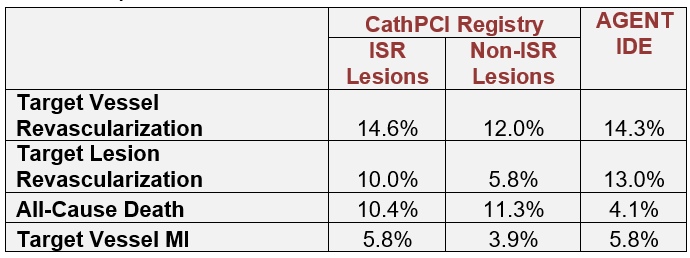
One-year registry outcomes—available for 30% of the total cohort—reflect an older, more complex Medicare-linked population, especially when compared with those from the AGENT IDE trial, according to Lalani. Yet, “we still are seeing reasonable 1-year outcomes in terms of efficacy,” she said.
One-Year Kaplan-Meier Outcomes
The frequent off-label use of DCBs likely indicates that “current DES technology is not a preferred treatment by the provider” for patients with certain de novo lesion characteristics like smaller and longer lesions and bifurcation disease, Lalani said. This “aligns with populations in which DCBs have been shown to potentially have some benefit . . . globally.”
The ongoing STANCE trial should hopefully give more clarity on use of DCBs in de novo lesions, she added.
One limitation of the registry is that it did not capture the proportion of patients treated for multilayer ISR, a group that made up about 40% of those treated within the AGENT IDE trial and derived added benefits from the intervention. “We have no understanding of, ‘Is this a single-layer ISR or is this patients who are being treated for recurrent ISR with two or more layers of stent?’” Lalani said, adding that future research should dig further into this question.
Additionally, due to how procedures are coded in the registry, there may have been an element of “undercapture,” Lalani said.
Other than that, she added that she would like to see long-term outcomes “especially because, when we get out to 3-plus years, [that is] when there’s, for example, in de novo disease, questions around [durability].”
Lesion Preparation Matters
Jeffrey W. Moses, MD (Good Samaritan University Hospital, West Islip, NY), the discussant for the study, congratulated the researchers on an original study design, saying that it’s unusual to get more than claims-based data.
Still, he cautioned, though one-third of the patients in this study had de novo lesions, “the pool was at least nine times bigger. So, it’s not like this has been widely embraced by the population. There’s still some hesitancy.”
Commenting for TCTMD, Michael Haude, MD (Rheinland Klinikum Neuss, Germany), who was not involved in the study, said lesion preparation remains a key factor for the success of DCB use. “Those patients who received the DCB for de novo lesions were those patients who really had a good lesion preparation result and then received the DCB with a good final result,” he explained. “I suppose that maybe many more lesions were attempted and then ended up finally with a stent.”
Still, he continued, the concept of “leave nothing behind is still very attractive for most of the interventional cardiologists, and a DCB at the moment is the way to achieve this.” The findings reflect what is being done now in clinical practice both in Europe and in Asia, although Haude said that countries like Singapore are using DCBs in as many as 80% of de novo cases.
“You might then really think where is the scientific background for doing [that], but there are really regional differences why people don’t want to get foreign body implants into their coronary arteries,” he said. “For [that thinking], the DCB is of course a good idea.”
For his part, Moses said he was “a little concerned” that the longest balloon available is 30 mm, but the average de novo lesion length was 29.1 mm. “I’m worried about some geographic miss, but I think drilling down on that is important and can be helpful,” he said. Additionally, since about 95% of cases used a single Agent balloon, “even though maybe some of these lesions technically were more than one, I think [that] indicates that the economics also may dictate an awful lot.”
An alternative strategy of DCB in combination with DES might become more common for longer lesions, Lalani said, adding, “That’s not something we’ve looked at yet in this analysis.”
Overall, she continued, “the fact that these drug-coated balloons are being used in clinical practice when the provider has an opportunity to choose between all of these therapies and is really making a clinical decision indicates that we need to understand why this choice is being made and why DES are failing these patients in a way that the providers are choosing alternative treatments.”
‘There Is a Need for DCB’
Panelist Tuomas Rissanen, MD, PhD (Heart Center of North Karelia Central Hospital, Joensuu, Finland), said that the results show “there is a need for DCB in this country for de novo lesions . . . and probably means that people are not willing to put a stent in a small vessel, noncalcified, diffuse, small bifurcations.” All things considered, the TLR rate reported here was “quite low,” he added.
Haude predicted that bioresorbable scaffolds (BRS) might have a “revival” in this population. “In major vessels, [BRS] might be superior to DCB, but for the smaller vessels, let’s say 2.5 and less, the DCB can have a kind of certain superiority,” he said. “So hybrid procedures in the future [with] bioresorbable devices and DCBs might play a larger role. But again, we need to do trials in order to support that adequacy.”
The ongoing BioMag-II trial of a next-generation magnesium BRS, for which he is an investigator, may be a game changer, Haude said.
He’d also like to see more work done examining outcomes following DCB use in true ISR lesions or in those where the stent is underexpanded, likely due to inadequate lesion preparation.
For the latter, “the DCB is potentially alone not the right tool because the balloons that are used are not usually strong enough to open up an underexpanded stent,” Haude said. “On the other side, if you have a very well-expanded drug-eluting stent that really then failed because there was excessive neointimal proliferation, this is something where the DCB really can work pretty nice because it’s addressing the aspect of neointimal proliferation as the major cause of the restenosis.”
Additionally, DCBs should be more closely examined in larger vessels compared with DES and over the long-term across the board, he said. “One year is not the adequate time frame here,” according to Haude. “We need to look at something at least of 5 years, even 10 years, to see that flattening of the curve. That would then really strongly support the application of DCBs in de novo lesions.”

Yael L. Maxwell is Senior Medical Journalist for TCTMD and Section Editor of TCTMD's Fellows Forum. She served as the inaugural…
Read Full BioSources
Lalani C. One-year real-world outcomes of the AGENT drug-coated balloon: a Medicare-linked CathPCI Registry analysis. Presented at: TCT 2026. October 31, 2026. San Diego, CA.
Disclosures
- This study was funded by Boston Scientific Corporation.
- Lalani and Haude report no relevant conflicts of interest.
- Moses reports holding equity/stock(s)/options in Orchestra Biomed.
- Rissanen reports receiving consultant/speaker fees from Abbott, Cordis, Shockwave Medical, and Boston Scientific and research support from B Braun.
Related News


Comments