Aficamten Wins in Nonobstructive Hypertrophic Cardiomyopathy: ACACIA-HCM
The findings open the door to regulatory approval for this patient group without other treatment options.

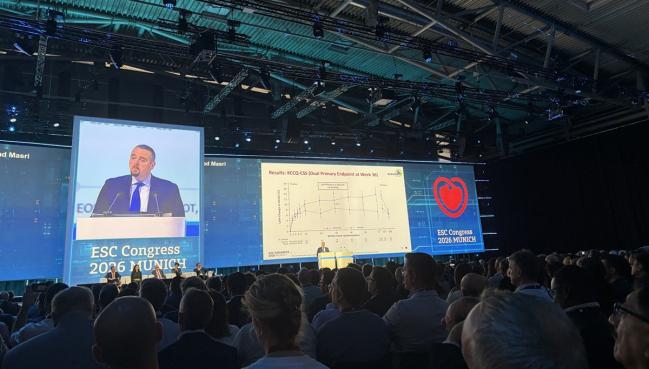
Among patients with nonobstructive hypertrophic cardiomyopathy (HCM), the selective cardiac myosin inhibitor aficamten (Myqorzo; Cytokinetics) increases exercise capacity and improves symptoms compared with placebo at 36 weeks, according to results from the ACACIA-HCM trial.
Beyond the top-line results released in May, the full dataset—presented today by Ahmad Masri, MD (Oregon Health & Science University, Portland), at the European Society of Cardiology Congress 2026 in Munich, Germany, and simultaneously published in the New England Journal of Medicine—includes additional safety, biomarker, and echocardiography data as well as results out to 72 weeks.
With no other drugs currently approved for the treatment of nonobstructive HCM, aficamten may well be a game changer for this patient community if green-lit by regulators, according to Masri.
“What I can say is that this is a positive clinical trial, and you have multiple domains of benefit,” he told TCTMD. “Every way, shape, or form you look at this, there was benefit that was derived from aficamten in a disease that has no treatments available right now. And so, I’m optimistic that the regulators will see the benefit that was derived from aficamten in this trial and we’ll see . . . what happens.”
ACACIA-HCM
Researchers randomized 517 patients with symptomatic nonobstructive HCM (mean age 55.1 years; 53.6% women) from 182 international sites to receive aficamten (starting dose 5 mg; maximum dose 20 mg) or placebo between August 2023 and March 2025. Similar proportions of the aficamten- (88.4%) and placebo-assigned patients (90.0%) completed the treatment period.
Mean left ventricular ejection fraction at baseline was 68%. The median NT-proBNP level was 893 pg/mL, mean Kansas City Cardiomyopathy Questionnaire clinical summary score (KCCQ-CSS) was 65.7, and mean peak oxygen uptake was 18.0 mL/kg/min. Background medical therapy for HCM was used by 85.3% of patients, and this remained stable at week 36.
The dose-adjustment phase of the trial was completed by week 8, at which point 1.6%, 6.2%, 5.8%, 22.9%, and 57.8% of patients assigned to the treatment arm were taking 0 mg, 5 mg, 10 mg, 15 mg, and 20 mg of aficamten, respectively. These percentages changed to 3.5%, 6.6%, 10.5%, 23.6%, and 55.8%, respectively, by the end of the treatment period.
Over 36 weeks of follow-up, patients assigned to aficamten compared with placebo had a greater change in the KCCQ-CSS (11.4 vs 8.4 points; P = 0.02). By 72 weeks, the between-group difference jumped to 7.0 points. Additionally, the treatment group saw a higher mean change in peak oxygen uptake (0.64 vs -0.03 mL/kg/min; P = 0.003) and ventilatory efficiency (P = 0.016) at 36 weeks. These results were maintained in prespecified subgroup analyses.
Those in the aficamten versus the placebo group more often reported improvement by at least one NYHA functional class at week 36 (41.9% vs 27.8%), had greater exercise performance as measured by the composite z score (0.05 vs -0.09), and had lower levels of NT-proBNP (P < 0.001 for all). Additionally, the between-group differences in the change from baseline to week 36 in left atrial volume index and time to first cardiovascular event were -1.3 mL/m2 and -0.6 weeks, respectively.
Serious adverse events occurred at rates of 20.2% in the study group and 14.7% in the placebo arm, leading to early discontinuation in 7.0% and 1.9%, respectively. These included heart failure (4.3% in the aficamten group and 0.4% in the placebo group), new atrial fibrillation (1.6% and 1.2%), and ventricular arrhythmias (2.7% and 4.7%).
Every way, shape, or form you look at this, there was benefit that was derived from aficamten in a disease that has no treatments available right now. Ahmad Masri
After the washout period, LVEF returned to baseline (least-squares mean between-group difference -0.5%). Reversible reductions in LVEF to less than 50% were reported in 10.5% of patients receiving aficamten and 0.8% taking placebo. Seven of these patients who were receiving aficamten (2.7%) had an LVEF reduction to less than 40% and paused treatment, including two who discontinued the drug permanently. Additionally, two patients receiving aficamten who had a LVEF of less than 50% reported a concurrent serious heart failure event.
“Aficamten works by modulating heart contractility, so that’s why we pay attention to ejection fraction,” Masri said during a press conference. “However, the majority of these patients actually continued on either the same dose or a lower dose of aficamten because per protocol, we just downtitrate aficamten dose for an EF between 40-50%.”
Additionally, of the two patients who had a serious heart failure event that led to stopping their medication, “one of them is already back on it . . . without irreversible harm,” he explained. “These findings show that aficamten is an effective treatment for patients with nonobstructive hypertrophic cardiomyopathy.”
Masri also presented results from a prespecified responder analysis of ACACIA-HCM. For this, the investigators looked at five factors: symptoms (improvement by at least one NYHA class and/or reported gain in Patient Global Impression of Change), exercise capacity (peak VO2 ≥ 0.5 mL/kg/min), left atrial volume index (> 10% decrease), septal e’ (> 10% increase), and NT-proBNP (≥ 50% reduction).
“Aficamten positively influenced all of these domains,” Masri said. “What happens if you put everything together here and define a ‘clinical response’ by achieving three or more of these domains? That happened for 53% of patients on aficamten versus 13% of patients on placebo, with a P value of less than 0.001.”
As the trial’s assigned discussant, Nosheen Reza, MD (University of Pennsylvania, Philadelphia), described ACACIA-HCM as a “milestone.” She proposed three paths forward.
“Nonobstructive HCM is unlikely to be a single disease phenotype, [so] we need to define the phenotypes that are most likely to benefit: perhaps contractile dysfunction, perhaps diastolic dysfunction or other mechanisms to target,” said Reza.
“Second, we need to align therapeutic targets with disease mechanisms. This includes of course addressing sarcomere-related biology but [also] other emerging therapies that may help us to understand other drivers of nonobstructive HCM,” she said. “And finally, we must look to inform myocardial-targeted therapies beyond HCM. The lessons we’ve learned here about cardiac myosin inhibition may extend beyond this disease.”
A Drug That ‘Resonates’
Commenting on the study for TCTMD, Brett Sperry, MD (Saint Luke’s Mid America Heart Institute, Kansas City, MO), said it “confirms and extends a lot of the things that we’ve seen in the obstructive population,” namely quality-of-life and peak VO2 benefits as well as a “dramatic” reduction in NT-proBNP.
He surmised that the findings with aficamten seen here were significant, while those observed in the ODYSSEY-HCM trial with mavacamten (Camzyos; Bristol Myers Squibb) were not, is likely because of the shorter half-life with the former drug. “You can more rapidly titrate [aficamten], and you can recognize if there’s a drop in ejection fraction more quickly because you’re seeing those effects more rapidly,” Sperry said.
In ODYSSEY-HCM, drug interruption due to drops in LVEF was more frequent than observed in ACACIA-HCM. “So, you have more people here who were actually on the drug for longer periods of time, so you see a little bit more benefit in this population than in the mavacamten population,” he said.
The findings are enough to support regulatory approval, according to Sperry. “There’s really nothing available for nonobstructive HCM, so there’s a definite need here, and we know that the medicine is working on the biological level,” he said, adding that he’d like to see more granular data on LVEF and quality-of-life findings. A risk evaluation and mitigation strategy (REMS) program will also be necessary to monitor patients.
“The vast majority of patients are not really worried about this risk of dropping the ejection fraction,” Sperry said. “These are symptomatic patients. They have a progressive disease. Many of them have a genetic predisposition to this, and they know that this is usually a progressive thing. And if you can have a medication that tries to get at the actual pathology, the actual biology, that is causing their hearts to fail, then that really resonates with them.”

Yael L. Maxwell is Senior Medical Journalist for TCTMD and Section Editor of TCTMD's Fellows Forum. She served as the inaugural…
Read Full BioSources
Masri A, Maron MS, Bhatia A, et al. Aficamten for symptomatic nonobstructive hypertrophic cardiomyopathy. N Engl J Med. 2026;Epub ahead of print.
Disclosures
- The trial was supported by Cytokinetics.
- Masri reports receiving research grants from Attralus, Cytokinetics, and Janssen and consulting fees from Cytokinetics, BridgeBio, Pfizer, Ionis, Lexicon, Attralus, Alnylam, Haya, Alexion, Akros, Edgewise, Rocket, Lexeo, Prothena, BioMarin, Intellia, Bayer, Imbria, Braveheart, AstraZeneca, Avidity, and Neurimmune.
- Sperry reports no relevant conflicts of interest.
- Reza reports receiving research contracts from the US National Institutes of Health and Bristol Myers Squibb; consulting fees from Roche Diagnostics, American Regent, Bristol Myers Squibb, ldorsia, Novo Nordisk, and AstraZeneca; and unpaid consultancy/travel support from Cytokinetics.
Related News



Comments