After TAVI, Early Hemodynamic Valve Deterioration May Elude Detection
The problem is poorly captured by VARC-3 and gradient rises in the first 3 months have consequences, international data suggest.

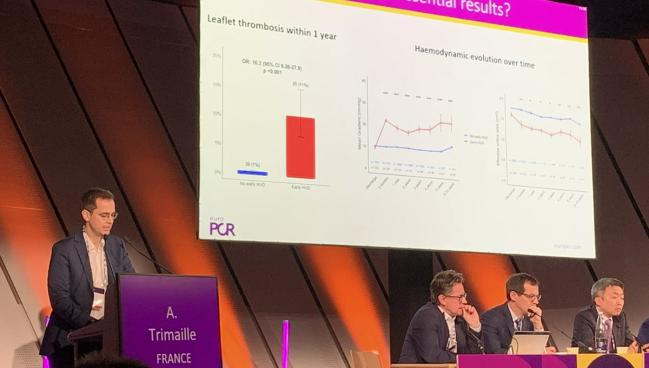
PARIS, France—Early hemodynamic valve deterioration (HVD) after TAVI may be inadequately characterized under current criteria, resulting in failure to identify problems soon enough in some patients to prevent long-term clinical and valve-related issues, new observational data suggest.
Applying a less restrictive version of the VARC-3 criteria of bioprosthetic valve dysfunction (BVD) to patients in an international, multicenter registry enhanced the detection of clinically significant early HVD. Researchers say this could have implications for optimizing post-TAVI surveillance and management.
“There was no significant difference in the demographic and clinical characteristics at baseline between patients with and without early HVD,” noted Antonin Trimaille, MD, PhD (Laval University/Quebec Heart & Lung Institute, Canada), in a Hotline presentation at EuroPCR 2026. The results were simultaneously published in EuroIntervention.
“However, they exhibited some difference in the procedural characteristics,” he added, “with higher transfemoral approach, balloon-expandable valve, and valve-in-valve procedure in patients with early HVD, and a lower rate of predilation, postdilation, and larger prosthesis size.”
Lack of oral anticoagulation prescribing at discharge also was an independent predictor in the 3.1% of patients in the study who developed HVD.
Over 8 years of follow-up, early HVD was associated with lower valve-related long-term clinical efficacy and a higher rate of stroke, Trimaille added. The investigators say the findings suggest there’s a need for systematic early echocardiographic follow-up and careful interpretation of early increases in transvalvular gradients.
To TCTMD, Trimaille said the researchers intentionally designed a new definition of early HVD that they believe captures a broader spectrum of patients than the VARC-3 definition.
“If we apply the VARC-3 criteria of stage 2 or stage 3 BVD, the proportion of patient in the first 3 months will be very small. But with such a different definition, with a less restrictive gradient elevation, we capture a subset of patients with worse outcomes, including valve-related and clinical outcomes with a higher risk of stroke,” he said.
The group defined early HVD as a ≥ 10-mm Hg increase in the mean transaortic gradient on echocardiography within 3 months after TAVI compared with discharge values
Asked by TCTMD if the researchers are suggesting that VARC-3 doesn’t adequately address the issue and needs an expanded definition to capture early HVD, Trimaille said, “Maybe it would be prudent.” VARC-3 does not mention the increase of ≥ 10 mm Hg in the mean transaortic gradient, which they hypothesize may at any time after TAVI be indicative of risk for early HVD.
Following the presentation, panelist Giuseppe Tarantini, MD (Padova Hospital, Italy), agreed that the concept challenges current evidence and should be explored further.
“This is important because it seems that VARC-3 underestimated the problem,” he added.
“It’s really a relevant point because if we’re going to identify the patients that are at risk, we have to be better at doing it and more specific,” agreed session anchorperson Jonathan Byrne, MD (King’s College Hospital NHS Foundation Trust, London, England). “I’m struck by the fact that whatever treatment they had, if you had elevated gradient at 3 months, the outcome was still worse.”
Markedly More Leaflet Thrombosis
For the study, Trimaille and colleagues analyzed data on 7,392 patients (mean age 81 years; 48% women) who underwent TAVI and were enrolled in a registry at one of 16 centers in Canada, Spain, France, and Italy between 2007 and 2025. All had echocardiography performed within three months of the procedure (median, 43 days). By the study definition, 3.1% of patients had early HVD, with a median increase in transvalvular gradient of 12 mm Hg at 3 months compared with discharge.
At 4 years, early HVD was independently associated with lower valve-related long-term clinical efficacy (subdistribution hazard ratio [sHR] 0.42, 95% CI 0.32-0.56), defined as freedom from bioprosthetic valve failure (BVF), stroke, or peripheral embolism, and type 2-4 bleeding secondary to or exacerbated by antiplatelet or anticoagulants.
Early HVD also was associated with increased incidence of stage 2 or 3 BVD (sHR 2.74; 95% CI 2.10-3.57), stage 3 BVD (sHR 3.53; 95% CI 2.15-5.79), and BVF (sHR 3.04; 95% CI 2.06-4.52).
Independent predictors of early HVD were high body mass index, prosthesis size < 26 mm, valve-in-valve procedure, and the absence of anticoagulation at discharge.
Having early HVD was not associated with increased all-cause or cardiovascular mortality, but was linked to a greater stroke risk compared with not having early HVD (log-rank P < 0.001). Strikingly, 11% of patients with HVD had leaflet thrombosis within 1 year compared with just 1% of patients without HVD (adjusted OR 16.2; 95% CI 9.26-27.9).
If we’re going to identify the patients that are at risk, we have to be better at doing it and more specific. Jonathan Byrne
“Given its early timing, the same predictors and associated complications, early HVD is likely driven by mechanisms related to leaflet thrombosis,” Trimaille said. “Early detection of HVD may enable the timely investigation of potentially reversible mechanism, including leaflet thrombosis, and help optimize long-term valve durability and clinical outcomes in our patients.”
“From a clinical perspective, in our practice typically we see patients at 30 days, get an echo and see them at 1 year,” noted panelist Tamim Nazif, MD (NewYork Presbyterian/Columbia University Irving Medical Center, New York, NY). He was left wondering whether 30 days is adequate or whether assessment is needed out to 3 months to look for signs of early HVD.
In a press conference prior the presentation, Trimaille said at this point he believes all patients should have an additional echocardiography within the first three months. If HVD is detected, anticoagulation should be started, he added, noting that future studies are needed to confirm these findings, however, and to define the optimal strategy for managing HVD.

L.A. McKeown is a Senior Medical Journalist for TCTMD, the Section Editor of CV Team Forum, and Senior Medical…
Read Full BioSources
Trimaille A, Morel O, Alperi A, et al. Prognostic value of early haemodynamic valve deterioration after TAVI. EuroIntervention. 2026;Epub ahead of print.
Disclosures
- Trimaille reports a fellowship grant from Edwards Lifesciences.
Related News


Comments