AI-ECG Models Detect Structural Heart Disease, Identify At-Risk Patients
The tools may help address underdiagnosis in this area, though there is still room for improvement in screening performance.

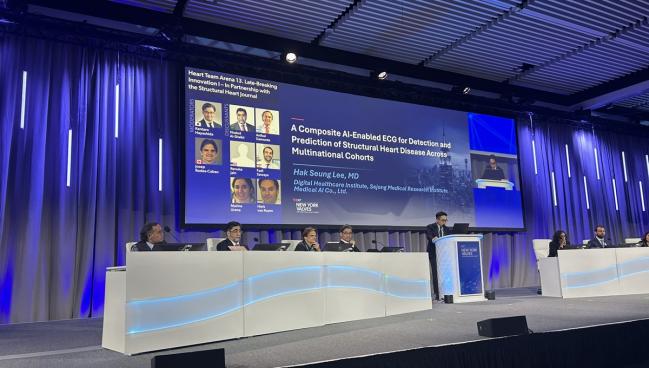
NEW YORK, NY—Artificial intelligence-enabled ECG (AI-ECG) tools reflective of systolic and diastolic dysfunction are able to identify patients with structural heart disease (SHD) who would benefit from definitive evaluation with echocardiography, new data suggest.
Moreover, individuals with positive findings based on these models were 2.75- to 3.75-fold more likely to develop new-onset SHD through 6 years of follow-up, Hak Seung Lee, MD (Sejong Medical Research Institute, Bucheon, and Medical AI, Seoul, Republic of Korea), reported recently at New York Valves 2026.
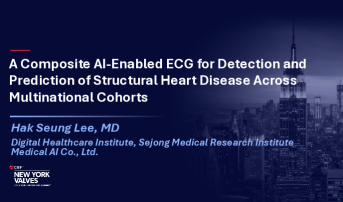
The composite AI-ECG tool, which incorporates information on left ventricular systolic dysfunction and left ventricular diastolic dysfunction (AiTiALVSD and AiTiALVDD; Medical AI), “detects prevalent and can predict incident structural heart disease across multinational cohorts,” Lee said, adding that “performance is consistent across diverse phenotypes and populations, with strong screening efficiency.”
The current study, he said, “can support AI-ECG as a deployable, broad cardiovascular screening tool” for a wider range of conditions than what the models were initially trained to detect.
Capturing Full SHD Spectrum
Despite being a leading cause of heart failure and death, SHD frequently goes undiagnosed, Lee said, noting that “echo is definitive, but costly and access-limited.”
AI-ECG has been shown to have the ability to detect signs of SHD, and in this study, Lee and his colleagues evaluated the ability of the AiTiALVSD model (trained to detect LVEF < 40%) and AiTiALVDD model (trained to detect septal E/e’ > 15), as well as their combination, to both identify prevalent disease and predict the development of SHD in the future. Both models have regulatory approval and have been deployed clinically in South Korea.
Previously, an analysis using an AI-ECG score incorporating LVSD and LVDD models showed that individuals within three large US cohort studies who were composite-positive (ie, positive on either of the two models) had a roughly 20-fold greater risk of heart failure. The tool also outperformed the PREVENT-HF equation for risk prediction.
In the current study, investigators evaluated whether a similar approach could be generalized to the full spectrum of SHD. For the purpose of this analysis, SHD encompassed any of the following, as detected using echo: LVEF < 50%, valvular heart disease (moderate or severe stenosis or regurgitation), LV hypertrophy, and pulmonary hypertension.
The retrospective analysis included individuals from three cohorts:
- 46,082 from Incheon Sejong Hospital (ISH) in South Korea
- 36,286 from Columbia University Irving Medical Center (CUIMC) in New York, NY
- 41,226 from the UK Biobank
SHD prevalence was 12.7% in the ISH cohort and 43.6% in the CUIMC cohort. The composite AI-ECG score had a sensitivity of 71.8% and 76.1%, respectively, for detection in the two cohorts, with similar results for each of the four types of SHD evaluated in the study.
“The signal can capture the full structural heart disease spectrum,” Lee said, adding that the LVSD and LVDD signals were complementary. The LVSD model more strongly correlates with reduced LVEF, whereas the LVDD model is more tightly associated with the other three types of SHD.
When looking at the relationship between AI-ECG scores and risk of developing new-onset SHD through 6 years of follow-up, researchers found that composite-positive individuals had a 3.75-fold greater risk of incident disease in the ISH cohort and a 2.75-fold greater risk in the UK Biobank compared with composite-negative individuals.
This sort of technology can be most valuable where imaging and specialist access are limited. Hak Seung Lee
“We used existing binary model outputs immediately deployable now in clinical workflows without site-specific tuning,” Lee said, adding that “this sort of technology can be most valuable where imaging and specialist access are limited.”
He acknowledged, however, that the study was limited by its retrospective design, highlighting the need for prospective validation. In addition, he said that incident SHD was not captured according to a protocol-driven imaging schedule, leading to possible surveillance bias, and that the composite AI-ECG score provides a screening signal and not a measure of disease severity or stage.
‘Unleash the Potential’ of ECG
Discussant Niels van Royen, MD, PhD (Radboud University Medical Center, Nijmegen, the Netherlands), noted that that vast majority of ECGs that are taken in practice are not acted upon. “With AI, we can truly unleash the potential of these several EKGs,” he added. “So that’s a good thing and also [it’s] important to realize that it’s not magic, it’s not voodoo—it’s pure computational power behind it.”
Combining the LVSD and LVDD models “makes a lot of sense because the outcome of these models is the same,” van Royen said. “Namely, do I have to make an echo, yes or no? . . . If it’s positive, then you go on for echocardiography.”
We need a lot of in-depth and meaningful discussions as a community to really implement this in a proper way. Niels van Royen
He added, however, that the AI-ECG models have “okay” sensitivity for detecting SHD, “but they still leave room for a lot of missed cases. So that’s something that we have to deal with.”
There are also questions about how AI-ECG will be implemented in practice, van Royen noted. “The discussion is often, ‘If I don’t use AI, will I be liable as a doctor?’ And as a matter of fact, there are several instances, like also in this case, where the models outperformed the physician,” he said. “But then again, what if your model makes a bad judgment? Who is responsible there?”
Overall, these are “very exciting data, and this will definitely change our clinical practice,” said van Royen. “But we need a lot of in-depth and meaningful discussions as a community to really implement this in a proper way.”
Lee said that there is a need for more data from prospective trials and studies assessing the impact of AI-ECG on clinical workflows, adding that his team is preparing for RCTs in the US and South Korea.

Todd Neale is the Associate News Editor for TCTMD and a Senior Medical Journalist. He got his start in journalism at …
Read Full BioSources
Lee HS. A composite AI-enabled ECG for detection and prediction of structural heart disease across multinational cohorts. Presented at: New York Valves 2026. June 25, 2026. New York, NY.
Disclosures
- Lee reports having stock/stock options from, receiving royalties from, and being a patent beneficiary of Medical AI.
- Van Royen reports grant support/research contracts from Abbott, Biotronik, Medtronic, and Philips and consulting/speaking fees or honoraria from Abbott, Bayer AG, and Microport.
Related News


Comments