AIR-STEMI: Angiography-Derived FFR Informs Complete PCI in STEMI
The study supports a strategy of going wire-free for functional assessment in this setting and may well be “practice changing.”

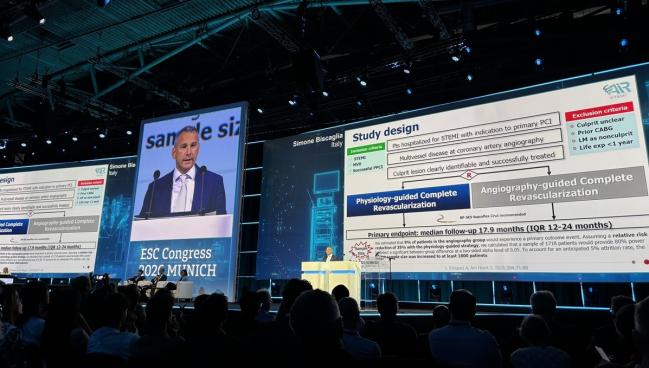
MUNICH, Germany—For STEMI patients with multivessel disease, the use of angiography-based functional assessment to guide complete revascularization improves outcomes compared with conventional angiography alone, according to results from the AIR-STEMI trial.
Better clarity on which nonculprit lesions merited treatment reduced the combined risk of death from any cause, MI, cerebrovascular accident (stroke or transient ischemic attack), or ischemia-driven revascularization by 38% in the study. Safety, too, was improved, with a 37% reduction in the combined risk of acute kidney injury (AKI) or major bleeding.
The findings were presented at the European Society of Cardiology Congress 2026 and simultaneously published in the New England Journal of Medicine.
“We know that we have to pursue complete revasc in a STEMI patient. What we don’t know is how,” AIR-STEMI investigator Simone Biscaglia, MD (Ferrara University Hospital, Italy), said in the Hot Line session. “Is it with angiography? Probably. But at the same time, we tend to overestimate lesions and to overtreat patients. Is it physiology? But wire-based physiology is difficult to do in the STEMI setting, and randomized clinical trials are conflicting when comparing the two.”
The 2023 FRAME-AMI trial found superior outcomes in acute MI patients with wire-based FFR guidance compared with angiography-guided PCI, whereas the 2021 FLOWER-MI trial found no difference.
On the backdrop of earlier studies showing the value of complete revascularization, “these findings across randomized trials suggest that the clinical benefit of physiological assessment depends not only on its use, but also on how it is integrated into the revascularization workflow,” the researchers note in their paper. “Functional coronary angiography may provide a practical means of achieving such integration in the context of STEMI. . . . By enabling incorporation of physiological assessment directly into the index procedure, this approach may overcome key limitations of wire-based physiological assessment, including the need for staged procedures and the separation between diagnostic assessment and procedural decision-making.”
Roxana Mehran, MD (Icahn School of Medicine at Mount Sinai, New York, NY), the current president of the American College of Cardiology, said the wire-free approach is novel in the setting of complete revascularization.
AIR-STEMI shows that, compared to angiography alone, “physiology is better,” she commented to TCTMD. “It was a big difference.”
While the specific tests evaluated in the study aren’t necessarily available at every center, functional coronary angiography is indeed feasible to use when the tools are on hand, said Mehran. “There is a good benefit. It makes a lot of sense: you want to [treat] things that are really, truly causing ischemia. You don’t want to just put a stent in something that’s not really obstructive.”
Fine-tuning Complete Revascularization
The researchers randomized 1,823 STEMI patients with multivessel disease (median age 66 years; 24% women) to undergo PCI informed either by angiography alone or with the addition of functional coronary angiography.
In the physiology-guided group, angiograms obtained at the time of primary PCI were sent to a central core lab, which analyzed distal FFR for all nonculprit vessels with an angiographically estimated diameter stenosis of at least 50%. This assessment was done using quantitative flow ratio (Medis Medical imaging), Murray law-based quantitative flow ratio (Pulse Medical), or vessel FFR (Pie Medical Imaging). Operators also were given a pullback curve analysis and a suggested procedural plan, which was followed in at least 75% of cases. Lesions with an FFR value of 0.80 or below were then treated with staged PCI within the index hospitalization or, in their absence, continue on optimal medical therapy.
Compared with angiographic guidance, procedures done with physiologic guidance were 38.4% less likely to be staged, used 19.3% less contrast, treated 45.3% fewer nonculprit valves, and had a 31.2% shorter stented length.
During a median follow-up of 17.9 months, 8.9% of the physiology group and 13.7% of the angiography group experienced the primary efficacy endpoint (HR 0.62; 95% CI 0.47-0.83). The secondary endpoint of cardiovascular death or MI occurred at rates of 5.7% and 10.5%, respectively, in the two study arms (HR 0.52; 95% CI 0.37-0.73). Both procedure-related and spontaneous MI were less common with physiology-guided PCI (3.8% vs 8.0%; HR 0.47; 95% CI 0.31-0.70), as was ischemia-driven revascularization (3.2% vs 5.2%; HR 0.61; 95% CI 0.38-0.97).
The primary safety outcome, which consisted of contrast-associated AKI or BARC type 3-5 bleeding, occurred at rates of 4.6% and 7.1% with physiology versus angiographic guidance (HR 0.63; 95% CI 0.43-0.93). The difference was driven by AKI, with rates of 2.2% and 4.0%, respectively (HR 0.55; 95% CI 0.32-0.94).
This is a practice-changing clinical trial, and of course, we will have the [next] ACS guidelines this time next year. Colin Berry
“What is important to underline is that the physiological assessment was performed at the level of the central core laboratory and not at the center level,” said Biscaglia, “so generalizability has to be assessed in further studies.”
Colin Berry, MBChB, PhD (University of Glasgow, Scotland), who discussed the AIR-STEMI trial after its presentation, highlighted the current European guidelines for the management of acute coronary syndromes. The document gives a class Ia recommendation to complete revascularization either during the index PCI or within 45 days, as well as a class Ib Ibrecommendation for PCI of the non-infarct-related artery (IRA) based on angiographic severity. Yet it also specifies that “invasive epicardial functional assessment of nonculprit segments of the IRA is not recommended during the procedure.”
AIR-STEMI has the strength of being a large international trial, but it also is limited by its core-lab approach, said Berry. On the whole, “this is a practice-changing clinical trial, and of course, we will have the [next] ACS guidelines this time next year,” he said, adding that the results from the COMPLETE-2 trial are worth keeping an eye on.

Caitlin E. Cox is Executive Editor of TCTMD and Associate Director, Editorial Content at the Cardiovascular Research Foundation. She produces the…
Read Full BioSources
Biscaglia S, Erriquez A, Calaiori I. Complete revascularization guided by functional coronary angiography in STEMI. N Engl J Med. 2026;Epub ahead of print.
Disclosures
- The study was funded by the Italian Health Ministry, SMT, and Siemens Healthineers.
- Biscaglia reports receiving research contracts with SMT, Medis, Siemens, Eukon, GE, Insight Lifetech, Abbott, Pulse Medical, and Life Medical as well as being a consultant to Abbott and Siemens.
- Berry reports no relevant conflicts of interest.
Related News



Comments