Amiodarone Patch Doesn’t Prevent Postoperative AF After Cardiac Surgery: BEAT-AF
The neutral trial evaluated a possible solution to a problem plaguing surgeons but left them “disappointed.”

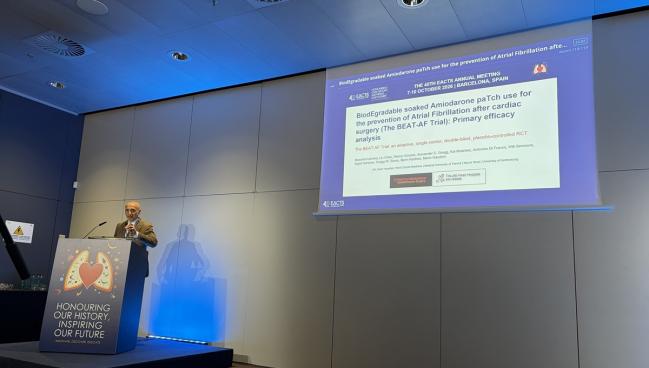
BARCELONA, Spain—Placing dissolvable patches soaked in amiodarone on the heart’s surface at the end of elective cardiac surgery does not seem to reduce the risk of postoperative atrial fibrillation (POAF), according to results from the BEAT-AF trial.
While the intervention did not cause any harm, the primary outcome of POAF for at least 30 seconds within 5 days of surgery occurred at similar rates in those randomized to the intervention and those who received placebo (13.4% vs 15.5%; adjusted OR 0.84; 95% CI 0.51-1.40).
Affecting as many as half of patients following cardiac surgery, POAF is a serious complication that has been linked to increased risk of hospitalization for heart failure. Researchers have struck out when testing the effectiveness of several preventive options—including epicardial injections of botulinum toxin and colchicine—and intravenous amiodarone remains the standard treatment for POAF, despite harsh side effects and the potential for drug-drug interactions.
Following positive early clinical research with an amiodarone hydrogel spray, Massimo Lemma, MD, PhD (Jilin Heart Hospital, China), and colleagues wanted to see if the findings could be replicated in a pragmatic clinical trial using a different method for applying topical amiodarone.
They randomized 502 patients (mean age 63 years; 33% women) undergoing elective cardiac surgery with sternotomy at a single center in China to receive two Surgicel Fibrillar (Johnson & Johnson MedTech) patches made of oxidized cellulose soaked in amiodarone 150 mg/3 mL or saline before closure. The patches were placed over the atrial ganglionated plexuses, the first over the left atrium via the transverse sinus and the second over the right atrium.
“It’s a fantastic idea because it’s so simple, and if it will work in the future, it will be a breakthrough,” Lemma, who presented the findings in a late-breaking clinical science session at the 2026 European Association for Cardio-Thoracic Surgery meeting, told TCTMD. “You cannot speculate too much on an RCT. An RCT is: one question, one answer. That’s it. And then you can reflect after that, you can reanalyze your data, and maybe in the future you can change strategy and plan a new study.”
You cannot speculate too much on an RCT. An RCT is: one question, one answer. That’s it. Massimo Lemma
Marc Ruel, MD, PhD (University of Ottawa Heart Institute, Canada), who moderated the session, said, “I’m disappointed because it would have been great if this had worked. It seems so simple, and it was so elegant.”
Nonetheless, “it’s refreshing to see a neutral trial. It’s not negative because there was no harm, but it’s neutral,” he added. “And there are so many positive trials out there that are not reproducible. So every time you see a neutral trial, you know that it’s honest.”
No Benefit, No Harm
Among the study participants, 37% had diabetes and more than half (54%) had a CHA2DS2-VASc score of at least 3. Isolated CABG was the most common surgery, at 76%, while 87% had a posterior pericardiotomy and 90% received beta-blockers. No patients received systemic amiodarone, and all patches were applied as randomized.
There were no in-hospital deaths in either group, and there were also no significant differences observed between the amiodarone and saline groups in terms of total time in POAF (median 360 vs 535 minutes), POAF burden (3.6% vs 4.1%), use of electrical cardioversion (four patients in each group), length of stay (7 days in each group), stroke (one vs two patients), or bleeding revision (one vs three patients; P = NS for all).
There remained no difference between groups in the use of electrical cardioversion through 30 days of follow-up (2.0% vs 1.6%; OR 1.28; 95% CI 0.34-5.23).
“The procedure was safe because we had no major adverse cardiac events, [no] thyroid dysfunction, no allogeneic toxicity, no third-degree AV block, and no pericardial effusion,” Lemma explained. “In the amiodarone group, we had only one death due to noncardiac reasons.”
He pointed out that the study was limited by a lower-than-expected rate of POAF, which “reduced the power,” as well as by a lack of pharmacokinetic data, the fact that the intervention only partially covered the ganglionic plexuses, and performance of AF monitoring for only 5 days.
I’m disappointed because it would have been great if this had worked. It seems so simple, and it was so elegant. Marc Ruel
Despite the limitations of BEAT-AF, Lemma plans to further explore this dataset to see if any other signals emerge. Also, if he were able to change any aspects of the current study, said Lemma, he might have added a third patch to the mix and placed the patches differently.
“I would have covered also the inferomedial wall of the heart in order to cover more ganglionic plexuses with a third patch,” he said. “Most probably, I wouldn’t have covered the . . . ganglionic plexi close to the left pulmonary veins, because they are on the back of the heart and [the] patch must be applied after full protamine therapy.”
Whether the intervention might have had an effect on POAF incidence specifically on postoperative day 2 or 3—typically the most common timeframe—deserves more scrutiny, Lemma said, adding that he will likely perform another study of the technique.

Yael L. Maxwell is Senior Medical Journalist for TCTMD and Section Editor of TCTMD's Fellows Forum. She served as the inaugural…
Read Full BioSources
Lemma M. Biodegradable soaked amiodarone patch used for the prevention of atrial fibrillation after cardiac surgery (the BEAT-AF trial): primary efficacy analysis. Presented at: EACTS 2026. October 9, 2026. Barcelona, Spain.
Disclosures
- Lemma reports no relevant conflicts of interest.
Related News



Comments