ANDES: Less Bleeding After DOACs, but Device-Related Thrombosis Signal Emerges
The apparent increase in late DRT at 1 year in the DOAC vs DAPT group should be interpreted cautiously, Josep Rodés-Cabau says.

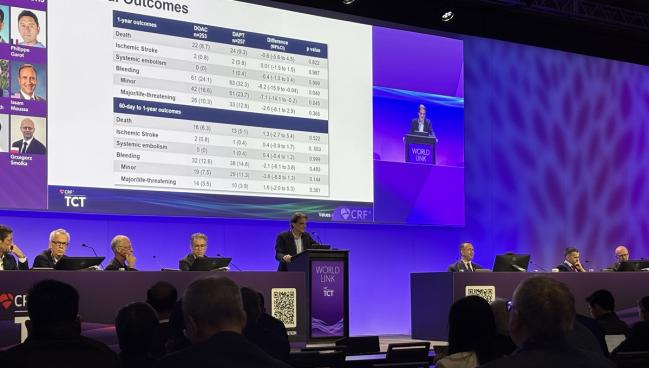
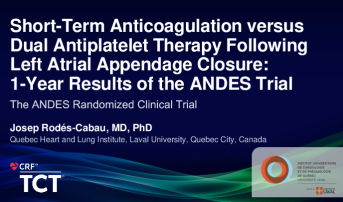
SAN DIEGO, CA—Among patients with atrial fibrillation (AF) undergoing left atrial appendage occlusion (LAAO) as part of the ANDES trial, overall 1-year results continue to give the edge to 2 months of direct oral anticoagulant (DOAC) therapy rather than dual antiplatelet therapy (DAPT) after the procedure.
The advantage was primarily related to a lower rate of minor bleeding in the DOAC group (16.6% vs 23.7%; P = 0.045), occurring largely in the first 60 days, with no differences in more serious bleeding, death, or thromboembolic events, Josep Rodés-Cabau, MD, PhD (Quebec Heart & Lung Institute, Laval University, Quebec City, Canada), reported here at TCT 2026.
In contrast to what was seen at 60 days, when device-related thrombosis (DRT) was detected by transesophageal echocardiography (TEE) less frequently, though not significantly so, in the DOAC group, DRT was numerically higher at 1 year among patients initially receiving DOACs versus DAPT after the procedure (5.2% vs 2.3%; P = 0.154). The difference reached statistical significance when the analysis was confined to patients who switched to single antiplatelet therapy at 60 days as recommended.
The findings, which were published simultaneously online as a research letter in JACC, were not surprising in terms of clinical events because they are consistent with what was seen at 60 days, Rodés-Cabau told TCTMD, noting that rates of thromboembolic events were very low in both groups.
Regarding the higher rate of DRT in the DOAC group beyond 60 days, Rodés-Cabau was cautious, calling the finding “very hypothesis-generating, not definitive at all.” He added that he doesn’t know if what’s being observed is indicative of a “rebound effect” or “catch-up phenomenon” that occurs when patients are no longer protected by a DOAC, allowing for a prothrombotic state to return.
This “merits further investigation,” he said, pointing out that when tallying all DRTs detected at either 60 days or 1 year, however, there was no difference between the DOAC and DAPT groups (5.5% vs 4.3%; P = 0.534).
“The good news is that these late episodes of thrombosis were not really associated with thromboembolic events. The numbers were so low that we cannot say anything [definitive], but at least there is no signal that this is extremely dangerous,” Rodés-Cabau said.
Issam Moussa, MD, MBA (Carle Heart & Vascular Institute, Urbana, IL), the lead discussant for the study, said whether to choose DOACs or DAPT after LAAO is a big question. “I know [we] and many use DAPT sort of intuitively thinking [it comes with] less bleeding. Yet, this trial shows there’s more bleeding, but the bleeding is minor,” he said.
The 1-year follow-up of ANDES was important because the initial 60-day results led everyone to conclude that DOAC therapy is the better option, “which was somewhat counterintuitive,” Moussa said, adding that these new results show that there’s not much difference between the two antithrombotic regimens aside from minor bleeding. “But then obviously, minor bleeding didn’t have any major impact clinically.”
Moussa pointed out that most patients are receiving DAPT after LAAO. “Does this change what we do? For me personally, it does not,” he said, indicating that an increase in minor bleeding with DAPT needs to be considered in the context of cost, which is higher with DOACs. “Personally, I don’t see that evidence support” to justify a switch from DAPT to anticoagulation, he said.
The ANDES Trial
The ideal post-LAAO antithrombotic approach remains unclear. Typically, most events of concern, including DRT, are seen within the first 3 months after the procedure, although up to one-third of DRTs have been observed at later time points in prior studies.
The ANDES trial, conducted at 12 centers in Canada and Europe, compared two different antithrombotic approaches after LAAO: DOAC therapy or DAPT for 2 months, followed by a recommended switch to indefinite single antiplatelet therapy (SAPT). The trial included 510 patients (mean age 77 years; 34.5% women), with 77% having had a prior bleed.
Patients randomized to DAPT all received aspirin plus clopidogrel. In the DOAC group, most patients received apixaban (76.3%), followed by rivaroxaban (12.3%), edoxaban (7.9%), and dabigatran (3.6%). At 60 days, about 78% of patients switched to SAPT, with roughly 80% of those who were still alive on that regimen at 1 year.
As seen at 60 days, there were no differences between the DOAC and DAPT groups in rates of death (8.7% vs 9.3%), ischemic stroke (0.8% in each group), or systemic embolism (0 vs 0.4%; P = NS for all).
A lower rate of minor bleeding drove a reduced rate of overall bleeding among patients who received DOACs versus DAPT after the procedure (24.1% vs 32.3%; P = 0.040). There was no difference in major/life-threatening bleeding (10.3% vs 12.8%; P = 0.365).
Rates of thromboembolic events and bleeding were statistically similar in both groups between 60 days and 1 year of follow-up, the period during which most patients were on SAPT. This is consistent, the investigators say, with the results of the ADALA trial, which compared low-dose apixaban with DAPT.
At 1 year, 74.3% of randomized patients were available for the imaging analysis: 90% underwent TEE and 10% contrast CT.
Of the 13 DRTs recorded at that time point, 10 were new and three had been previously detected at the 60-day follow-up. The rate of new DRT was 4.7% in the DOAC group and 1.2% in the DAPT group (P = 0.061).
In an analysis confined to patients who switched to SAPT at 60 days, those initially treated with DOACs had significantly higher rates of any DRT (6.5% vs 0.8%; P = 0.019) and new DRT (5.8% vs 0.8%; P = 0.036) compared with those initially treated with DAPT.
This difference “should be considered exploratory and hypothesis-generating, particularly considering the low number of events along with incomplete imaging data at 1 year, and will need confirmation in future trials,” Rodés-Cabau et al write. “Overall, these results must be interpreted with caution as DOAC versus DAPT treatment was limited to 60 days, and the study was not powered for detecting differences in 1-year clinical and DRT events.”
Additional study limitations, Rodés-Cabau reported, were the lack of an adjudication committee for clinical events and missing imaging exams at 1 year for about one-quarter of participants.
Unclear Mechanism
Most DRTs detected in ANDES occurred late, in contrast to some prior studies. The researchers point out, however, that a similar result was seen in a substudy of the Amulet IDE trial, in which 75% of DRTs were detected after 45 days in the group treated with aspirin plus oral anticoagulation after LAAO.
That could be related to incomplete device endothelialization after the procedure, Rodés-Cabau suggested during a panel discussion following his presentation.
“If the endothelialization process has not been completed—and we have some studies showing that [it] sometimes is incomplete at 6 months, 1 year—then maybe after stopping this high protection . . . it’s not extremely surprising that maybe there is a kind of a rebound effect that appears at 1-year follow-up,” he said.
Matthew Price, MD (Scripps Clinic, La Jolla, CA), one of the moderators of the session, raised a question about whether the DRT finding could be a play of chance, noting that there will be more data forthcoming at the TCT meeting to provide insights into post-LAAO antithrombotic regimens. The SIMPLAAFY trial testing three approaches—aspirin alone, reduced-dose DOAC, and DAPT—will be presented on Monday, November 2, 2026.
“I think certainly it’ll be interesting taking this data in combination with the SIMPLAAFY data. . . . So excited to see whether they’re consistent or inconsistent,” Price said.

Todd Neale is the Associate News Editor for TCTMD and a Senior Medical Journalist. He got his start in journalism at …
Read Full BioSources
Rodés-Cabau J, Nombela-Franco L, Cruz-Gonzalez I, et al. Short-term anticoagulation vs dual antiplatelet therapy following left atrial appendage closure: 1-year results of the ANDES trial. JACC. 2026;Epub ahead of print.
Disclosures
- ANDES was an investigator-initiated trial that received financial support from the Research Chair “Fondation Famille Jacques Larivière” for the Development of Structural Heart Disease Interventions (Laval University); was supported by grants from the Foundation of the Quebec Heart & Lung Institute and the Research Center of the Quebec Heart & Lung Institute; and was supported by an unrestricted grant from Boston Scientific.
- Rodés-Cabau holds the Research Chair “Fondation Famille Jacques Larivière” for the Development of Structural Heart Disease Interventions (Laval University); has received institutional research grants from Boston Scientific; and is a consultant for Abbott.
- Price reports receiving consulting fees/honoraria/speaking fees from Boston Scientific, Philips, Abbott, Alleviant Medical, Shockwave Medical, InnovHeart, Biosense Webster, CathWorks, Cordis, and W.L. Gore & Associates, as well as having equity/stocks/options in Indian Wells, InterShunt, Bolt Medical, and Atraverse.
- Moussa reports no relevant conflicts of interest.
Related News



Comments