Better Hemodynamics With Self-Expanding Valves in Small Annuli at 3 Years: SMART
Clinical event rates were still no different with longer follow-up, but one investigator thinks an advantage will emerge in time.

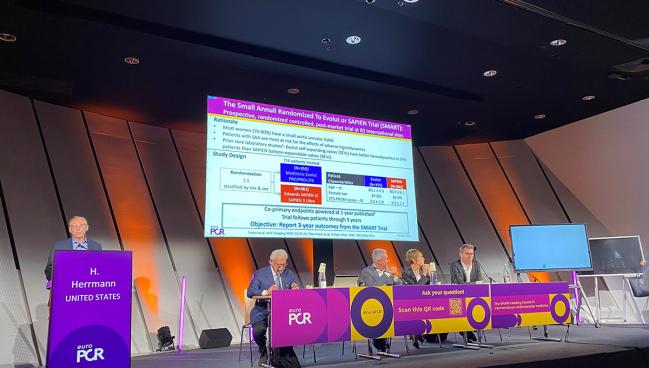
PARIS, France—Among patients with severe symptomatic aortic stenosis and small annuli, use of a supra-annular self-expanding valve results in similar clinical outcomes, but a lower risk of bioprosthetic valve dysfunction and better hemodynamics, compared with a balloon-expandable valve at 3 years, according to new data from the SMART trial.
Howard C. Herrmann, MD (Perelman School of Medicine at the University of Pennsylvania, Philadelphia), who presented the data today at EuroPCR, believes that the hemodynamic advantage with the self-expanding valve will eventually translate into a clinical difference, but when that might happen is not known.
“I think we should start to see it over the next 2 years,” he told TCTMD. “Whether we’re going to be able to show it in the primary endpoint, or only in a [secondary endpoint] like cardiovascular mortality, I think remains to be seen.” The advanced age of the population, with many octogenarians, will likely complicate the researchers’ ability to show a difference in the primary composite endpoint, Herrmann explained, “because there are competing risks for mortality, for stroke, and for heart failure rehospitalization.”
The data, which compare the self-expanding Evolut PRO/PRO+/FX (Medtronic) with the balloon-expandable Sapien 3/3 Ultra (Edwards Lifesciences) in 716 low- to intermediate-risk patients (mean age 80 years; 87% women), look similar to those at 1-year and 2-year follow-up.
The composite of death, disabling stroke, or heart failure rehospitalization occurred in 22.6% of patients treated with the balloon-expandable device and 25.4% of those treated with self-expanding valves at 3 years (HR 1.13; 95% CI 0.83-1.53). Additionally, the second co-primary endpoint of bioprosthetic valve dysfunction favored the self-expanding valve, with a difference of 38.1% (16.3% with Evolut vs 54.4% with Sapien; P < 0.001).
It takes time for hemodynamics to affect clinical outcomes. Howard C. Herrmann
Session moderator Martin Leon, MD (NewYork-Presbyterian/Columbia University Irving Medical Center and Cardiovascular Research Foundation, New York, NY), highlighted that “if anything, there’s a slight numerical advantage to the balloon-expandable platform [for clinical endpoints], despite what appear to be a whole variety of hemodynamic disadvantages based upon specific echo definitions.”
“It takes time for hemodynamics to affect clinical outcomes,” Herrmann said, as evidenced by several studies looking at the effects of prosthesis-patient mismatch on outcomes and hemodynamics.
“Well, then we’ll anxiously await the 5-year data, and we’ll see if there’s any difference,” Leon responded. “We’ll also note that, later on, there has been some additional recent data suggesting that at 6 and 7 years, there may be other changes that do affect clinical outcomes that go beyond hemodynamics relating to specific valve types. So it may be that we have to go even beyond 5 years to get a true sense as to what the clinical outcome differences are between devices.”
SMART at 3 Years
Herrmann also reported that at 3 years, balloon-expandable valves were associated with higher rates of hemodynamic structural valve dysfunction (46.4% vs 6.7%) and nonstructural valve dysfunction (20.4% vs 7.7%; P < 0.001 for both) compared with self-expanding devices. There were no differences, though, in clinical thrombosis (1.2% vs 0.3%; P = 0.18), endocarditis (5.0% vs 3.3%; P = 0.29), or aortic valve reintervention (1.2% vs 0.9%; P = 0.67).
However, when endocarditis was adjudicated as definite, self-expanding valves did hold an advantage (3.4% vs 1.0%; P = 0.04). Additionally, VARC-2 valve thrombosis rates were higher with balloon-expandable valves (5.8% vs 1.3%; P = 0.002), and this finding was driven by a higher rate of subclinical valve thrombosis.
When researchers defined valve thrombosis by VARC-3 criteria, self-expanding valves came out consistently ahead of balloon-expandable devices (1.3% vs 6.8%; P < 0.001). The finding was consistent for both clinical (0.6% vs 3.7%; P = 0.008) and subclinical (0.7% vs 3.1%; P = 0.023) thrombosis.
Additionally, compared with balloon-expandable valves at 3 years, those treated with a self-expanding device had larger effective orifice areas, greater Doppler velocity indexes, and lower aortic mean gradients. This was true if the aortic annuli were larger or smaller than the median 386 mm2 (P < 0.001 for all comparisons).
The rate of moderate-to-severe prosthesis-patient mismatch (PPM) was greater in the Sapien arm compared with Evolut (33.2% vs 9.9%; P < 0.001). PPM was associated with greater risks of both all-cause and cardiovascular mortality in the overall trial population (HR 1.68; 95% CI 1.05-2.70, for all-cause and HR 2.24; 95% CI 1.18-4.25, for cardiovascular). These relationships were significant in the Sapien arm but not in the Evolut cohort.
In an exploratory analysis landmarked to the time of the reference echocardiogram (30 days, and if not available then, at discharge), patients with PPM at 3 years were more likely than those without to die for any reason (21.8% vs 14.2%; P = 0.03) or from cardiovascular causes (13.4% vs 6.2%; P = 0.004).
“We think these findings emphasize the importance of minimizing PPM whenever feasible and emphasize the importance of the planned comparison through 5 years of follow-up,” Herrmann concluded.
PPM and Thrombosis
Anna Petronio, MD (Pisa University Hospital, Italy), the discussant for the study, said that small valve anatomy is one of the primary predictors of PPM, which is also a known cause of mortality and heart failure. Since the time the first SMART data, in which PPM was calculated as measured and not predicted, were released, “there has been a debate on the definition, the timing, and the measurements of PPM,” Petronio commented. “So now, after 3 years of confirming the results, should we still continue the debate on the predicted and the measured?”
“For those who aren’t completely familiar with this, the concept is that stroke volume index increases from the time of the procedure until actually a year, but much of it improves by 30 days,” Herrmann explained. “The use of predicted PPM at 30 days, which is still an echocardiographic measure, can reduce the influence of low stroke volume index on the calculation.”
This was minimized in SMART by using 30-day data that was further adjusted in a landmark analysis, he continued. “I think we took the advantages of the predicted PPM, and it’s better than leaving only the disadvantages of predicted PPM, which is applying a group mean to the individual and not being able to account for underexpanded valves, asymmetrically expanded valves, leaflet material, that sort of thing.”
Davide Capodanno, MD, PhD (University of Catania, Italy), one of the moderators during a press briefing, said the finding that most struck him in SMART was thrombosis.
“I had a feeling looking at the low-risk trials that there was numerically more thrombosis with the balloon-expandable valve,” he said. “You may say these are different trials, different definitions, et cetera. Now, they are comparing head-to-head, and we are seeing a signal of more thrombosis in smaller valves, of course, with the balloon-expandable. Is that signal real?”
Well, then we’ll anxiously await the 5-year data, and we’ll see if there’s any difference. Martin Leon
Herrmann said he believes it likely is. “There is a pathophysiologic rationale for it,” he said. “We know that there’s more stagnation with intra-annular valves than there is with supra-annular valves. There’s less washout. I think the combination of the pathophysiology and the larger studies that have also shown this makes me believe this is a real finding.”
EuroPCR course director Thomas Cuisset, MD, PhD (CHU La Timone, Marseille, France), who co-moderated the press briefing, said that “more or less the same signal” of slightly more thrombosis over time was seen in PARTNER 3. “Does that mean that probably we closed the discussion of the optimal antithrombotic strategy after TAVI in small annulus maybe too early based on POPular TAVI?” he asked. “Probably the truth is somewhere in between and more tailored as we do in the coronary field than to say it’s black or white as we did for TAVI.”
Clinicians can’t predict which patients will have leaflet thrombosis “and we don’t even know that treating it really makes a difference,” Herrmann said. “To treat everybody with oral anticoagulants, even for a short time, exposes 90% of the patients to unnecessary risk of bleeding.” As such, he doesn’t think that post-TAVI anticoagulation should change “and we should stick to primarily [a] single antiplatelet agent or maybe find some predictors of thrombosis, like biomarkers or anything else.”
ALL WOMEN Data
In another presentation in the same session, Ignacio Cruz-Gonzalez, MD, PhD (University Hospital of Salamanca, Spain), provided additional evidence to help guide valve choice in women undergoing TAVI. He showed early data from the ALL WOMEN trial comparing the supra-annular self-expanding Allegra valve (Biosensors) with balloon-expandable devices in 130 women (mean age 83 years) with symptomatic severe aortic stenosis treated at 12 European sites.
The primary endpoint of 30-day aortic valve mean gradient was lower in the Allegra arm compared with the balloon-expandable devices (7.1 vs 11.3 mm Hg; P < 0.0001). Additionally, there was a 6.1-mm Hg difference in mean gradients from baseline to 30 days between the groups (P = 0.005). This was higher than the expected difference of 5.5 mm Hg.
The Allegra group had a 4.3-mm Hg lower mean gradient, 0.38-m/sec lower peak velocity, 0.11 higher Doppler velocity index, and 0.25-cm2 larger effective orifice area at 30 days (P < 0.01 for all). Allegra-treated patients had lower rates of PPM classified as moderate (9.6% vs 31.6%) or severe (0 vs 7%; P = 0.007) compared with those treated with balloon-expandable valves.
Early safety results were reassuring, according to Cruz-Gonzalez. The composite safety endpoint trended higher for those treated with balloon-expandable valves at 30 days, but this was not significant (86.4% vs 71.9%; P = 0.069).
“These findings highlight the importance of sex-specific device evaluation and may help to optimize transcatheter valve selection in women with severe aortic stenosis,” he concluded.

Yael L. Maxwell is Senior Medical Journalist for TCTMD and Section Editor of TCTMD's Fellows Forum. She served as the inaugural…
Read Full BioSources
Herrmann HC. Three-year outcomes of the SMART Trial. Presented at: EuroPCR 2026. May 20, 2026. Paris, France.
Cruz-Gonzalez I. ALL WOMEN: multicenter randomized clinical trial ALLEGRA vs balloon-expandable valve in women. Presented at: EuroPCR 2026. May 20, 2026. Paris, France.
Disclosures
- Herrmann reports receiving grants/research support from Abbott, Edwards Lifesciences, Johnson & Johnson, and Medtronic; receiving honoraria or consulting fees from Carvolix, Medtronic, and Microinterventional Devices; and holding stock options in Carvolix, Microinterventional Devices, and YoungHeartValve.
- Cruz-Gonzalez reports serving as a proctor and consultant for Biosensors.
- ALL WOMEN was funded by Biosensors.
- SMART was funded by Medtronic.
Related News


Comments