CCTA Noninferior to IVUS for PCI Guidance: P4 Trial
Using previously obtained CT scans, operators were able to plan procedures ahead of time, with no ill effects on outcome.

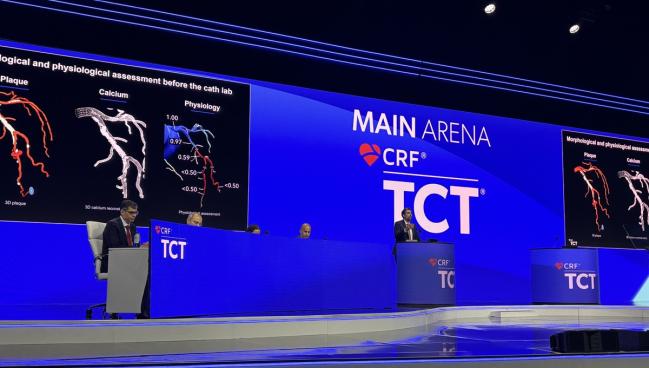
SAN DIEGO, CA—Percutaneous coronary intervention guided by coronary CT angiography (CCTA) is noninferior to PCI done under intravascular ultrasound guidance, the randomized P4 trial has found. The two strategies had similar rates of target-vessel failure (TVF) at 12 months.
“PCI decisions are often made during the procedure. We diagnose, interpret, think, decide, and treat—and react—in real time,” something that creates additional cognitive load for interventionalists, said lead investigator Carlos Collet, MD, PhD (Cardiovascular Research Foundation, New York, NY), who presented the late-breaking results today at TCT 2026.
The idea driving the P4 trial is a desire to think ahead and better prepare for the procedure using details provided by CCTA. Being able to plan, said Collet, allows for not only a tailored approach, but also better shared decision-making.
The results were simultaneously published in the New England Journal of Medicine.
As to whether the CT-based approach will prove attractive to interventionalists, Collet told TCTMD that current availability of CCTA and IVUS varies both within the US and internationally. An advantage of CCTA, though, is that “we’re using information that is already acquired to plan the procedure,” a process that removes many unknowns ahead of the PCI itself, he added. The potential downsides are the need for high-quality images and the addition of a small amount of radiation.
Ajay Kirtane, MD (NewYork-Presbyterian/Columbia University Irving Medical Center, New York, NY), who moderated the Late-Breaking Clinical Trial session, commented to TCTMD that “because more and more patients are getting CTs before they come to the cath lab, you are able to use information you already have.”
This study is a “compelling” proof of concept, one that may be quite “powerful, as long as the data can be presented in a very algorithmic fashion that doesn’t require a lot of manipulation and all that,” said Kirtane.
The streamlined display of the CT findings is important for consistent interpretation. As Kirtane and co-author Robert S. Zilinyi, MD (NewYork-Presbyterian/Columbia University Irving Medical Center), outlined in a recent JAMA Cardiology viewpoint, “there’s a training gap” when it comes to CT. “Right now, there are a lot of interventionalists who don’t know how to read CTs and don’t know how to understand them,” he said.
Artificial intelligence might prove useful in this regard, Kirtane added.
Two Strategies
For the investigator-initiated noninferiority trial, Collet and colleagues analyzed data on 1,105 patients (median age 65 years; 21.7% female) who had a clinical indication for revascularization, at least one epicardial lesion with a diameter stenosis > 70%, and a CCTA-derived fractional flow reserve (FFR) ≤ 0.80. All were randomized to a CCTA- or IVUS-guided strategy. Around one-third (35.8%) had multivessel disease, 98% had stable ischemic heart disease, around 8.5% had a chronic total occlusion, and nearly 14% had severe calcification. Median SYNTAX score was 8 in the CCTA group and 9 in the IVUS group.
In the CCTA-guidance arm, physicians reviewed core lab-provided information on plaque and calcium in a 3D format that “makes the interpretation of it very intuitive,” as well as a CT-derived physiological assessment ahead of PCI, said Collet. During PCI, stent placement was optimized by synchronizing CCTA reconstructions with the angulation of the angiographic imaging system (QAngio CT Research Edition; Medis Medical Imaging).
In the IVUS arm, the added guidance was performed both before and after PCI.
The initial management strategy was PCI for 88.2%, CABG for 3.7%, and medical therapy for 8.1%. Within the CCTA group, five patients underwent IVUS either before or after PCI: four of those instances were elective and one was bailout IVUS following a PCI-related complication.
For the patients who did undergo PCI, median procedure durations were 46 minutes with CCTA and 63 minutes with IVUS guidance. Median contrast volumes during PCI were 150 and 170 mL, respectively (P < 0.001), and median radiation exposures (measured as dose-area product) were 35.6 and 38.5 Gy·cm2 (P = 0.07). Advanced calcium-modification tools were more often used in the CCTA-guided group versus the IVUS-guided group (9.2% vs 3.8%). Post-PCI, the mean invasive FFR value was 0.88 in both groups.
Clinical procedural complications occurred in six of the patients whose PCIs were guided by CCTA and nine of those whose PCIs were guided by IVUS: coronary perforation (0.5% vs 0.2%), vascular access-site complications (0.4% vs 0.5%), procedure-related BARC type 3 or 5 bleeding (0 vs 0.2%), ventricular tachycardia or fibrillation (0.2% vs 0.5%), and periprocedural stroke (0 vs 0.4%).
The primary endpoint of 12-month TVF, defined as cardiac death, target-vessel MI, or ischemia-driven TVR, was 4.1% with CCTA and 4.6% with IVUS. The difference in absolute risk fell between the noninferiority margin of 4.5 percentage points (P < 0.001 for noninferiority).
“The findings suggest that key PCI-planning decisions can be shifted from the cardiac catheterization laboratory to preprocedural CCTA, thereby extending the role of CCTA beyond diagnosis,” the investigators write. “An important implication of this upstream planning is the opportunity to enhance shared decision-making before the invasive procedure. By defining coronary anatomy, disease complexity, and the anticipated benefit of revascularization in advance, CCTA may allow patients and clinicians to discuss treatment alternatives, expected benefits, and procedural risks before cardiac catheterization.”
They stress that P4 “compared procedural strategies rather than imaging methods in isolation.”
Collet said that while the central CT analysis took some time to do, the actual time it took clinicians to review the resulting “package” was just 2 to 3 minutes. “If you want to do this tomorrow, you can, because there are [software] tools already on the market that perform this automatically,” he specified.
But Will Interventionalists Use It?
Emmanouil S. Brilakis, MD, PhD (Minneapolis Heart Institute Foundation, MN), the study’s assigned discussant, called P4 a “landmark trial.” He praised the use of a clinical endpoint, the multipronged approach to CT planning, and meticulous methodology, but pointed out that “the population was not that complex,” the participating sites tended to be expert, and the study lacked an angiography-only arm.
“However, the study does provide the clinical evidence we need to move to this new era that Dr. Collet alluded to: [one that involves] planning the procedures before coming to the cath lab,” Brilakis commented. Yet, to achieve this, image quality must be high and interventionalists need to learn how to interpret CTs and apply that knowledge.
CT imaging prior to PCI is becoming more common in clinical practice, Collet pointed out. But when Kirtane asked the audience for a show of hands, still only a minority said they tend to see patients coming into the cath lab with CT scans already performed.
For panelist Margaret McEntegart, MD (NewYork-Presbyterian/Columbia University Irving Medical Center), it’s important that the CCTA-derived information be presented in a way that doesn’t give busy interventionalists information overload. “The user interface . . . has to be very intuitive and very simplified,” she suggested.
R. Jay Widmer, MD, PhD (Baylor Scott & White Health, Dallas, TX), member of the American College of Cardiology Interventional Council, commented on the findings for TCTMD.
He agreed that CCTA guidance appears to have several strengths, among them the rarity of IVUS performed in the CCTA arm. “I’m not saying that we’re phasing IVUS out,” Widmer added. The question is how best to use IVUS and whether there might be ways to optimize patient care using what interventionalists have on hand.
However, Widmer also cautioned that while most centers should have the CT equipment, not all scanners are the same and not all scans are read in the same way. That said, “as the technology gets better and as it gets a little more democratized, I think we will be able to [adopt it]. . . . It’s becoming a very powerful tool,” he said. “I think that this gives us the data we need to say, yeah, I can do this.”
Note: Collet is an employee of the Cardiovascular Research Foundation, the publisher of TCTMD.

Caitlin E. Cox is Executive Editor of TCTMD and Associate Director, Editorial Content at the Cardiovascular Research Foundation. She produces the…
Read Full BioSources
Collet C, Mizukami T, Bouisset F, et al. Coronary CT angiography versus intravascular ultrasound guidance for PCI. N Engl J Med. 2026;Epub ahead of print.
Disclosures
- P4 is funded by GE HealthCare and Heartflow.
- Collet reports grant support/research contracts from Abbott, Boston Scientific, GE HealthCare, Shockwave Medical, and Insight Lifetech; consulting fees/honoraria/speaking fees from Abbott, Boston Scientific, CathWorks, GE HealthCare, Shockwave Medical, Medyria, and Siemens Healthineers; royalty/intellectual property rights with Coroventis Research; and equity/stock(s)/options in Powerful Medical, CathFlow, and Medyria.
- Brilakis reports consulting fees/honoraria/speaking fees from Abbott Vascular, Cordis, Biotronik, Boston Scientific, GE HealthCare, Medtronic, Teleflex, IMDS, Recor, Shockwave Medical, SIS Medical, and Terumo Medical; royalty/intellectual property rights from Elsevier; equity/stock(s)/options in MHI Ventures, Cleerly Health, Stallion Medical, LifeLens Technologies, and TrueVue; and grant/research support from Boston Scientific, GE HealthCare, and Angiowave. He is an owner of Hippocrates LLC.
- Kirtane reports receiving consulting fees/honoraria from Neurotronic, SoniVie, Airiver, and Bolt Medical; and research grants from Abbott Vascular, Amgen, Boston Scientific, CathWorks, Concept Medical, Cordis, Magenta Medical, Medtronic, Philips, Recor, SoniVie, and Supira. He also reports serving as PI on a Heartflow trial that looks at changes in medical therapy.
- Widmer reports no relevant conflicts interest.
Related News



Comments