CHIP-BCIS3 Hemodynamic Substudy Aims to Clarify Why Impella Didn’t Benefit in High-risk PCI
(UPDATED) Data show a link between loss of pulse pressure with Impella and more myocardial injury, but others say it can’t be causative.
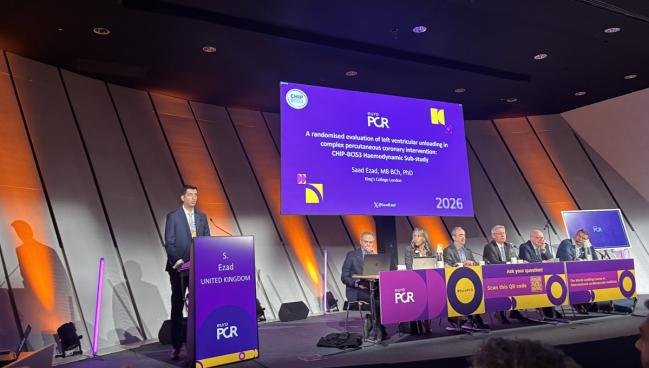
PARIS, France—For stabilized patients undergoing complex PCI, left ventricular unloading with an Impella CP microaxial flow pump (Abiomed/Johnson & Johnson MedTech) reduced the need for inotropes but led to a significant loss of pulse pressure that was associated with a higher risk of periprocedural myocardial injury, according to a new analysis of the CHIP-BCIS3 study.
Complex PCI also led to more ischemic stunning and this was not helped by the Impella device, investigators reported last week at EuroPCR 2026. The prespecified hemodynamic substudy was designed to provide a mechanistic understanding of the neutral overall trial results, which were published in the New England Journal of Medicine in late March.
The substudy shows “that the Impella does as we thought it would do: it improves cardiac output, it reduces filling pressures,” lead investigator Saad Ezad, MBBCh, PhD (King’s College London, England), told TCTMD. “Despite that, patients still had adverse outcomes.”
CHIP-BCIS3 included 300 patients with severe left ventricular dysfunction and extensive coronary artery disease randomized to PCI with or without unloading using the percutaneous left ventricular assist device. Over a median of 22 months, there was no advantage in those treated with Impella support over those treated with standard care when it came to the primary endpoint of all-cause mortality, disabling stroke, spontaneous MI, cardiovascular hospitalizations, or periprocedural myocardial injury.
“Of note, however, there was an almost twofold excess of cardiovascular death in the microaxial flow pump arm,” said Ezad. “This raises two important questions if our supposition that the microaxial flow pump interrupts the ischemic cascade is correct: why was there a neutral trial result and why was there an excess of cardiovascular death?”
Divaka Perera, MD (Guy’s and St. Thomas’ Hospital, London, England), who led the CHIP-BCIS3 trial, said another reason for the analysis was to determine if they could identify potential responders to Impella. “We found no evidence of that at all,” he told TCTMD.
Commenting on the results during EuroPCR, William O’Neill, MD (Henry Ford Hospital, Detroit, MI), who led the PROTECT II study comparing Impella to an intra-aortic balloon pump in complex patients with depressed LV function, said he wasn’t certain that the loss of pulse pressure could explain the increased risk of cardiovascular mortality.
“If you look at pressure-volume loops, and if you had put a catheter in the left ventricle, when the pressure gets lost, the ventricle actually rests,” he said. “The systolic pressure drops and the left ventricular diastolic pressure drops so all the determinants of myocardial oxygen consumption actually are improved. I wouldn’t conclude that loss of pulse pressure is why you’re seeing [the increase in CV mortality]. It gets confounded. I don’t think that’s causal.”
I wouldn’t conclude that loss of pulse pressure is why you’re seeing [the increase in CV mortality]. It gets confounded. I don’t think that’s causal. William O’Neill
Babar Basir, DO (Henry Ford Hospital), who led an analysis looking at loss of pulse pressure in the PROTECT III study, told TCTMD that using the endpoint when comparing cases with versus without Impella doesn’t make sense.
The reason, he explained, is that mechanical circulatory support (MCS) devices like Impella and extracorporeal membrane oxygenation provide continuous flow, allowing the native heart ejection to decrease. In select situations, this results in left ventricular uncoupling where the systemic circulation is provided completely by the MCS.
On the other hand, loss of pulse pressure “is very unlikely to occur in the standard-of-care arm, because if native heart ejection ceases, the patient will arrest. It may occur over brief periods of time; however, it would likely need to be treated quickly with vasoactive agents,” said Basir.
Except in rare instances, “pulse pressure can only be lost with a continuous circulatory support device,” he noted, adding that its occurrence “is not a bad thing in all circumstances, but in the context of complex PCI, it represents a time interval [when] systemic circulation was completely reliant on the MCS.”
That said, loss of pulse pressure while on Impella can also be “a marker that you’re pushing your limits from a revascularization standpoint,” Basir commented. In high-risk PCI, “if you’re having a lot of episodes where you’re dependent upon the device—that’s a red flag! It becomes really important to keep in mind that you may need a Swan-Ganz catheter for more invasive hemodynamic monitoring, you may need to leave the Impella in overnight, you may need for [the patient] to be put into the ICU for further monitoring, and you may need to stop your revascularization and stage the rest.”
Hemodynamic Substudy
The CHIP-BCIS3 subanalysis included 97 patients who underwent invasive hemodynamic assessments using pulmonary artery catheterization prior to and after completion of PCI. The thinking, according to investigators, was that ventricular unloading would reduce intraprocedural instability and potentially reduce ischemic stunning that is caused by PCI. LV stunning is a temporary period of myocardial dysfunction in response to acute ischemia.
Activating the Impella CP pump at baseline led to an increase in mean arterial pressure, an increase in cardiac index, and a reduction in pulmonary capillary wedge pressure (PCWP), which shows the device unloaded the LV and provided hemodynamic support as expected, said Ezad. There was no loss of pulse pressure with activation of the device before PCI.
Overall, a reduction in systolic blood pressure—defined as at least a 20-mm Hg drop to an absolute value of less than 90 mm Hg—occurred in 46% of patients treated with Impella and 53% treated with standard care (RR 0.86; 95% CI 0.58-1.29). Treatment with Impella CP did result in significantly less need for intraprocedural inotropic medications, but its use was also associated with an eightfold greater risk of loss of pulse pressure (RR 7.83; 95% CI 2.53-24.24).
“Of these variables, only loss of pulse pressure was subsequently associated with periprocedural myocardial injury, which we know from the primary trial results is associated with cardiovascular death,” said Ezad. “Whether loss of pulse pressure is a mediator or simply a marker of increased risk remains unknown.”
Whether loss of pulse pressure is a mediator or simply a marker of increased risk remains unknown. Saad Ezad
The researchers also developed a risk score using variables associated with hemodynamic instability (cardiac power output, EF, heart rate, and clinical presentation), but they were unable to identify any metrics that predicted a response to Impella CP. The change in cardiac output and rise in PCWP, measures of LV stunning, were the same in patients randomized to Impella CP and those treated with standard care.
In a multivariate analysis including hemodynamic and demographic variables, assignment to Impella CP was significantly associated with cardiovascular mortality.
To TCTMD, Perera stressed that patients were quite sick at baseline, with a cardiac index of 2.1 L/min/m2 (a cardiac index ≤ 2.2 L/min/m2 is one of the criteria for defining cardiogenic shock). Under the new definition of cardiogenic shock, they would be considered SCAI SHOCK class A patients, meaning they are hemodynamically stable, not experiencing signs or symptoms of cardiogenic shock, but are at risk of developing it.
During the discussion following the presentation, Ezad pointed out that use of Impella CP maintained mean arterial pressure during times of acute ischemia, which may help explain why fewer inotropes were needed with the device.
However, “a common thought amongst operators is that you are safe, you are protected to carry on causing ischemia, and you can proceed and carry on doing what you were doing because the pump is maintaining mean arterial pressure,” said Ezad. “I think we need to take a step back and think whether this actually affects clinical outcomes now and whether it’s not such a good thing to have prolonged ischemia, even if the mean arterial pressure is maintained.”
Note: This story (originally titled Loss of Pulse Pressure With Impella CP Tied to Adverse Outcomes: CHIP-BCIS3) was updated on June 5, 2026, using additional reporting by TCTMD Executive Editor Caitlin E. Cox.
Sources
Ezad S. A randomized evaluation of left ventricular unloading in complex percutaneous coronary intervention: CHIP-BCIS3 hemodynamic substudy. Presented at: EuroPCR 2026. May 21, 2026. Paris, France.
Disclosures
- Ezad reports no relevant conflicts of interest.
Related News



Comments