CLASP II TR: Pascal T-TEER Offers Health Status Benefits and More
At 6 months, the win ratio favored the device over optimal medical therapy, in large part driven by improved quality of life.

SAN DIEGO, CA—Tricuspid transcatheter edge-to-edge repair (T-TEER) with the Pascal system (Edwards Lifesciences) offers better outcomes over optimal medical therapy (OMT) alone at 6 months, largely driven by differences in quality of life, in patients with symptomatic, severe tricuspid regurgitation (TR), the CLASP II TR trial shows.
Suzanne V. Arnold, MD (Saint Luke’s Mid America Heart Institute, Kansas City, MO), and Charles J. Davidson, MD (Northwestern Memorial Hospital, Chicago, IL), presented the findings Monday at TCT 2026.
Pascal Precision, the system tested in CLASP II TR, uses “the same delivery and implant technology as the mitral TEER system,” Davidson said in the Main Arena. “Some distinguishing features are the nitinol design, atraumatic clasping, precise navigation, and device elongation for mitigation of chordal entanglement.”
The data arrive in the wake of last month’s US Food and Drug Administration approval of the device for use in patients with severe TR who remain symptomatic despite use of optimal medical therapy, have at least an intermediate surgical risk, and are considered good candidates for the procedure by a multidisciplinary heart team. That regulatory decision was based on the previously unreleased findings from CLASP II TR. Four years ago, the FDA approved Pascal for the treatment of degenerative mitral regurgitation.
American College of Cardiology President Roxana Mehran, MD (Icahn School of Medicine at Mount Sinai, New York, NY), told the media at a press conference that with a “device-agnostic” perspective, this trial and TRIC-I-HF taken together show “patient selection matters so, so very much” in TR.
Pinak B. Shah, MD (Mass General Brigham, Boston, MA), speaking at the TCT press conference, said the CLASP II TR data are “quite consistent” with the TRILUMINATE Pivotal results in showing both a reduction in TR and improvement in quality of life with intervention. There’s now a “body of evidence suggesting that we may actually have impact if we follow these patients longer term,” said Shah, who added that a remaining question is when to best intervene in the disease course of TR.
Outcomes With Pascal
Across 58 North American sites, the CLASP II TR investigators enrolled 450 patients with symptomatic, severe TR despite medical therapy, randomizing them 2:1 to receive either T-TEER with Pascal plus OMT or OMT alone. All had NYHA class II-IV symptoms and had an intermediate or higher risk of surgical mortality .
Mean STS PROM score for mitral valve repair was around 7.5% at baseline. Two-thirds had chronic kidney disease stage 3 or greater, and 25% had a heart failure hospitalization within the past year. Most had secondary TR and all had severe or greater TR (more than 40% of cases were massive or torrential).
In the Pascal group, 92.5% had a successful device implantation, with the remainder not receiving an “implant due to anatomy, imaging, or inadequate TR reduction,” said Davidson. Around half of patients received one device and the rest got two or more. Median device time was 106 minutes, and median postprocedure length of stay was 1 day. Fully 98.3% of patients were discharged directly home.
Initially, the primary endpoint was meant to be assessed at 24 months, he noted. “This was subsequently revised to 6 months due to control group attrition following regulatory approval of alternative transcatheter therapies,” namely TriClip (Abbott) and Evoque (Edwards Lifesciences).
At 6 months, follow-up data were available for 274 patients in the Pascal arm who underwent attempted T-TEER and for 130 controls.
“The primary endpoint was a hierarchical composite using a win ratio at 6 months determined by pairwise comparisons for all outcomes between the device and control groups,” Davidson explained. That composite consisted of all-cause mortality, right ventricular assist device or heart transplant, tricuspid valve surgery or intervention, heart failure hospitalization, and quality of life as measured by KCCQ overall summary score (KCCQ-OS).
The win-ratio analysis found that the Pascal group won 47.5% of the comparisons and the control group won 24%. The difference was largely driven by quality of life.
At 30 days, the major adverse event rate was 6.9% with Pascal. Single leaflet device attachment occurred in 3.4% and severe bleeding in 3.1%. Cardiovascular mortality and stroke rates each were 0.3%. There were no MIs, cases involving a need for renal replacement therapy, nonelective tricuspid valve interventions, or major cardiac structural complications. By 1 year, the major adverse event rate for Pascal was 20.1%.
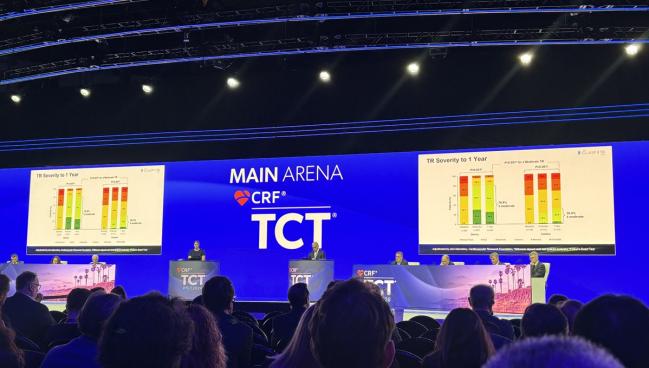
“Treatment with the Pascal system substantially reduced TR severity, with 80% of patients achieving moderate or less [TR] at 1 year,” Davidson reported. That number was 30% in the control group. Additionally, the Pascal patients had a “clinically significant” mean change on the KCCQ-OS of 17.5 points by 30 days, compared with a 2.2-point gain among controls (P < 0.001). That initial improvement was sustained through 1 year.
On Kaplan-Meier analysis, 1-year rates of all-cause mortality were 8.8% with Pascal and 4.6% with OMT alone, a nonsignificant difference. Rates of heart failure hospitalization were 13.2% and 12.9%, respectively. Comparing the year before enrollment and the year after enrollment, the Pascal group had a 55.2% relative reduction in heart failure hospitalization (P < 0.001); the 38% relative reduction in the control group wasn’t statistically significant (P = 0.149).
Tricuspid valve interventions (TVIs) occurred with similar frequency in the Pascal and OMT groups in the first 6 months. “However, within 1 year, a clear separation emerged with a significantly higher TVI rate of 16% in the control group,” versus around 6% in the Pascal group, said Davidson. “This was due to significant control group attrition that coincided with commercial approval of two alternative transcatheter technologies.”
Controls who underwent TVI tended to have massive torrential TR, more heart failure hospitalizations, lower quality of life, and more severe symptoms. “This suggests,” he added, “that the control group patients with more advanced disease pursued TVI that likely impacted their outcome assessment.”
Health Status in CLASP II TR
Arnold presented a deep dive into health-status outcomes, kicking off her talk with the KCCQ-OS, which encompasses physical and social limitations, symptoms, and quality of life.
By 30 days after randomization, “there was little change in mean KCCQ scores in the control group, whereas patients who were randomized to device had a moderately large early improvement in health status,” for a mean difference of 13.7 points between the two study arms, she said. This “persisted through 6 months,” at which time the mean difference was 10.9 points.
“The health-status benefit of T-TEER with Pascal was consistent across the KCCQ domains,” as well as for generic health status and the SF-36 physical and mental summary scores, Arnold added.
At 6 months, a greater proportion of the Pascal patients versus controls were alive with moderate or large improvements in KCCQ-OS. Fully 69.2% of patients in the device arm were alive and well, she said, compared with 50.8% of controls (P < 0.001), amounting to a number needed to treat of 5.4.
“Looking at this slightly differently, categorizing patients by all possible changes in health status, we see that not only are a greater proportion of patients in the device arm reporting moderate or large improvements in health status, but also a smaller proportion of patients are either worse or dead,” Arnold added.
The greatest health-status impact was seen among Pascal patients with the worst baseline KCCQ-OS.
“In conclusion, the CLASP II TR trial demonstrates safety and efficacy of the Pascal system to improve health status in symptomatic patients with severe or greater TR,” said Arnold.
Jörg Hausleiter, MD (Ludwig-Maximilians-Universität München, Germany), the trial’s assigned discussant in the late-breaking session, agreed that the evidence for T-TEER as a whole is persuasive.
“This is now the fourth trial investigating the impact of tricuspid valve repair over medical therapy. And if you put all these studies together and look at the 1-year outcomes, you see that there is a consistent superiority of tricuspid valve repair over medical therapy, driven in most of those studies by patient-reported outcome improvements.”
Hausleiter drew attention to CLASP II TR’s evolving primary endpoint, noting that a ”question might be what the outcomes might have been if those changes were not necessary.”

Caitlin E. Cox is Executive Editor of TCTMD and Associate Director, Editorial Content at the Cardiovascular Research Foundation. She produces the…
Read Full BioSources
Arnold SV, Davidson CJ. Transcatheter tricuspid valve repair with the Pascal system vs. medical therapy for severe, symptomatic tricuspid regurgitation: clinical and health status outcomes from the CLASP II TR randomized trial. Presented at: TCT 2026. November 2, 2026. San Diego, CA.
Disclosures
- CLASP II TR was funded by Edwards Lifesciences.
- Davidson reports grant/research support from Edwards Lifesciences, CroiValve, V-Dyne, Cardio Mech, and Abbott, as well as equity in ReValve.
- Arnold reports institutional grant/research support from the FDA and the National Institutes of Health/National Heart, Lung, and Blood Institute.
- Hausleiter reports consulting fees/honoraria/speaking fees and grant support/research contracts from Edwards Lifesciences.
- Shah reports consulting fees/honoraria/speaking fees from Edwards Lifesciences and equity/stocks/options in Xenter.
Related News

Comments