Consistent Benefit of LAA Closure Across Ages: CHAMPION-AF Subanalysis
While the age-specific analysis was welcome, some felt it didn’t dig deep enough and others questioned the bleeding endpoints.

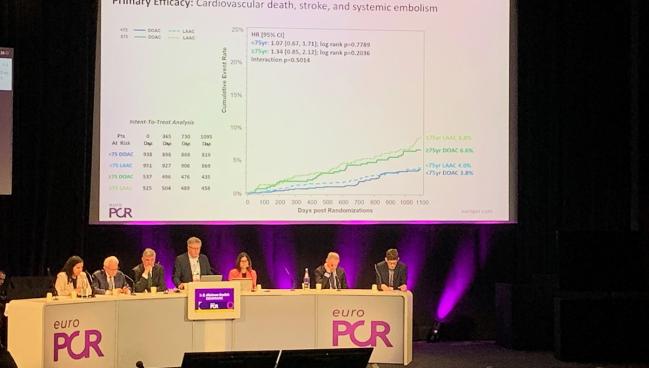
PARIS, France—Patients with atrial fibrillation (AF) and elevated risk of stroke who are eligible for long-term anticoagulation fare well with left atrial appendage occlusion (LAAO), regardless of their age, according to a prespecified subgroup analysis of CHAMPION-AF.
In the subset of patients younger than 75 years, the rate of the composite primary efficacy endpoint of CV death, stroke, or systemic embolism at 3 years was 4.0% in those treated with the Watchman FLX device (Boston Scientific) and 3.8% in those treated with direct oral anticoagulant (DOAC) therapy (log-rank P = 0.77). Among patients 75 years and older, the rates were 8.8% and 6.6%, respectively (log-rank P = 0.20).
“[LAAO] procedural performance was consistent across age groups, with high implant success and low rate of procedural complications,” said Jens Erik Nielsen-Kudsk, MD, DMSc (Aarhus University Hospital, Skejby, Denmark), in a late-breaking presentation here at EuroPCR 2026.
As in the main study, the number of ischemic strokes, a secondary endpoint, were higher among patients treated with LAAO versus anticoagulation in both the younger and older subgroups.
Patients in the older-age group who were on a DOAC had the highest rates of nonprocedural ISTH major and modified ISTH clinically relevant nonmajor bleeding, while those in the younger age group who underwent LAAO had the lowest rates (22.4% and 9.5%, respectively).
Discussant Philippe Garot, MD (Cardiovascular Institute Paris Sud, Massy, France), put the findings from the subanalysis into context with those of two recent large LAAO trials that have caused some confusion among clinicians.
He noted that the OPTION trial, which had a primary efficacy endpoint of all-cause death, stroke, or systemic embolism, showed LAAO was noninferior to oral anticoagulation at 3 years. However, in the investigator-initiated CLOSURE-AF trial, which included patients at high risk for both stroke and bleeding, the intervention did not meet noninferiority criteria for its primary endpoint—a composite of stroke, systemic embolism, cardiovascular/unexplained death, or major bleeding.
While all three trials had high rates of successful implantation, they contain starkly different patient characteristics, including life expectancy and risks for stroke and bleeding.
“In my opinion, there’s no contradiction between these trials,” Garot said. “I think we should look at these differences as supporting the tailored use of left atrial appendage closure in patients with reasonable life expectancies seeking an alternative to long-term oral anticoagulant.”
For panelist Martin B. Leon, MD (NewYork-Presbyterian/Columbia University Irving Medical Center, New York, NY), the results of all three trials are welcome at a time when LAA closure has become the most commonly performed structural heart procedure in the United States, with numbers that keep dramatically rising each year.
“Doing these secondary subgroup analyses are critical to help us to understand what subgroups might benefit or not, and one of them is age,” he added.
In a press conference prior to the presentation, Nielsen-Kudsk told TCTMD that while CHAMPION-AF had a significant number of patients in their 80s, the investigators didn’t explore differences beyond the chosen cut point of 75 years of age. This, Leon said following the presentation, was a choice in the study design that may have led to incomplete understanding of outcome differences in older versus younger patients.
He said “it would be better in a study of this size to have multiple age cutoffs” because results might be different in the 80- or 85-year-old subgroups, for instance.
Contemplating Bleeding Endpoints
The CHAMPION-AF trial was conducted at 141 sites in 16 countries and included 3,000 patients (mean age 71.7 years; 31.9% women) at increased risk for stroke, but low risk for bleeding, who were randomized to LAAO with the Watchman FLX device or treatment with an approved DOAC. The subanalysis presented here assessed the primary endpoint in those who were younger than age 75 and received a DOAC (n= 953), 75 or older and received a DOAC (n = 548), younger than age 75 and underwent LAAO (n = 962), or 75 or older and underwent LAAO (n = 537).
The rate of intraprocedural complications was low in both age groups. Rates of peridevice leak were similar in both groups across categories of leak size: 0 to ≤ 3 mm; > 3 to ≤ 5 mm; and > 5 mm. Device-related thrombus occurred in 4% of the younger age group and in 6.3% of the older group.
A secondary safety analysis looking at procedural and nonprocedural ISTH major bleeding confirmed that the highest rates were in the older age group on DOAC therapy and the lowest were in the younger group treated with LAAO.
Total bleeding, both procedural and nonprocedural, occurred in 10.7% of the 75 and younger group treated with LAAO and in 16% of DOAC-treated patients (HR 0.67; 95% CI 0.50-0.89); the corresponding rates in the 75 and older group were 14.2% and 19.6% (HR 0.73; 95% CI 0.52-1.02).
Looking at additional endpoints, ischemic stroke at 3 years occurred in 1.5% of those under age 75 on DOAC therapy in the per-protocol population and in 2.2% of those under age 75 who received LAA closure (HR 1.48; 95% CI 0.69-3.19). The respective rates in the 75 and older group were 2% and 4.1% (HR 2.20; 95% CI 0.94-5.15). Disabling ischemic stroke occurred at a rate of 0.8% in both the DOAC and LAA closure groups among the younger population (HR 1.01; 95% CI 0.33-3.14) and at rates of 0.5% and 0.8%, respectively, in the older cohort (HR 1.62; 95% CI 0.27-9.69).
Nielsen-Kudsk added that adherence to DOAC therapy in the trial was higher than what could be expected in routine clinical practice, where adherence may be as low as 50-60%, suggesting that the ischemic stroke rates may be even higher in the real world with medical therapy.
Frailty was not assessed, which Nielsen-Kudsk said may have limited the ability to differentiate chronological age from biological vulnerability. Additionally, there was a rate of crossover from DOAC therapy to LAAO of about 14%, which could have impacted treatment differences in the intention-to-treat analysis.
Panelist Davide Capodanno, MD, PhD (University of Catania, Italy), noted that CHAMPION-AF was a noninferiority study without the nuances of an absolute risk margin, and yet “we have learned a lot from this analysis regarding the clustering of ischemic stroke, particularly in the elderly.”
Additionally, he raised an issue that was highlighted when the main trial results were presented earlier this year—namely, that the primary safety endpoint focused on non-procedure-related bleeding and discounted procedural bleeding. The secondary safety endpoint combined procedural and nonprocedural major bleeding, which he felt muddled the results.
Nielsen-Kudsk pushed back, saying he disagreed with the argument to have a separate analysis for the two bleeding types.
“Having a bleed in-hospital in relation to the procedure where you can react, that’s different from having, let’s say, an intracranial bleed 1 year after the procedure,” he added. “It’s two different scenarios.”

L.A. McKeown is a Senior Medical Journalist for TCTMD, the Section Editor of CV Team Forum, and Senior Medical…
Read Full BioSources
Nielsen-Kudsk JE. Outcomes of LAAC versus DOAC in patients with atrial fibrillation across different age groups from CHAMPION-AF. Presented at: EuroPCR 2026. May 20, 2026. Paris, France.
Disclosures
- Nielsen-Kudsk reports grants/research support from Abbott and Boston Scientific.
Related News

Comments