Coronary Sinus Reducer Has Little Impact on ANOCA in Sham-Controlled Trial
REMEDY-PILOT showed the safety and feasibility of using the device, but with no effects on perfusion or angina symptoms.

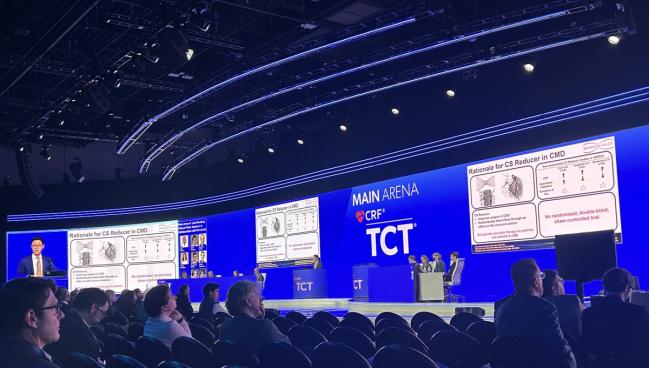
SAN DIEGO, CA—The Shockwave Reducer (Shockwave Medical/Johnson & Johnson MedTech) can be safely used in patients with angina with no obstructive coronary artery disease (ANOCA) and coronary microvascular dysfunction (CMD), according to the results of the REMEDY-PILOT trial. However, it appears to have minimal clinical impact.
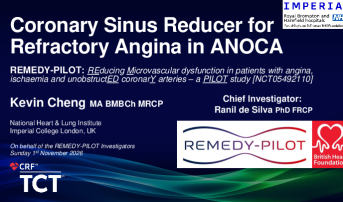
Compared with a sham procedure, implantation of the coronary sinus reducer did not improve perfusion metrics or have major effects on symptoms or quality of life through 6 months of follow-up, Kevin Cheng, BMBCh (Imperial College London, England), reported here at TCT 2026.
“REMEDY-PILOT is the first randomized, double-blind, sham-controlled, stratified treatment trial of Reducer in patients with refractory angina, ANOCA, and CMD,” Cheng said during a media briefing, adding that despite the lack of clinical effects in this study, “ongoing analyses and additional studies are needed to define a role for reducer therapies in this patient group.”
He said the Shockwave device seemed to improve Canadian Cardiovascular Society (CCS) angina grade, and that his group plans to examine predictors of outcomes and data from cardiopulmonary exercise testing and invasive physiology collected at baseline and 6 months. “We need to drill down further on those going forward,” noted Cheng.
Patients with ANOCA are an understudied population, according to Suzanne Baron, MD (Mass General Brigham, Boston, MA), a panelist at the media briefing.
“We see these folks coming in more and more. They tend to be women. They tend to be middle-aged, and . . . often their symptoms are dismissed. We are recognizing more and more about ANOCA and that it is a real entity and something that needs to be further studied,” Baron said.
REMEDY-PILOT shows that “we do need some further work,” she commented, adding that she’s interested in seeing the further analyses from the study, particularly on exercise tolerance. Baron also asked whether this pilot study can serve as a platform for a larger trial, “because this was obviously very small, but we’re looking at a very difficult set of patients to treat.”
Cheng noted that there is another similarly sized study currently recruiting in Europe. Looking more closely at signals in REMEDY-PILOT might help inform future meta-analyses combining data from additional trials once they’re available.
Many patients with ANOCA have CMD, according to Cheng. “Patients suffer from a significant burden of angina, deemed to impair quality of life and incur excess healthcare costs,” he said. “Despite stratified medical therapy, many of these patients remain symptomatic and live with life-limiting symptoms.”
REMEDY-PILOT
The hourglass-shaped Shockwave Reducer is a stainless-steel-mesh device implanted percutaneously into the coronary sinus. It has been evaluated in two sham-controlled trials—COSIRA and ORBITA-COSMIC—that showed it reduces symptoms in patients with refractory angina related to advanced coronary artery disease.
“These effects are thought to be mediated at the level of the microcirculation through the redistribution of blood flow towards ischemic myocardium and, therefore, the coronary sinus reducer may be a biologically plausible treatment for patients with ANOCA and CMD,” Cheng said.
Though three nonrandomized studies in ANOCA have suggested that the device increases coronary flow reserve and reduces hyperemic resistance, with both changes tied to improvements in symptoms and quality of life, there have been no sham-controlled trials in this population.
REMEDY-PILOT, conducted at a single center, was an investigator-initiated pilot study designed to evaluate the feasibility of using the Reducer, as well as its potential efficacy, in patients with ANOCA, refractory angina (CCS grade II-IV for at least 3 months despite use of maximally tolerated medical therapy), and CMD indicated by reduced global myocardial perfusion reserve (MPR; ≤ 2.2) measured by quantitative perfusion-cardiac magnetic resonance (CMR) imaging.
After review by an angina heart team, 54 patients (median age 65 years; 56% men) were randomized to undergo implantation of the coronary sinus reducer or a sham procedure, which included the same 10-Fr internal jugular access, right atrial pressure measurement, coronary sinus venogram, and coronary angiogram as in the reducer group. Participants were taking a median of four antianginal medications and were highly symptomatic, with about 90% in CCS class III or IV.
The primary outcome was the change in segmental endocardial MPR, a measure chosen based on prior research showing good correlation with invasive Doppler coronary flow reserve (CFR). At 6 months, there was no difference between the reducer and sham arms in the change in this endpoint (P = 0.72). The ratio of endocardial to epicardial myocardial blood flow during stress also was unaffected by use of the reducer (P = 0.88).
The number of patient-reported daily angina episodes improved in both groups, albeit with no significant difference between the reducer and sham arms (OR 0.92; 95% credible interval 0.42-2.04); the probability of benefit was 0.41. Similarly, the reducer did not have a significant impact on Seattle Angina Questionnaire summary score or any of the individual domains: physical limitation, angina stability, angina frequency, treatment satisfaction, and quality of life.
The reducer procedure was safe, with only one device-related serious adverse event (tamponade) recorded.
Mechanisms and Placebo Effects
At the media briefing, panelist Kyung Woo Park, MD, PhD (Seoul National University Hospital, Republic of Korea), acknowledged differences in patient population between REMEDY-PILOT and the prior sham-controlled trials with positive results. But, he said, “if you look at the mechanism of how Reducer would improve coronary flow and improve symptoms, it would seem as though these patients [with ANOCA and CMD] would be the right patients who would show the benefit.”
Cheng said that “whilst we believe that the Reducer by increasing venous pressure . . . improves the microcirculation, it’s been hypothesized actually there’s different mechanisms at play in the context of advanced coronary artery disease and without.”
Carlos Collet, MD, PhD (Cardiovascular Research Foundation, New York, NY), another panelist at the media briefing, noted that despite the lack of significant treatment effects, there were some hints that the coronary sinus reducer did decrease angina versus the sham procedure.
Even so, Cheng said, “the key is that after randomization, both arms improved their angina. There was a significant placebo effect.”
That might explain the discrepancy between REMEDY-PILOT and COSIMA, a randomized trial presented a day earlier at TCT showing significantly better outcomes in patients with high-resistance microvascular angina implanted with the Shockwave Reducer versus guideline-directed medical therapy alone.
“Importantly, that was not a sham-controlled trial. It was nonblinded. It was open-label. Participants knew what they were receiving,” Cheng said. “I think it speaks to the difficulty of doing these types of trials in an unblinded fashion.”
David Cohen, MD (St. Francis Hospital & Heart Center, Roslyn, NY, and Cardiovascular Research Foundation), who moderated the media briefing, said that’s an important point. “We worry about placebo effects with any kind of health status, quality of life, patient-reported outcome, and angina seems to be particularly susceptible,” he said.
The discussant for the study after Cheng’s Main Arena presentation, Jennifer Tremmel, MD (Stanford Medicine, CA), raised some possible explanations for why the coronary sinus reducer did not have a significant clinical impact in REMEDY-PILOT, citing sample size, the types of patients enrolled, the testing that was used, and changes in medications and behaviors that might have occurred during follow-up.
Again, Cheng highlighted the need to continue analyzing information from the trial to gain insights. “We need to do a deeper dive in that data to see if there’s any potential signals of benefit to design our future trials,” he said.

Todd Neale is the Associate News Editor for TCTMD and a Senior Medical Journalist. He got his start in journalism at …
Read Full BioSources
Cheng K. Coronary sinus reducer for refractory angina in ANOCA. Presented at: TCT 2026. November 1, 2026. San Diego, CA.
Disclosures
- The study was funded by the British Heart Foundation with grants from Shockwave Medical (Johnson & Johnson MedTech) and Abbott Vascular.
- Cheng reports receiving honoraria from Johnson & Johnson MedTech and research funding from the British Heart Foundation.
- Baron reports serving on advisory boards for Boston Scientific, Zoll Medical, and Medtronic; receiving grant support/research contracts from Boston Scientific, Abiomed, and Acarix; and receiving consulting fees/honoraria/speaking fees from Edwards Lifesciences, Medtronic, Zoll Medical, Shockwave Medical, Pi-Cardia, Boston Scientific, Heartflow, Abbott, Janssen Pharmaceuticals, and Chiesi.
- Park reports receiving consulting fees/honoraria/speaking fees from Amgen, Daiichi-Sankyo/Eli Lilly, HK InnoN Pharmaceutical, Novartis, Samjin Pharmaceutical, and Shockwave Medical.
- Collet reports receiving grant support/research contracts from Abbott, Boston Scientific, GE HealthCare, Shockwave Medical, and Insight Lifetech; receiving consulting fees/honoraria/speaking fees from Abbott, Boston Scientific, Cathworks, GE HealthCare, Shockwave Medical, Medyria, and Siemens Healthineers; owning royalty/intellectual property rights with Coroventis Research; and holding equity/stocks/options in Powerful Medical, CathFlow, and Medyria.
- Cohen reports receiving grant support/research contracts from Abbott Vascular, Boston Scientific, Edwards Lifesciences, Corvia, Ancora, Philips, CathWorks, Zoll, and Medtronic and consulting fees/honoraria/speaking fees from Boston Scientific, Edwards Lifesciences, JenaValve, Elixir, Heartflow, and Zoll.
- Tremmel reports receiving consulting fees/honoraria/speaking fees from Abbott, ACIST, Boston Scientific, Cordis, Edwards Lifesciences, and ExploraMed, as well as grant support/research contracts from Boston Scientific, Medtronic, and Shockwave Medical.
Related News

Comments