Deaths Tied to Aortic Stenosis Become Less Common but Disparities Persist
(UPDATED) An analysis of CDC data for 1999-2024 shows that patient prognosis varied by sex, age, race/ethnicity, and region.


Mortality among older adults with aortic stenosis (AS) “declined modestly” over a 26-year period starting in 1999, according to an analysis of data from the US Centers for Disease Control and Prevention (CDC).
Yet, there were some disparities by sex, age, race/ethnicity, and region that persisted over that period, as well as temporary increases in AS-related death observed during two windows, from 2004 to 2013 and from 2018 to 2021. The results were published online recently in JSCAI.
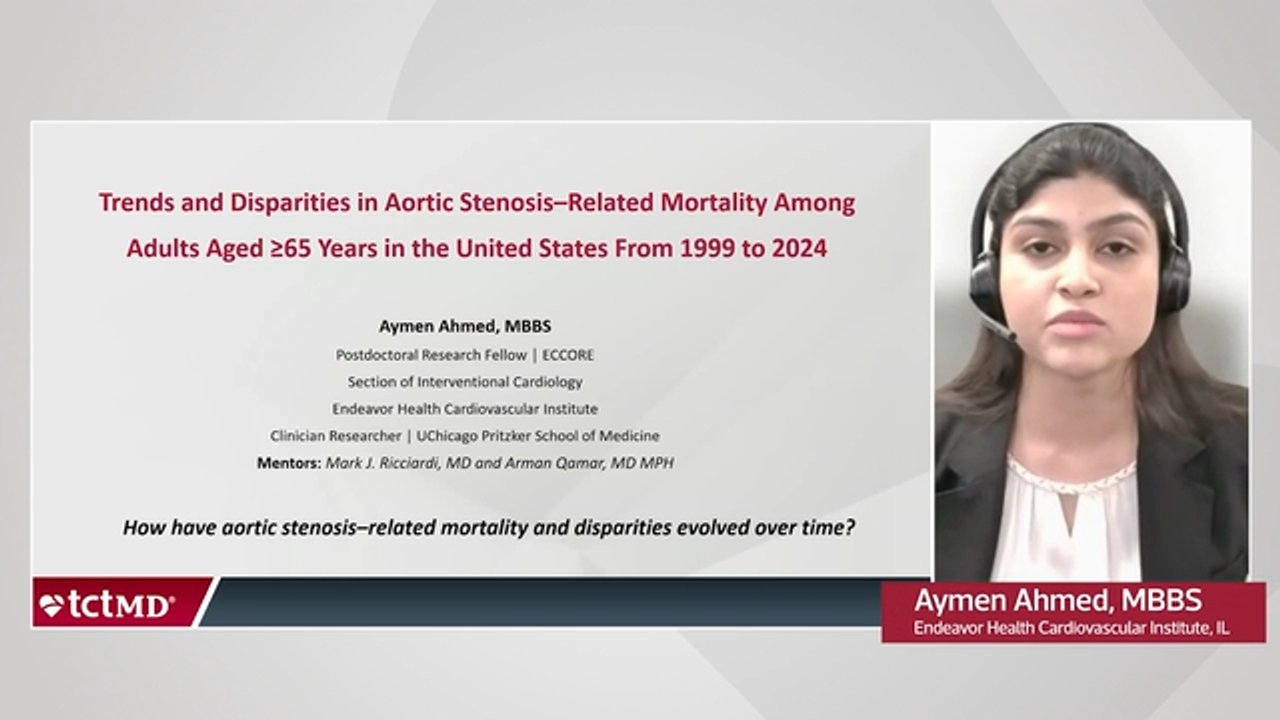
Mark J. Ricciardi, MD (Endeavor Health, Glenview, IL), the study’s senior author, told TCTMD that the ramifications of AS are top of mind for many in the medical community. “There are tremendous changes in the field of aortic stenosis,” not just in terms of therapy but also when it comes to awareness of the disease and the ability to diagnose and monitor patients, he said.
“Going into this, I thought that the mortality improvement would be more impressive than what we saw,” he commented. Moreover, the slight though significant survival gain “didn’t touch all of our patients age 65 or greater.”
As with any observational analysis, it’s reasonable to consider whether the relationships are in fact causal, said Ricciardi. There are several plausible drivers of the disparities, he noted, “but certainly our study can’t explain any of that. It just says, ‘Hey, this is an observation. Why might this be and how do you study further?’”
Ricciardi stressed that the population they studied was defined by disease state, not by which treatment patients might have received. Thus, he said, it’s a stretch to fully attribute the patterns to shifts in the use of aortic valve replacement—whether transcatheter or surgical—or medical therapy.
Moreover, it’s hard to pin down whether deaths recorded in patients with AS were caused by the disease or due to other factors like comorbid conditions or better recordkeeping, he added.
“But having said that, severe AS is a lethal disease,” Ricciardi continued. “And so you can’t completely exclude the fact that the presence of AS in somebody who dies may very well contribute to their death, even if it wasn’t directly causal. When I talk to patients, I mention this too.”
Some patients whose AS has progressed to the severe range, but have minimal or no symptoms, want to wait a little while before undergoing intervention, he added. On the contrary, the EARLY TAVR trial supports the strategy of addressing asymptomatic severe AS. With the condition, “you’re down one of your soldiers, so your heart has some compromise. If you develop a severe pneumonia or something else happens, that may be the cause of their death. But the AS probably isn’t helping,” said Ricciardi.
Ups and Downs
Led by Aymen Ahmed, MBBS (Endeavor Health), the researchers used the CDC WONDER database to identify patients age ≥ 65 years with a diagnosis of nonrheumatic aortic stenosis. They paired that information with details from multiple-cause-of-death files and death certificates to determine whether AS was an underlying or contributing cause of death.
Between 1999 and 2024, a total of 637,178 AS-related deaths occurred, amounting to about half of all valve disease-related deaths during that period. The age-adjusted mortality rate (AAMR) for AS decreased over time, from 55.74 per 100,000 individuals in 1999 to 52.46 per 100,000 individuals in 2024—an average annual percent change (AAPC) of -0.23 (P = 0.004).
The trajectories varied over time, however. From 2004 to 2013, mortality rose significantly before declining again between 2013 and 2018. Within the 4 years from 2018 to 2021, a period that notably overlaps with the COVID-19 pandemic, there was yet another rise. This was followed by a reduction in mortality from 2022 to 2024.
Differences in AS-Related Mortality Over Time
Years | Annual Percent Change |
1999-2004 | -0.52 (-2.7 to 0.3) |
2004-2013 | 0.88 (0.5 to 2.3) |
2013-2018 | -1.85 (-3.5 to 1.1) |
2018-2021 | 1.88 (0.4-3.0) |
2021-2024 | -2.39 (-4.7 to -1.3) |
Demographic differences also emerged. AS-related mortality stayed stable in men over the years (AAPC -0.06; P = 0.33) but decreased in women (AAPC -0.35; P= 0.002), who consistently had a lower AAMR. Patients 85 years and older had the highest AAMR of all age groups as well as an increase in mortality across the study period (AAPC 0.28; P= 0.003). In contrast, patients ages 65-84 years tended to have declining mortality over time, with significant drops in those ages 75-79 years and 80-84 years (AAPC -0.60 and -0.94, respectively; P < 0.001 for both).
Across the US, all census regions experienced decreases in death rate apart from the Midwest, which reached an AAMR of 60.91 in 2024 (AAPC 0.38; P < 0.001). These declines were significant in the West (AAPC -0.34; P = 0.01), Northeast (AAPC -0.3; P = 0.03) and South (AAPC -0.33; P < 0.001). Additionally, mortality rose in nonmetropolitan areas but decreased in metropolitan areas.
The highest mortality was seen among non-Hispanic white individuals (AAMR 61.66), whereas the lowest was seen in the non-Hispanic Asian/Pacific Islander population (AAMR 24.25), who along with the Hispanic/Latino group had declines in mortality over time (AAPC -1.00 and -0.44, respectively, with P values of < 0.001 and 0.007). There were no significant shifts for non-Hispanic American Indian or Alaska Native, non-Hispanic white, and non-Hispanic Black individuals.
“These patterns are consistent with prior analyses examining racial disparities in the management of AS and may also reflect broader systemic factors, including patient-provider communication and healthcare access,” Ahmed and colleagues suggest. The regional imbalances, meanwhile, hint at differences in infrastructure, referral networks, and practice patterns, while the sex gap may arise from men tending to have a higher prevalence of cardiovascular risk factors.
However, the overall trajectory toward better survival “likely reflects evolving management of severe AS and expanding access to definitive valve therapies. Although historically considered a degenerative process, AS is now recognized as an active disease involving inflammatory and calcific pathways within the valve,” the researchers write, adding that while “causality cannot be established, the observed decline in AS-related mortality coincided with broader adoption of transcatheter valve therapies across progressively lower surgical risk populations.”
Seeing these results, it’s clear “that we are not rocking the world in decreasing AS mortality,” Ricciardi said. Although the analysis is at the population level, it does serve as a reminder of “the lethality of the disease and the importance of follow-up,” as well as the need to be especially alert when managing at-risk patients like the very elderly, he added.
We are not rocking the world in decreasing AS mortality. Mark J. Ricciardi
As reported by TCTMD, a similar study with a slightly different design and interpretation was presented earlier this spring at the Society of Thoracic Surgeons 2026 meeting.
A third set of investigators, meanwhile, describe their take on the topic in a brief report published online August 19 in JACC: Advances. Led by Ahmed Kamal Siddiqi, MBBS (Emory University, Atlanta, GA), they looked at 671,877 AS-related deaths among adults ages 45 and older in the CDC WONDER database from 1999 through 2024.
Notably, while age-adjusted mortality was “statistically stable” overall, it increased across the study period for adults ages 55-64 years, Siddiqi pointed out. Among those ages 45-54, mortality begin to rise in the latter part of the study. These patterns remained even after restricting the analysis to deaths in which AS was specified in the database as the underlying cause. “Thus, the national average concealed unfavorable trends within specific younger age groups,” he told TCTMD.
Additionally, the disadvantage for nonmetropolitan versus metropolitan areas grew with time, coinciding with greater TAVI availability—a geographic gap that remained even when restricting the analysis to the prepandemic period.
“These data cannot establish that TAVR caused the patterns, but they identify younger and rural populations that warrant closer investigation,” said Siddiqi.

Caitlin E. Cox is Executive Editor of TCTMD and Associate Director, Editorial Content at the Cardiovascular Research Foundation. She produces the…
Read Full BioSources
Ahmed A, Shakoor M, Kamal UH, et al. Trends and disparities in aortic stenosis–related mortality among adults aged ≥65 years in the United States from 1999 to 2024. JSCAI. 2026;Epub ahead of print.
Disclosures
- Ahmed and Ricciardi report no relevant conflicts of interest.
Related News



Comments