Degenerative Mitral Valve Disease Rising Steadily Worldwide With Sharp Sex, Socioeconomic Divides
Underdiagnosis and undertreatment likely drive the profound effects observed in certain populations, says Juan Granada.

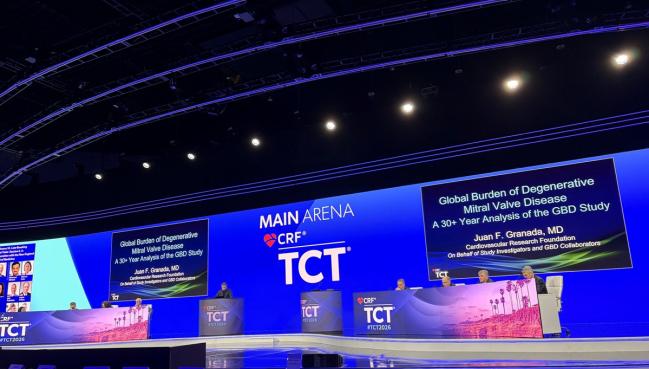
SAN DIEGO, CA—As the worldwide prevalence of degenerative mitral valve disease (DMVD) has amplified over the last three decades, striking discrepancies in outcomes for women as well as in low-resource regions have emerged, according to new Global Burden of Disease (GBD) data.
“This is one of the largest and more comprehensive global analyses laying the foundation of degenerative mitral valve research and innovation priorities,” said Juan Granada, MD (Cardiovascular Research Foundation, New York, NY), who presented the findings here at TCT 2026. “True prevalence may be higher and related to underdiagnosis. This carries a high immeasurable cost in disability and care in a disease that is correctable if diagnosed early.”
Moreover, he continued, the financial burden related to DMVD will continue to grow alongside aging populations. “Simpler and affordable detection and corrective tools are critically needed, especially in low-resource staff areas,” Granada said.
Bernard Prendergast, MD (St Thomas’ Hospital, London, England), the discussant for the study, said the findings “require us, if only momentarily, to lift our eyes from the day-to-day obsessions with valve anatomy, with new technology, with comparisons of transcatheter and surgical technology, to much more important considerations.”
Specifically, “we need to reinforce the message that [degenerative mitral regurgitation] is common and its prevalence is going to rise fast,” he said. “We also need to acknowledge that . . . the true prevalence is likely much higher, particularly since diagnosis is underresourced in economically disadvantaged healthcare settings, where there is also a competing survival bias, where many patients do not live to the age of 70.”
Also, Prendergast highlighted that degenerative mitral regurgitation (MR) “is a treatable disease, whether with surgical or transcatheter technology.
“But these technologies are only readily available in the comfort of North America and mainland Europe,” he continued. “We have a fundamental duty as a global network to narrow this gap between rich and poor and focus our attention on the priorities of early diagnosis and triage, wider access to specialist assessment, and timely and early intervention in the right patients.”
Assessing the Global Burden
Last year, data from the GBD study showed a more than doubling of prevalence of DMVD between 1990 and 2023. In the new analysis, Granada and colleagues dig further into the numbers to paint a clearer picture of what’s been happening.
Overall, the prevalence of disease—identified as at least moderate MR through echocardiography or ICD codes, but excluding nondegenerative causes—increased by 126% over the three decades, with researchers estimating 16.1 million individuals are affected. Additionally, DMVD-related mortality also rose by 75% to almost 40,000 annually, with the greatest number of deaths recorded between ages 85 and 89.
In age-standardized analyses, the prevalence of DMVD was mostly stable over time (175.4 per 100,000). But when researchers stratified regions by sociodemographic index (SDI), both prevalence and mortality increased as SDI went down. Also, while DMVD was more commonly identified in men compared with women (2.39 vs 1.29 million), women more commonly died from the disease (24,400 vs 15,400).
Notably, Granada said, the global decline in DMVD-related mortality is driven by countries with high SDI, as mortality continues to rise in low-SDI countries. Global disability-adjusted life years lost due to DMVD have increased by 66% since 1990 given the aging population.
‘This Is All About Access’
Granada told TCTMD he was “shocked” upon seeing both the sex- and the SDI-related results. “For me, the conclusion is very simple,” he said. “We’re underdiagnosing the disease in countries that we don’t have the resources to do that. People are walking around, with mitral primary disease, and women that have to stay at home, taking care of the kids and not having access to care, are the ones that are getting impacted the most.”
American College of Cardiology President Roxana Mehran, MD (Icahn School of Medicine at Mount Sinai, New York, NY), said at a TCT press conference that undertreatment is also a big barrier in this space. “The fact that you see more prevalence in high demographic indices is probably because of the tools that they have as opposed to others. So this is all about access,” she stressed. “It’s incredible data.”
Without promoting a specific intervention or procedure, Granada said, “the thing is, this is a correctable disease. If you diagnose it early, you can treat it with medications. You can help [with] prevention. And the impact that is having on mortality and disability is unbelievable.”
Commenting during the media briefing, Mamas Mamas, BMBCh, DPhil (Keele University/Royal Stoke University Hospital, Stoke-on-Trent, England), said the data validate what he’s seen in his clinical outreach work in Ethiopia.
“It really reflects what’s happening on the ground,” he said. “One of the hospitals I work at, they have a waiting list of 10,000 patients with valvular heart disease and there’s one cardiac surgeon for 280 million people. The vast majority of people on that waiting list will die, and so I think this work is just so important in highlighting the disparities we see in the lower-income populations. I think that’s an issue of detection rather than true prevalence.”
Granada said his team plans to next look at the global burden of mitral annular calcification as well as tricuspid disease.

Yael L. Maxwell is Senior Medical Journalist for TCTMD and Section Editor of TCTMD's Fellows Forum. She served as the inaugural…
Read Full BioSources
Granada JF. Global burden of degenerative mitral valve disease: a 30+ year analysis of the GBD study. Presented at: TCT 2026. November 2, 2026. San Diego, CA.
Disclosures
- The study was funded by the Cardiovascular Research Foundation and the Gates Foundation.
- Prendergast reports receiving consultant/speaker fees from Edwards Lifesciences and being a partner and board member of CERC CRO.
- Mamas reports receiving grant/research support from Abbott Vascular and Terumo Medical and consulting/speaker fees from Terumo Medical, Bristol-Myers Squibb, Boehringer Ingelheim, and Amgen.
- Mehran reports receiving grant/research support from Abbott, Alleviant Medical, Chiesi, Concept Medical, Cordis, CPC Clinical Research, Daiichi Sankyo, Duke, Faraday Pharmaceuticals, Idorsia Pharmaceuticals, Janssen, MedAlliance, Medtronic, NewAmsterdam Pharma, Novartis, Novo Nordisk, and Population Health; receiving consultant/speaker fees from Affluent Medical, Boehringer Ingelheim, Chiesi, Cordis, Esperion Science/Innovative Biopharma, Gaffney Events, Educational Trust, Global Clinical Trial Partners, IQVIA, Medscape/WebMD Global, Novo Nordisk, PeerView Institute for Medical Education, AMA, and ACC; and holding equity/stock/options in Elixir Medical, Stel, and ControlRad.
- Granada reports no relevant conflicts of interest.
Related News



Comments