DETECT AS II: EHR-Based Valve Care Pathway Boosts Early AS Management
An opt-out system seems to help, but there’s more work to do to meet performance goals endorsed by the AHA and ACC.

NEW YORK, NY—Implementation of an automated valve care pathway integrated into the electronic health record (EHR) is associated with an increase in the timely evaluation and management of patients with severe aortic stenosis (AS), according to the results of the DETECT AS II study.
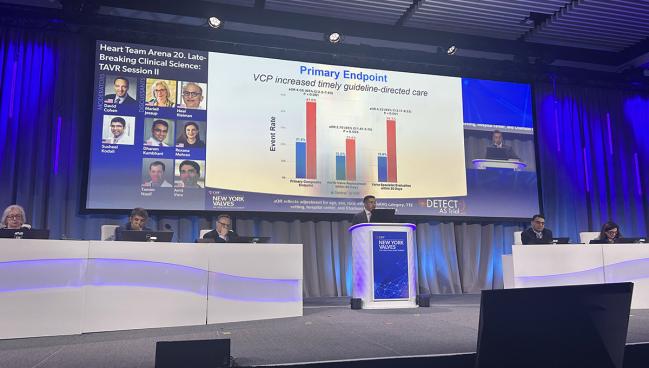
The proportion of patients who completed a valve specialist evaluation within 30 days or underwent aortic valve replacement (AVR)—either surgical or transcatheter—within 90 days increased to 47.0% once the system was put in place from 21.8% in the year prior to implementation (adjusted OR 4.05; 95% CI 2.20-7.43), Sammy Elmariah, MD (UCSF Health, San Francisco, CA), reported last week at New York Valves 2026.
The results remained robust even in groups that have been undertreated for AS historically, including older patients, women, nonwhite and Hispanic individuals, those with low aortic valve mean gradients, and those seeking care at a safety-net hospital without an on-site valve program.
This is “helping to mitigate disparities in care,” Elmariah said. “Proactive, system-level, EHR-based interventions may therefore represent a scalable strategy for improving AS care delivery.”
DETECT AS II
The proportion of patients with asymptomatic severe AS who are eligible for and receive AVR within 90 days of diagnosis is a quality measure endorsed by the American College of Cardiology (ACC) and American Heart Association (AHA) in 2024.
“There is, therefore, a clear and unmet need for effective, low-cost, and scalable tools to bolster guideline-driven management of severe aortic stenosis,” Elmariah said.
Both DETECT AS, led by Elmariah, and ALERT have shown that electronic provider notifications can improve timely management of severe AS, although treatment rates remain suboptimal overall despite the use of passive alerts.
In DETECT AS II, investigators assessed whether a more proactive approach can improve the situation. The valve care pathway that was tested started with automated screening to identify transthoracic echocardiograms (TTEs) with findings suggestive of severe AS, which included an aortic valve area ≤ 1 cm2, a mean gradient ≥ 40 mm Hg, or a peak velocity (Vmax) ≥ 4 m/s. After patients who already underwent AVR or who had an appointment scheduled with a valve specialist or a planned AVR within the next 30 days were excluded, alerts about significant TTE findings were sent to the EHR inbox of a patient’s valve specialist (if already seeing one), cardiologist, or primary care physician (PCP). Physicians then chose to accept or decline a referral to a valve clinic, and if no action was taken, patients were automatically referred to the valve clinic.
“This is essentially an automated referral with an opt-out functionality that serves as a safety net to ensure that patients do not fall through the cracks,” Elmariah said.
The study, conducted at both a quaternary academic medical center with comprehensive valve and surgical programs and an affiliated safety-net hospital without an on-site valve program within the UCSF Health system, compared 117 TTEs sent through the valve care pathway with 133 TTEs managed with usual care in the year prior to implementation of the program. Mean patient age was about 78 years, and roughly half were women.
This is essentially an automated referral with an opt-out functionality that serves as a safety net to ensure that patients do not fall through the cracks. Sammy Elmariah
Use of the valve care pathway was associated with greater proportions of appropriate patients seeing a valve specialist within 30 days (39.3% vs 15.8%; adjusted OR 4.23; 95% CI 2.17-8.23) and getting AVR within 90 days (25.6% vs 15.0%; adjusted OR 2.70; 95% CI 1.41-5.15) compared with the historical controls. The findings were similar when looking at cumulative incidence curves adjusted for the competing risk of mortality, both in the overall cohort and in the subset of symptomatic patients.
The researchers also examined how different types of physicians interacted with the notifications from the system. Compared with cardiologists, PCPs were more likely to accept the recommended referral to a valve clinic (38.7% vs 16.3%) and less likely to decline it (19.4% vs 51.2%). Roughly a quarter of patients were automatically referred for evaluation after physicians failed to act on the alert within 2 weeks.
Shifting Management of AS Upstream
Discussant Amit Vora, MD (Yale School of Medicine, New Haven, CT), said AS is a “particularly enticing target for cardiovascular quality-improvement initiatives” since it is becoming increasingly prevalent among older individuals; diagnostic tools are widely available; safe and effective treatment options exist, including for asymptomatic individuals; and treatment rates are not as high as they should be.
“Ultimately, the situation that we’re all trying to avoid is treating that patient in the ICU with an acute valve syndrome that otherwise could have been treated in a more controlled, elective setting had the aortic stenosis been identified and addressed in a more timely manner,” Vora said. “And to that end, the identification and treatment really has shifted upstream to a more population-based strategy.”
The most important aspect of the approach studied in DETECT AS II was the automatic referral to the valve clinic if no action was taken within 14 days, Vora commented. “This is an important distinction because it still allowed the patient’s primary team, their primary cardiologist as well as their PCP, an opportunity to direct their care. But if they did not respond, there was a safety net which captured these patients for evaluation.”
He noted that his health system has tried to implement a similar pathway.
“One of the main challenges is the tact that’s required in interfacing with primary cardiologists as well as PCPs because it sometimes is hard to wrest that decision away,” Vora said.
One of the main challenges is the tact that’s required in interfacing with primary cardiologists as well as PCPs. Amit Vora
Elmariah agreed that this can be a sticking point, saying that cardiologists in particular showed “a desire to hold onto patients and a reluctance to engage in an automatic referral platform. Whereas on the other hand, primary care providers said, ‘Listen, you’re saying these patients need evaluation? Take them.’ So there’s very different culture[s] amongst the two.”
He reframed the issue to cardiologists from being about taking away power to one of accountability. To them, Elmariah said: “’If you don’t notice this and act upon it within a 2-week period, given that our feet are being held to the fire because of the AHA Target: AS initiative, then we have to do something to move that patient’s care forward,’” he said. “And I think once folks came to terms with that, we were able to implement it, and generally the response has been very positive.”

Todd Neale is the Associate News Editor for TCTMD and a Senior Medical Journalist. He got his start in journalism at …
Read Full BioSources
Elmariah S. An EHR-integrated valve care pathway improves management of severe aortic stenosis: DETECT AS II trial. Presented at: New York Valves 2026. June 26, 2026. New York, NY.
Disclosures
- The study was sponsored by Edwards Lifesciences.
- Elmariah reports receiving research support from Abbott, Edwards Lifesciences, Medtronic, and P&F Products and Features; receiving consulting fees from Abbott, Edwards Lifesciences, and LightHearted AI; and having equity in Prospect Health.
- Vora reports consulting/speaking fees or honoraria from Edwards Lifesciences and Medtronic.
Related News



Comments