Early Data Look Promising for Nickel-Free Siegel TAVI Valve
The novel balloon-expandable device had good clinical outcomes and favorable hemodynamics out to 2 years.
NEW YORK, NY—A novel nickel-free, low-profile TAVI valve shows promise in treating severe aortic stenosis, according to first-in-human (FIH) and early feasibility study (EFS) data.
The balloon-expandable Siegel valve (MiRus), which features a rhenium frame coated in nitric oxide with commissural alignment flats, dry porcine leaflets, and a conformable skirt designed to minimize paravalvular leak, is delivered through an 8-Fr expandable sheath and is manufactured in three sizes: 23 mm, 26 mm, and 29 mm.
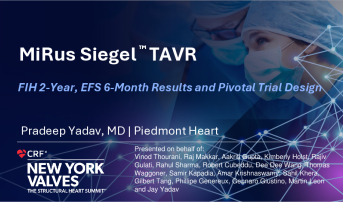
Among the first 35 patients treated with the MiRus valve, including three who were previously turned down for TAVI at other centers due to severe nickel allergy, one died for reasons not related to the valve by 6 months (< 1%) and three needed a new pacemaker (8.5%). However, there were no other adverse outcomes, including stroke, annular rupture, need for a second valve, reintervention or surgery, major vascular complications, VARC-3 type 2-4 bleeding, moderate or severe aortic regurgitation, or acute kidney injury. Also, hemodynamics out to 2 years seemed to be at least on par with what is seen with commercially available valves.
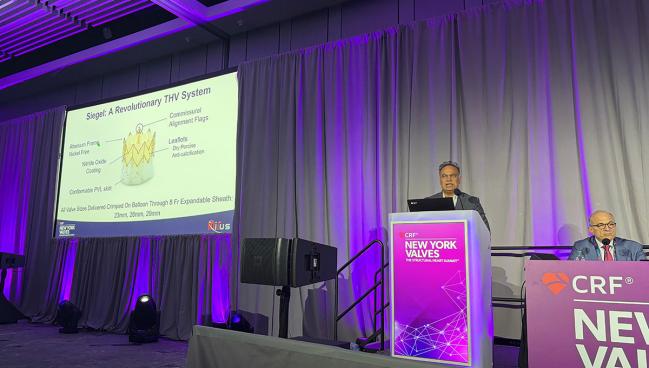
“The team has looked at every single thing from leaflets, from flow dynamics, from stent design, from commissural alignment, access, the sheath, the bleeding, where do you put a suture in, how hydrophilic, [and] I don’t see any limitation with this valve,” said Pradeep Yadav, MD (Piedmont Heart Institute, Atlanta, GA), who presented the findings last week at New York Valves 2026.
Many of the device’s features were informed by lessons learned from past valves, with an eye toward improving biocompatibility and long-term durability, he said.
“The stent frame has a nitric oxide coating, which hopefully will help with healing. The frame itself has commissural alignment flags that will help us visualize where our commissures are pre-deployment, and then you can align them right before deployment if you need to,” Yadav explained. “The valve comes mounted on the balloon, so when you’re inserting through the sheath into the abdominal aorta, you do not need to de-mount it.”
Additionally, he continued, this valve does not foreshorten due to the placement of vertical rods in the stent frame. This “really helps with keeping the valve exactly where you want and with procedural safety [leading to] less conduction issues.”
His conclusion from the data is that “acute procedural outcomes are very, very good. The pacemaker [rate] is very low. Hemodynamics are superior, [and] the valve is very circular.”
“Circularity has apparently turned out to be an important thing in valve durability and certainly what we all want,” commented panelist Neil Kleiman, MD (Houston Methodist DeBakey Heart & Vascular Center, TX). “But you’ve got high radial force, and that means something’s got to give.” As such, he asked whether patients with very calcified annuli would be candidates for this device.
While it’s logical to think that a rigid-framed valve might lead to rupture, “rupture is a phenomenon of sizing, not pressure,” Yadav said, adding that commercially available valves are often hyperinflated due to inherent recoil. “Whereas with this valve, we do not need to go beyond the range if we’re actually targeting 0-2% oversizing. So, the balloon never hits that larger area.” As such, his team has included patients with calcium scores up to 7,000, including those with bicuspid anatomy, so long as they were eligible for transfemoral TAVI and a review committee signed off.
“The more the valve is calcified, the better the performance of this valve,” Yadav added. “We actually think that this is going to perform very well in very heavily calcified valves.”
FIH and EFS Outcomes
The researchers looked at two cohorts of Siegel valve recipients: five patients treated in the first-in-human cohort in Chile and 30 enrolled in the EFS (mean age 76 years; 57% male), which was conducted at nine sites in the United States. In the EFS group, mean STS score was 2.81%, with 80% of patients at low surgical risk.
This specifically “points to the confidence of the investigators enrolling in [a study of] a new technology,” Yadav highlighted.
Two patients received general anesthesia and all had transfemoral access. The rates of pre- and post-dilation were 20% and 33%, respectively. Positioning and commissural alignment was achieved in all procedures, and the mean time from sheath insertion to valve deployment was 15 minutes.
Mean gradient dropped from 40.1 mm Hg at baseline to 7.8 mm Hg at 2 years in the first-in-human cohort. Additionally, it fell from 41.2 to 7.0 mm Hg for the 26-mm valve and from 39.0 to 8.3 mm Hg for the 23-mm valve between baseline and 6 months in the EFS cohort. Over the same spans, aortic valve area (AVA) increased from 0.8 to 2.0 cm2 in the first-in-human dataset and from 0.8 to 2.5 cm2 for the 26-mm valve and 0.7 to 2.2 cm2 for the 23-mm valve in the EFS.
Yadav called this the “most impressive” finding. “At 2 years [with the] FIH balloon-expandable valve, the gradients are very stable with an AVA that is also very stable,” he said. “When you go down to that 23-mm valve, that’s where we see those double-digit, 10-, 15-mm Hg gradients with the commercial devices. We’re not seeing that here.”
With no “waist” in the Siegel valve frame, the low gradients seen here make sense, he continued. The ellipticity ratio for all tricuspid valves was 1.02 and it was similar for bicuspid valves at 1.03. In comparison, those numbers run at 1.09 and 1.12, respectively, for Sapien valves (Edwards Lifesciences) and 1.2 and 1.3 for Evolut valves (Medtronic), Yadav reported.
The STAR trial is now underway, randomizing 1,000 patients with severe aortic stenosis to TAVI with either the Siegel valve or a commercially available device.
Better Durability?
Panelist Gregory Fontana, MD (HCA Los Robles Regional Medical Center, CA), said the findings represent “an exciting technology and early success,” but noted that the “Achilles’ heel for so many bioprostheses has been durability.” Is it possible, he asked, that the way the tissue is uniquely treated in the Siegel valve will make a difference there?
The answer is likely yes, Yadav said, adding that surgical porcine valves like the Hancock and Freestyle aortic root bioprostheses (both Medtronic) have shown good long-term durability. “And what the team is doing is not just taking any pericardium, they’re [doing an] extreme degree of quality check on that pericardium, looking at the varying thickness of the pericardium, the cross-linkage of fibers, and only selecting the very, very high-quality [parts] of that pericardium,” he explained, adding that the leaflet thickness is “somewhere in the middle” of the Evolut and Sapien valves.
Panelist Kentaro Hayashida, MD, PhD (Kansai Medical University, Hirakita, Japan), congratulated the researchers on “a great success” and asked whether it’s possible the device can be delivered transradially.
“Let’s stay humble,” Yadav replied. “Sapien 3 is an amazing valve. It’s a very, very, very good valve. So the bar is very high and the margin of error is none. So I think that is the first goal.” Eventually, he said, if the device turns out to match commercially available devices, “we can go with a smaller access on the femoral side.”
Radial access would be difficult because of the expandable sheaths, he added. “But you raise a point that after the pivotal trial, do you run a registry [to ask]: how small can you go femoral?”

Yael L. Maxwell is Senior Medical Journalist for TCTMD and Section Editor of TCTMD's Fellows Forum. She served as the inaugural…
Read Full BioSources
Yadav P. MiRus Siegel TAVR: FIH 2-year, EFS 6-month results and pivotal trial design. Presented at: New York Valves 2026. June 25, 2026. New York, NY.
Disclosures
- Yadav reports receiving grant/research support from Edwards Lifesciences, Abbott, Medtronic, Boston Scientific, JenaValve, HighLife, Innovalve, Trisol, Laplace, Croi, TriCare, and MiRus; receiving consulting fees/honoraria from Edwards Lifesciences, Abbott, and Boston Scientific; holding stock in Dasi Simulations and Excision Medical; and serving on the medical advisory board for DASI Simulations, Trisol, TriCare, Versa, Pi-Cardia, Excision Medical, inQB8, and Brightflow.
- Kleiman reports serving as a consultant or speaker for Abbott, Medtronic, Boston Scientific, and Siemens Healthineers and receiving grant/research support from Edwards Lifesciences.
- Fontana reports receiving grant support/research contracts from Abbott Vascular, Medtronic, V-Wave, 4C Medical, Pi-Cardia, EMBLOCK, CroiValve, and Edwards Lifesciences; serving as a consultant or speaker for Abbott Vascular, Medtronic, and JenaValve; and serving on the steering committee for Janssen Pharmaceuticals.
- Hayashida reports serving as a consultant or speaker for Edwards Lifesciences, Abbott, and Medtronic.
Related News


Comments