EARLY TAVR: Economic Analysis Supports TAVI Over Clinical Surveillance for Asymptomatic AS
Immediate costs are higher for TAVI, but patients and the healthcare system benefit long-term from earlier intervention.

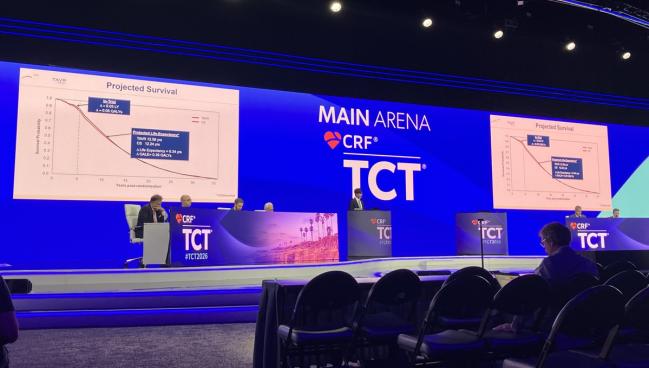
SAN DIEGO, CA—Early TAVI for patients with asymptomatic severe aortic stenosis (AS) is projected to be highly cost-effective, an economic analysis of the EARLY TAVR trial shows.
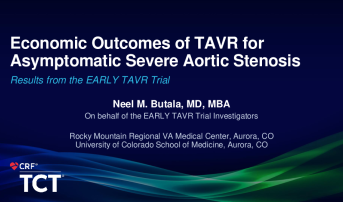
Despite having moderately higher up-front and lifetime costs, TAVI provided a larger gain in quality-adjusted life-years (QALYs) compared with clinical surveillance over the long run, Neel M. Butala, MD, MBA (Rocky Mountain Regional VA Medical Center and University of Colorado School of Medicine, Aurora, CO), reported at TCT 2026 on Sunday.
This supports the cost-effectiveness of early TAVI, “at least from a US healthcare system perspective,” Butala told TCTMD. “If you do an early TAVR, you have a gain in quality-adjusted life-years compared to just waiting, and I think that’s the usefulness of this right now.”
Benjamin Galper, MD (Mid-Atlantic Permanente Medical Group, Washington, DC), who was not affiliated with this analysis, said it is important to note that most patients from the clinical-surveillance arm ended up undergoing TAVI: 25% by 6 months, 70% by 2 years, and 95% by 5 years.
“Initially, this caused some people to think, ‘Okay, does this really make a big difference if the patients are still getting TAVR anyway?’” said Galper. “But then what the study showed was that those patients did get TAVR but had heart failure admissions. I think this economic analysis . . . does a really good job to address some of the concerns or quell some of the [skepticism] about this study.”
Suzanne Baron, MD, (Massachusetts General Hospital, Boston, MA), echoed this idea during a press conference.
“When we think about this, what everyone always says is, ‘Well, you’re treating patients earlier [so] it means they’re going to need more interventions more frequently.’ But the reality is a lot of these patients who crossed over [from clinical surveillance] were treated within 1 or 2 years, and so that difference isn’t really going to be that substantial,” she said.
Financial Costs of TAVI
Prior studies have shown that TAVI is a cost-effective option compared with medical therapy and SAVR in patients with symptomatic severe AS.
EARLY TAVR tested a new paradigm by randomizing 901 patients with asymptomatic severe AS to undergo immediate TAVI or remain under clinical surveillance; participants had an LVEF ≥ 50% and an STS risk score ≤ 10.
Results from EARLY TAVR, showing a lower rate of a composite of death, stroke, or unplanned cardiovascular hospitalization with prompt TAVI versus watchful waiting, led to the approval of TAVI for the treatment of asymptomatic patients with severe AS. In June, 5-year results from the trial were presented at New York Valves.
Butala said his team examined cost-effectiveness within EARLY TAVR from both healthcare system and societal perspectives. They assessed costs through linkages with Medicare fee-for-service claims. In-trial utilities and survival rates were taken from the trial itself.
On average, the 5-year cumulative cost of TAVI was $86,572, compared with $85,044 for clinical surveillance (P=0.60). However, there were more QALYs gained in patients who received TAVI versus clinical surveillance.
“When we extend it over a lifetime, early TAVR is predicted to increase in cost about $4,500,” said Butala. “However, you gain about 0.3 quality-adjusted life-years.”
To put that into perspective, he said this difference is more than the gain in QALYs achieved by choosing TAVI over SAVR for intermediate-risk patients, as seen in a cost-effectiveness analysis of the PARTNER 2 trial.
Butala and his colleagues also looked at the incremental cost-effectiveness ratio (ICER) for these patients, which was $14,698 per QALY gained. He said this is considered high economic value from the perspective of the system, with a 91.3% probability of TAVI being cost-effective.
Clinical Perspectives
Galper told TCTMD that the EARLY TAVR investigators “really made sure” to include truly asymptomatic AS, showing “that it is beneficial to do TAVR early in these patients. It’s a unique device trial where the control arm actually ended up still getting the device.”
In his commentary after Butala’s presentation, he observed that “one of the main concerns people raise for TAVR in patients with asymptomatic AS is that we start the clock early, that these patients are going to undergo reintervention sooner and that could be a problem.
This study “may have put to rest” this concern, he said, because the data from Butala et al’s sensitivity analysis show that even at 10 years, TAVI is still highly cost-effective in these patients.
Butala concluded his TCT presentation by highlighting three reasons EARLY TAVR saw survival benefits in asymptomatic severe AS patients undergoing TAVI.
“There were small benefits—nonsignificant—during the trial period. For relatively healthy people who are going to live a long time, these can accrue over time,” he said. “Second, the age of death between the two treatment arms is a little bit different; patients in the [clinical surveillance] arm are actually dying at younger ages.”
He also noted a “more subtle” point: differences in baseline demographic data. Patients in the clinical surveillance arm were about 0.4 years younger than the TAVI arm and 4% more likely to be female.

Bailey Salimes is a Medical Journalist at TCTMD. Prior to CRF, she was at MedStar Health Research Institute in Washington…
Read Full BioSources
Butala N. Economic outcomes of TAVR for asymptomatic severe aortic stenosis: results from the EARLY TAVR trial. Presented at: TCT 2026. November 1, 2026. San Diego, CA.
Disclosures
- The EARLY TAVR trial was funded by a research grant from Edwards Lifesciences.
- Butala reports consulting fees from Shockwave Medical, Boston Scientific, Emboline, HiLabs, and CatchBio; grants from the American Heart Association and Boettcher Foundation; and equity in HiLabs.
- Galper reports no relevant conflicts of interest.
Related News



Comments