Esprit and Motiv: Bioresorbable Scaffolds Hit Their Stride in BTK Procedures
A postapproval study and a subgroup analysis of complex patients show high efficacy rates for the two limus-eluting technologies.

LAS VEGAS, NV—Two bioresorbable, limus-eluting scaffolds are making their mark in the treatment of infrapopliteal disease and chronic limb-threatening ischemia (CLTI) below the knee (BTK), with evidence of their efficacy coming from real-world populations as well as high-risk subgroups.
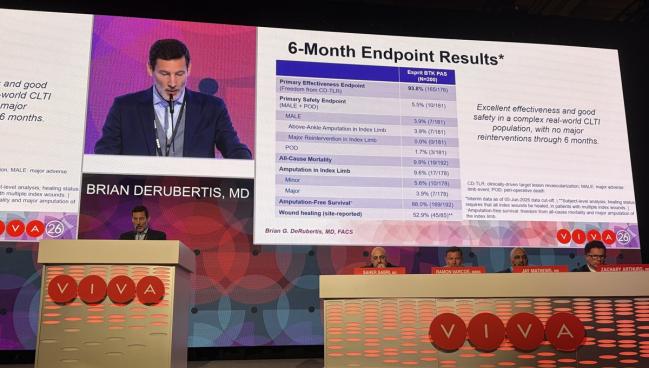
In a postapproval study of the everolimus-eluting Esprit BTK (Abbott), freedom from clinically driven TLR was 93.8% at 6 months and the rate of amputation-free survival was 88%. In the MOTIV trial of the sirolimus-eluting Motiv (Reva Medical), the composite of limb salvage and primary patency—which includes freedom from clinically driven TLR—was 87.2% at 6 months in patients with ischemic rest pain and 77% in those with more advanced disease and distal tissue loss.
The results were presented this week in a late-breaking clinical trials session here at VIVA 2026.
“I’ve got to say, it’s always reassuring to see two similar randomized controlled trials find very, very similar results,” noted panelist Andrew Holden, MBChB (Auckland Hospital, New Zealand). “It makes the whole thing appear that it is the truth: that these devices, whether they be [the Motiv] or the Esprit device, have distinct advantages over what we’ve used previously.”
Speaking with TCTMD, panelist Eric Secemsky, MD (Beth Israel Deaconess Medical Center, Boston, MA), said data from both studies help put into perspective how novel scaffold technology can be applied in at-risk and at-need populations with BTK disease, who are often excluded from clinical trials.
“For the postapproval study, it’s broad. This is a sicker population, more complex anatomy, and the biggest question is, can we still replicate some of the findings that we saw in the clinical trial in this population? And I think the investigators nicely showed optimal outcomes in the real-world population even as we get into more complex territory,” he added.
Like Holden, Secemsky said the MOTIV subgroup data align nicely with the Esprit data thus far, suggesting that “we can perform a more lasting procedure in people with complex below-the-knee anatomy using this bioabsorbable scaffold versus our standard of care right now, which is balloon angioplasty.”
It’s fun for me as both a cardiologist and a vascular specialist that we’re taking this first to the vascular bed and then going to the coronaries. Eric Secemsky
In addition to using different drug elution, Esprit and Motiv have slightly different structures, consisting of a poly L-lactide backbone for Esprit and radiopaque Tyrocore for Motiv. Both completely resorb within 3 to 4 years after implantation. Several more drug-eluting scaffolds for BTK are in the development pipeline, Secemsky noted, and these are expected to further evolve the technology and the field as researchers discover what works and how to improve upon it.
Esprit Postapproval Study
The Esprit BTK scaffold was approved by the US Food and Drug Administration in 2024 and remains the only such device on the market for the treatment of BTK lesions. Its approval was based on results from the LIFE-BTK study of 261 patients with Rutherford class 4 or 5 CLTI and infrapopliteal artery stenosis or occlusion.
For the postapproval study presented by Brian DeRubertis, MD (NewYork-Presbyterian/Weill Cornell Medical Center, New York, NY), 200 patients (mean age 71 years; 36% women; 21% Black) were enrolled from 50 sites globally. Patients with Rutherford class 5 or 6 disease accounted for 63% of the population and 63.5% of those enrolled had a wound at the time of the index procedure.
The real-world patients also had a high burden of comorbid disease, including hypertension, hyperlipidemia, diabetes, multivessel PAD and CAD, and renal disease. The rate of end-stage renal disease (ESRD) with dialysis was nearly 13%, with DeRubertis noting that none of the RCT patients were on dialysis. Additionally, about 13% of patients had a prior minor amputation of the index limb.
Patients in the postapproval study also tended to have longer lesion lengths than those in the RCT at a mean of 69 cm. Yet another difference from the RCT was that while only about one-third of trial participants had moderate-to-severe calcification, 59% of the real-world patients exhibited moderate-to-severe calcification and 23% were classified as having a TASC D lesion. DeRubertis also noted that 43% of the lesions in the postapproval study were total occlusions, and the mean lesion length of these occlusions before the intervention was about 5 cm.
At 6 months, the combined rate of major adverse limb events (MALE) and perioperative death (primary safety endpoint) was 5.5%: MALE in 3.9% of patients and perioperative death in 1.7%. No major reinterventions were reported.
According to DeRubertis, mortality and major amputations were clustered in patients with advanced disease, particularly those with ESRD, who accounted for 44% of all deaths. Of the seven patients with major amputations, all had Rutherford 5 or 6 disease and five had ESRD.
“Looking at this a different way, [clinically driven] TLR was 7.7% in this population at 6 months, and if you compare this to the randomized controlled trial, it’s slightly higher, as the RCT had about a 5% TLR at 6 months,” he added.
MOTIV Subgroups
The MOTIV trial compared the sirolimus-based Motiv scaffold with plain balloon angioplasty. In the main trial of 292 patients from 45 sites in the US and Europe, the primary efficacy endpoint (freedom from above-the-ankle amputation, target-lesion occlusion, clinically driven target-lesion revascularization, or binary restenosis of the target lesion) was higher in the scaffold arm versus uncoated-balloon arm (70% vs 48%; P = 0.0003). The secondary endpoint, which was a composite of limb salvage and primary patency at 6 months, also favored the scaffold, with a patency rate of 81% versus 62% with balloon angioplasty,
The subgroup analysis, presented here by Ehrin Armstrong, MD (Swedish Medical Center, Englewood, CO), stratified outcomes by Rutherford category at baseline: 90 patients classified as Rutherford 4 and 202 as Rutherford 5.
Acute procedural success among the Rutherford 4 patients was 89.8% in the Motiv arm and 78.4% in the uncoated balloon arm. Angiographic acute gain in-segment was 1.76 vs 1.64 mm.
In the Rutherford 5 patients, acute procedural success was the same as in the Rutherford 4 group at 89.8%, but the uncoated balloon group had a much lower rate of 63.6%. Angiographic acute gain in-segment was 1.66 mm in the Motiv arm and 1.51 mm in the uncoated balloon arm.
Looking at the primary efficacy endpoint at 12 months, there was a 22.1% absolute difference between the Motiv and uncoated-balloon groups among Rutherford 4 patients, and a 19.5% absolute difference between groups among Rutherford 5 patients.
Armstrong said the differences speak to the fact that the Rutherford 5 patients had more complex lesions overall, adding that there appeared to be an immediate benefit of scaffold implantation compared with uncoated balloon angioplasty.
“Consistent with that, there was again a benefit of scaffold implantation with regards to the angiographic acute gain that was slightly higher in the Rutherford 5 patients,” he added. Those respective acute gain differences between the scaffold and uncoated balloon groups were 0.12 mm in the Rutherford 4 patients and 0.15 mm in those classified as Rutherford 5.
The absolute difference in the efficacy endpoint between Rutherford 4 and 5 patients was larger at 6 months than at 12 months, which Armstrong said “suggests that scaffold implantation has an early 6-month benefit in patients with more complex disease, and then there are sustained clinical outcomes to 12 months regardless of Rutherford 4 or Rutherford 5 status.”
He added that the MOTIV investigators are starting to analyze the longer-term data.
“So we’ll have the 2-year results coming out down the road and likely also do some other subgroup analyses related to diabetic status and lesion length,” Armstrong noted. “But I think these initial results are really very successful . . . and as they pan out over 2 to 3 years, I think it will be very interesting both [for this] and with other scaffolds as well to see how this really changes the field.”
It’s always reassuring to see two similar randomized controlled trials find very, very similar results. Andrew Holden
The success of these scaffolds has renewed interest in bioresorbable devices for coronary interventions, something that has had such a troubled history that many are hesitant to call it a comeback.
The Absorb BVS (Abbott Vascular) was approved by the US Food and Drug Administration in 2016 on the basis of the ABSORB trials, after gaining CE Mark approval in Europe in 2011, but the later emergence of scaffold thrombosis in trials and meta-analyses led to the device being restricted in Europe. By 2017, it had been pulled from the market in the United States and scaffold technology for the coronaries dissolved into the past.
“We have a lot yet to evolve here, but I think that there’s a lot of excitement about this right now,” Secemsky noted, “It’s fun for me as both a cardiologist and a vascular specialist that we’re taking this first to the vascular bed and then going to the coronaries, whereas a lot of times we try to adopt the coronary practices in the vascular bed.
“If anything, it gives us a little bit more ability to put more scaffolds in where we might be hesitant and not necessarily pay the price for a permanent implant. So, I think we’re going to be hearing a lot more about these in the future,” he concluded.

L.A. McKeown is a Senior Medical Journalist for TCTMD, the Section Editor of CV Team Forum, and Senior Medical…
Read Full BioSources
DeRubertis B. Real-world 6-month outcomes of the Esprit BTK drug-eluting resorbable scaffold in CLTI: results from the post-approval study. Presented at: VIVA 2026. October 5, 2026. Las Vegas, NV.
Armstrong E. Clinical outcomes of the MOTIV sirolimus-eluting resorbable scaffold in Rutherford category 4 versus Rutherford category 5 chronic limb-threatening ischemia: subgroup analysis from the MOTIV pivotal trial. Presented at: VIVA 2026. October 5, 2026. Las Vegas, NV.
Disclosures
- DeRubertis reports consulting fees and/or honoraria from Abbott Vascular, Bard, Boston Scientific, Concept Medical, and Medtronic.
- Armstrong reports consulting fees and/or honoraria from Abbott Vascular, Boston Scientific, Cardiovascular Systems, Medtronic, and Spectranetics.
Related News

Comments