Evolocumab Cuts MACE Risk in Stented Patients Without Prior MI: VESALIUS-CV
In this high-risk population, those who had a prior PCI had higher event rates but benefited from aggressive LDL-lowering.

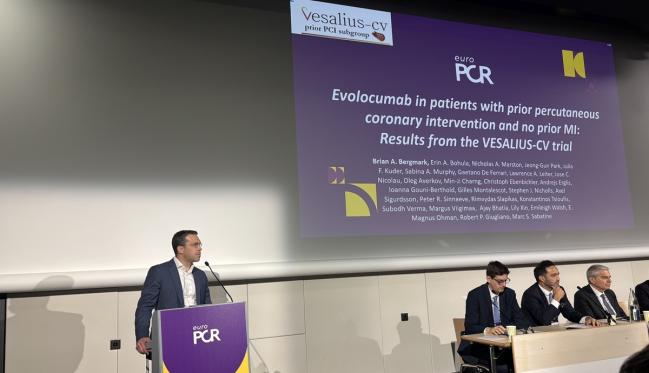
PARIS, France—Patients with atherosclerosis or high-risk diabetes who have undergone PCI, but who have not yet had an MI or stroke, fare significantly better when LDL-cholesterol levels are treated aggressively with a PCSK9 inhibitor, according to a new VESALIUS-CV analysis presented today at EuroPCR 2026.
Compared with usual care, including the use of high-intensity statins, adding evolocumab (Repatha; Amgen) significantly cut the relative risk of the three-point MACE endpoint of coronary heart disease, MI, or ischemic stroke by 30%. Evolocumab also reduced the relative risk of a four-point MACE endpoint, which included ischemia-driven revascularization, by 40% compared with usual care alone.
“We’re specifically looking at this with the thought that this is a clinically identifiable group of patients,” lead investigator Brian Bergmark, MD (Brigham and Women’s Hospital, Boston, MA), told TCTMD, referring to people who have received a coronary stent. “They’re also, by definition, tied into the medical system to some degree. They had an invasive procedure, and we know that the rates of LDL monitoring and optimization in those patients is very low.”
With the addition of evolocumab 140 mg every 2 weeks, LDL-cholesterol levels were reduced from a median of 109.5 mg/dL at baseline to a median of 41.5 mg/dL at 48 weeks. After 96 weeks, the median achieved LDL-cholesterol levels were 40.0 mg/dL in the evolocumab-treated patients and 97.0 mg/dL in those treated with usual care.
In going this low with LDL levels, “there was a striking benefit in this stable population,” said Bergmark. Given the lag between the last recent PCI and the initiation of evolocumab, the researchers say, the study also shows that patients still stand to gain if they are identified quite late after PCI.
Lower and Lower LDL
The PCSK9 inhibitor evolocumab is approved for use in adults with established atherosclerotic cardiovascular disease (ASCVD) based on positive results from the FOURIER randomized trial. Last year, evolocumab gained an indication for primary prevention, specifically in high-risk adults without established ASCVD.
VESALIUS-CV, which was presented in 2025 and reported on by TCTMD at that time, included 12,257 patients at high cardiovascular risk, which was defined as having diabetes plus a cardiovascular risk enhancer or atherosclerosis with or without diabetes and elevated LDL cholesterol (≥ 90 mg/dL). While the population was considered high risk, patients did not have a prior history of stroke or MI. They were randomized to usual care or evolocumab, with the PCSK9 inhibitor reducing the risk of coronary heart disease, MI, or stroke by a relative 25% (and the four-point MACE endpoint by 19%).
The new analysis, which was published in Circulation to coincide with the EuroPCR presentation, focused on 3,627 patients (median age 66 years; 30.7% women) who had undergone PCI. The median time from the most recent PCI to enrollment in the study was 4 years. More than three-quarters of patients were treated with high-intensity lipid-lowering therapy, 80.3% were taking aspirin, and one-third were on dual antiplatelet therapy.
Compared with those who hadn’t undergone PCI, those who’d received a stent had higher overall risks of the three- and four-point MACE endpoints at 5 years. The rates of coronary heart disease mortality, MI, and urgent revascularization were roughly double in those with a prior PCI than in those without.
Homing in the patients with a prior PCI, evolocumab reduced the primary three-point MACE endpoint when compared with usual care: 7.0% in the evolocumab arm versus 9.5% in the usual-care group at 5 years (HR 0.70; 95% CI 0.56-0.89). The four-point MACE endpoint was also significantly lower in the evolocumab-treated patients: 17.9% versus 21.7% with usual care at 5 years (HR 0.82; 95% CI 0.71-0.96).
“There were really substantial reductions in all the [prespecified] secondary endpoints, including a 50% reduction in MI,” said Bergmark. The decrease in MI with evolocumab was statistically significant as early 6 months after randomization, and there were significant reductions in the risks of both STEMI and NSTEMI.
The relative risk of ischemia-driven revascularization was reduced by 26%, and urgent ischemia-driven revascularization by 39%, among the evolocumab-treated patients. Treatment had no effect on stroke. Rates of cardiovascular and all-cause mortality were lower in the evolocumab-treated patients, but Bergmark said that the nominal reduction should be considered exploratory and hypothesis-generating.
Future Guidelines to Include VESALIUS-CV
The latest US dyslipidemia guidelines recommend physicians treat high-risk primary prevention patients to an LDL-cholesterol target of less than 70 mg/dL. For this group, treatment should start with a high-intensity statin, and if treatment goals are not met, according to the guidelines it’s reasonable to add ezetimibe next and then a PCSK9 inhibitor.
The VESALIUS-CV results came too late to be part of the guideline review so were not incorporated into the cholesterol recommendations. In an editorial published when the those were released, Roger Blumenthal, MD (Johns Hopkins University School of Medicine, Baltimore, MD), and Pamela Morris, MD, (Medical University of South Carolina, Charleston), the respective chair and vice chair of guidelines, say the trial “redefined a lower threshold for LDL-lowering” in high-risk patients with ASCVD. Future guidelines, they add, will likely include a recommendation for more intensive lipid-lowering down to < 55 mg/dL.
“We keep parsing these things, but obviously LDL cholesterol should just be very low,” said Bergmark. “Like in all people, all the time.”
Ziyad Ghazzal, MD (American University of Beirut, Lebanon), one of the panelists during the Hotline session, asked about the best way for physicians to achieve the guideline-recommended target, whether that’s less than 70 or 55 mg/dL. He noted that roughly 70% of patients were treated with a high-intensity statin and 25% were treated with ezetimibe, then questioned whether increasing statin intensity, when possible, and getting more patients on ezetimibe would be a viable approach versus adding evolocumab.
In response, Bergmark agreed with that approach but said there are barriers to intensifying existing treatment, including statin intolerance. In reality, he said, only 50% of US patients have their LDL cholesterol measured, let alone optimized, 6 months after PCI.
“Also, I think this population reflects what is happening in the real world,” said Bergmark. “These are experienced trial sites who consider their patients to be as optimized as possible on those medications.”
Roxana Mehran, MD (Icahn School of Medicine at Mount Sinai, New York), another panelist during the session, said this analysis should reinvigorate physicians to get more aggressive in lowering LDL levels in stable patients treated with PCI.
“If you think we are doing well, we are not,” she said. “We have data from our [hospital’s] database of chronic coronary syndrome patients, which are patients who have not had a prior MI or stroke, but they’ve had multiple PCIs, and the average LDL is around 80 mg/dL. This is at the great Mount Sinai [Hospital] with great, great doctors.”
PCI, she said, could be used to identify a patient at very high risk of recurrent events who should be treated aggressively with LDL-lowering medications, including evolocumab.
“A 50% reduction of spontaneous MI is unheard of in any clinical trial,” said Mehran, current president of the American College of Cardiology. “As great as our interventions and our tools are, they are not going to be great in averting events in nontarget lesions or anywhere else. To make our interventions durable, we have to pair it with prevention.”
She noted that the pragmatic EVOLVE-MI trial, which has completed enrollment, is testing aggressive LDL-lowering in patients with ASCVD immediately after ACS (within 10 days of MI).

Michael O’Riordan was the Managing Editor for TCTMD from April 2024 to May 2026. He completed his undergraduate degrees at…
Read Full BioSources
Bergmark BA, Bohula EA, Martson NA, et al. Evolocumab in patients with prior percutaneous coronary intervention and no prior MI: results from the VESALIUS-CV trial. Circulation 2026:Epub ahead of print.
Disclosures
- Bergmark reports research grants through Brigham and Women’s Hospital from Pfizer, Ionis, Abbott Vascular, Inari, AstraZeneca/MedImmune, and Amgen, as well as consulting or personal fees from Philips, Abbott Vascular, Abiomed, Boston Scientific, Teleflex, Bolt, Endovascular Engineering, SpectraWAVE, and the Boston Clinical Research Institute.
- Mehran reports grant/research support from Abbott, Alleviant, Chiesi, Concept Medical, Cordis, CPC Clinical Research, Daiichi Sankyo, Duke, Faraday Pharmaceuticals, and Idorsia Pharmaceuticals.
- Ghazzal reports no relevant conflicts of interest.
Related News

Comments