Evolocumab Reduces MACE in Patients With Prior CABG but No MI: VESALIUS-CV
The results make the case for surgeons to be more involved in secondary prevention, especially with the PCSK9 inhibitor.

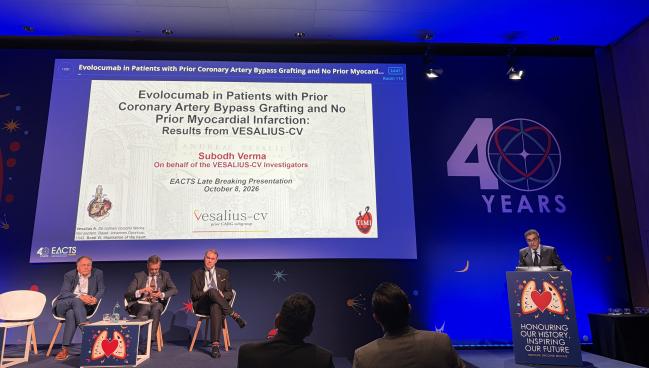
BARCELONA, Spain—Among stable patients who have undergone CABG but do not have a history of MI, treatment with the PCSK9 inhibitor evolocumab (Repatha; Amgen) on top of statins reduces the risk of major cardiovascular events, according to a new analysis of the VESALIUS-CV trial.
Of the more than 1,400 patients in this subgroup of the main trial, the risk of four-point MACE (coronary heart disease death, MI, ischemic stroke, or ischemia-driven revascularization) was a relative 28% lower in those randomized to evolocumab versus placebo over a median follow-up period of 4.5 years.
“We have a tremendous opportunity to favorably and positively impact the long-term cardiovascular prognosis of patients that have had bypass surgery,” Subodh Verma, MD, PhD (University of Toronto, Canada), who presented the findings in a late-breaking clinical science session at the 2026 European Association for Cardio-Thoracic Surgery (EACTS) meeting, told TCTMD. “Beyond statin therapy, PCSK9 inhibition here with evolocumab results in quite formidable reductions in cardiovascular and coronary outcomes. And there’s no safety signal of any concern per se. In our current era, there are not very many therapies that we have access to that can move the needle so aggressively.”
Further, Verma urged his colleagues to be an active participant in reducing their patients’ LDL cholesterol levels to “below 1.4, but closer to 1.0 mmol/L . . . following bypass surgery.”
Similarly, Patrick Myers, MD (Lausanne University Hospitals, Switzerland), secretary general of EACTS, told TCTMD “it’s very interesting to see such a high treatment effect, and it tells us that we really need to do better on secondary prevention after CABG.”
He was not surprised by the results, given how much they’re in line with other subanalyses of the VESLALIUS- CV trial, but said they show “that it’s not just what happens in the operating room, but [also] after” that counts.
CABG Data
For the study, Verma and colleagues included 1,432 patients from VESALIUS-CV (mean age 68 years; 21% female) who had prior CABG a mean 7 years before study enrollment but had not had an MI. They were randomized to receive either evolocumab 140 mg subcutaneously every 2 weeks or matching placebo. Baseline LDL cholesterol was 3.0 mmol/L, and 88% were on statins, including 71% on high-intensity statins. One-quarter of patients were taking ezetimibe and 43% had diabetes.
Notably, patients with prior CABG assigned to placebo had higher event rates compared with those in the overall study. They were more than twice as likely to report MI and about 60% more likely to report either MACE endpoint. It is not surprising, Verma said, that “people with a history of bypass surgery, even in the absence of a prior myocardial infarction, are at higher risk compared to the other patients within the trial.”
Compared with those assigned to placebo, patients with prior CABG assigned to evolocumab saw a 56% reduction in LDL cholesterol that was maintained throughout the duration of treatment (absolute difference 1.53 mmol/L; P < 0.0001). This led to a drop in the risk of four-point MACE for those in the study arm compared with placebo (18.4% vs 24.6%; HR 0.72; 95% CI 0.57-0.92), with a number needed to treat of 16. A similar trend was observed for three-point MACE, which did not include ischemia-driven revascularization (9.0% vs 11.5%; HR 0.75; 95% CI 0.53-1.06).
Results were maintained when the researchers looked at individual endpoints, with significant reductions in MI (3.5% vs 8.0%; HR 0.45; 95% CI 0.27-0.74) and ischemia-driven revascularization (13.7% vs 19.8%; HR 0.68; 95% CI 0.52-0.90) with the addition of evolocumab; rates of all-cause death were similar in the treatment and placebo groups (9.7% vs 10.4%; HR 0.82; 95% CI 0.58-1.17).
Benefits of evolocumab were seen consistently across subgroups according to age, gender, diabetes status, and baseline LDL cholesterol.
Additionally, evolocumab reduced the total number of four-point MACE compared with placebo (190 vs 298; incidence rate ratio 0.65; 95% CI 0.49-0.87) as well as the total risk of a first event (115 vs 160; HR 0.72; 95% CI 0.57-0.92).
Lastly, similar to the main analysis, evolocumab was safe in the CABG population, with no differences observed in the rates of any adverse event, serious adverse event, or adverse event leading to study medicine discontinuation noted between the intervention and control groups.
“I just want to emphasize that LDL cholesterol-lowering remains a cornerstone of secondary prevention in all patients with cardiovascular disease, including patients with bypass surgery,” Verma said, citing the recently published American Heart Association scientific statement on secondary prevention after CABG. “Within this document, we have emphasized that LDL target goals of less than or equal to 1.4 [mmol/L] are ideal and less than 1.8 [mmol/L] is really . . . the minimum standard. But PCSK9 inhibitors are recommended really here as third-line agents to try to achieve that goal.”
‘Quite Relevant’ to Surgeons
During the session, Myers thanked Verma for presenting the data to a room full of surgeons and asked how it should change practice.
“As a heart surgeon, I think presenting these data to heart surgeons is quite relevant so that we can all make this part of our vernacular,” he replied. “There’s really very little argument around intensive LDL-lowering in people that have had a prior ischemic event. . . . But the question is, why are we not going to less than 1.4, closer to 1, in people who haven’t had an MI based on these data? VESALIUS is arguing that even in people that have, not really subclinical disease, but have not had an event per se, they should be treated with the same intensity LDL cholesterol-lowering as we do someone who’s actually had ACS.”
More often than not, therapies come with efficacy and safety concerns like bleeding, “and that calculus often is very difficult for us to navigate,” Verma continued. “Here we have one strategy where there is no calculus on the other side; there’s only efficacy and cost, but there’s no bleeding risk or other types of interactions to deal with.”
To TCTMD, he said he hopes “these data will resonate with people who write position statements and guidelines and will strengthen the resolve of the cardiac surgical community to really help people with residual lipid risk get to these lower targets.”

Yael L. Maxwell is Senior Medical Journalist for TCTMD and Section Editor of TCTMD's Fellows Forum. She served as the inaugural…
Read Full BioSources
Verma S. Evolocumab in patients with prior coronary artery bypass grafting and no prior myocardial infarction: results from VESALIUS-CV. Presented at: EACTS 2026. October 8, 2026. Barcelona, Spain.
Disclosures
- Verma reports receiving grants and/or research support and/or speaking honoraria from and/or acting as an advisor for Amgen, AstraZeneca, Bayer, Boehringer Ingelheim, Canadian Heart Research Centre, Canadian Medical and Surgical Knowledge Translation Research Group, Eli Lilly, HLS Therapeutics, Humber River Health, Janssen, Merck, Novartis, Novo Nordisk, Pfizer, S & L Solutions Event Management, Sanofi, and Sun Pharma; and serving as the Chair of the MIST Trial that was coordinated by the University of Ottawa Heart Institute.
- Myers reports no relevant conflicts of interest.
Related News

Comments