FFR-Guided PCI Reduces Revascularization Over a Decade, but Not Death
A meta-analysis confirms what’s known: physiology-guided PCI is “not a survival treatment” when compared with OMT.

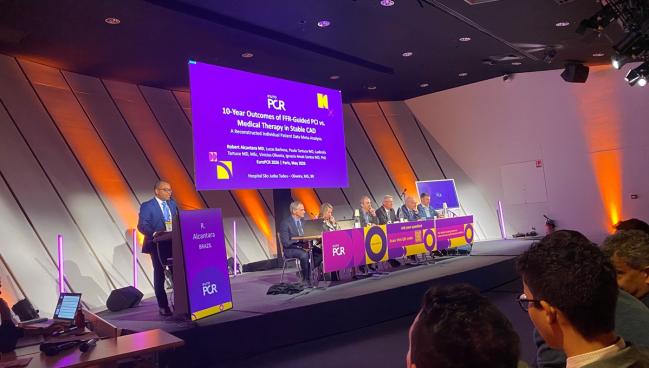
PARIS, France—Patients undergoing PCI guided fractional flow reserve (FFR) are more likely than those treated with optimal medical therapy (OMT) to be alive without having had an adverse event at 10 years, a new meta-analysis shows.
Importantly, this finding was driven by a reduced rate of revascularization but not death.
“Our take-home message is FFR-guided PCI is a powerful tool for reducing repeat procedures over a decade, but it’s not a survival treatment,” said Robert Alcantara, MD (Hospital São Judas Tadeu, Oliveira, Brazil), who presented the data here at EuroPCR 2026. “That distinction matters for our guidelines, for our practice, and above all, for our conversations with patients.”
The results are in line with recently reported 10-year data from FAME 2, which showed that performing PCI on functionally significant stenoses conferred a benefit regarding the composite endpoint of all-cause mortality, MI, or urgent revascularization, but this was also driven by the revascularization component.
In this individual patient-level meta-analysis, researchers included 1,515 patients enrolled in FAME 2 and DANAMI3-PRIMULTI, who were assigned to either FFR-guided PCI (n = 761) or OMT (n = 754).
Over 10 years of follow-up, those who received FFR-guided PCI had a lower risk of the primary composite endpoint of death, MI, or revascularization than did the OMT group (HR 0.70; 95% CI 0.60-0.81). However, Alcantara noted, “this endpoint was violated with a P value for a Schoenfeld test of 0.045. That means that hazard rate is not a stable estimate across time, and it should not be the primary result.”
Using a restricted mean survival time analysis, they determined that FFR-guided PCI resulted in 345 more event-free days over 10 years compared with OMT, or roughly one fewer event per year.
When the composite endpoint was broken down, repeat revascularization stood out as the only event to be significantly decreased with FFR-guided PCI versus OMT over 10 years (HR 0.46; 95% CI 0.38-0.56). MI trended lower over the same time frame (HR 0.80; 95% CI 0.64-1.00), but there was no difference seen with mortality (HR 1.02; 95% CI 0.84-1.25).
The findings were not a surprise, according to Alcantara.
“ISCHEMIA recruited over 5,000 patients selected through noninvasive ischemia testing, not FFR—different methodology, different population, and the same answer: no benefit for all-cause mortality,” he said. “Our population had more dynamically significant stenoses confirmed by FFR, [representing] possibly the patients most likely to benefit from PCI. And even here at 10 years, survival is neutral. Consistency across different studies with different designs is a strong signal.”
He noted several limitations with the study. Namely, it was a reconstructed analysis with Kaplan-Meier curves extracted algorithmically, and also the populations from the two studies were heterogeneous as FAME 2 enrolled stable CAD patients and DANAMI3-PRIMULTI included STEMI patients with multivessel disease. Moreover, these studies used varying endpoints, with the former tracking urgent revascularization and the later including any revascularization.
Because of these drawbacks as well as the “modest” sample size, the results should only be considered “hypothesis-generating,” Alcantara said.
Some Caveats
Panelist Bruce Samuels, MD (Cedars-Sinai Medical Center, Los Angeles, CA), noted that many physiology trials have shown a greater advantage for patients with lesions in the LAD artery compared with elsewhere.
“The other thing I would say is the definition of optimal medical therapy [is] very loosey-goosey,” Samuels continued. “We’ve seen from ORBITA how important it is to really have optimization of medical therapy because that can really affect outcomes as well. . . . What’s come out of many of the medical therapy arms of these studies that people don’t take their medications; about 60% of them don’t take them as they are instructed to and that if they did take them, as you’ve seen in some of the other studies, they actually do quite well.”
Petr Kala, PhD (University Hospital Brno, Czech Republic), another panelist, questioned the applicability of combining trials that measured two different revascularization endpoints. There’s “really a huge difference” between any revascularization and urgent revascularization, he said. “This is quite questionable for me.”
Alcantara confirmed the limitation of that comparison, but noted that “both trials have the same fundamental question.”
Panelist Samir Alam, MD (American University of Beirut Medical Center, Lebanon), suggested that moving revascularization decisions away from a binary FFR cutoff might be a better strategy in the hopes of improving outcomes. “From now on, in our quest to decrease mortality of coronary disease, FFR should be considered in the context of biology of the plaque, and FFR is only one measurement,” he said. “And I think the data is clearly shifting towards integrating all these aspects together.”

Yael L. Maxwell is Senior Medical Journalist for TCTMD and Section Editor of TCTMD's Fellows Forum. She served as the inaugural…
Read Full BioSources
Alcantara R. 10-year outcomes of FFR-guided PCI vs. medical therapy in stable CAD: a reconstructed individual patient data meta-analysis. Presented at: EuroPCR 2026. May 21, 2026. Paris, France.
Disclosures
- Alcantara and Alam report no relevant conflicts of interest.
- Samuels reports receiving honoraria or consultant fees from Abbott and Philips as well as holding stock in VahatiCor.
- Kala reports receiving honoraria or consulting fees from Abbott and Boston Scientific.
Related News



Comments