Heat and Fire-Related Pollution Compound CV Risk
The findings should have implications for emergency response and early warning systems, say experts.

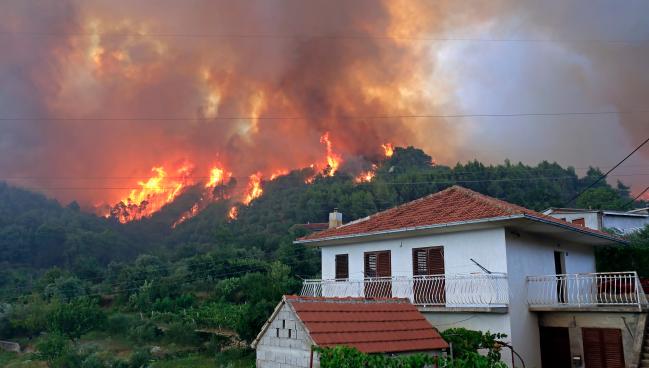
People who are subjected to both hot weather and air pollution caused by fires at the same time are at higher risk of dying from cardiovascular disease than if they were exposed to these environmental factors individually, according to international data.
In a look at nearly 6 million CVD death records in six countries, compound exposure to heat waves and substantial fire-sourced air pollution (SFAP) was associated with an 11.5% greater risk of CV mortality (RR 1.12; 95% CI 1.10-1.13). The relationship was even stronger when focusing on heart failure-related mortality (RR 1.25; 95% CI 1.19-1.30), with 7.73% of such deaths on compound exposure days likely related to the additive interaction.
“The findings do not mean that every person exposed to heat and wildfire smoke will experience a cardiovascular event,” senior author Yuming Guo, MD, PhD (Monash University, Melbourne, Australia), told TCTMD in an email.
“Rather, they suggest that these combined exposures may create periods of increased cardiovascular stress and vulnerability, particularly among individuals with preexisting cardiovascular conditions or limited cardiovascular reserve,” he continued. For these people, dual-threat days “may represent times when additional precautions are warranted, including reducing unnecessary exposure, following personalized guidance from healthcare providers, and ensuring that underlying cardiovascular conditions are well managed.”
Prior studies have identified the increased cardiovascular risks associated with extreme heat and air pollution, including from wildfire smoke. But until now, research combining these hazards has been limited.
The study adds evidence that CV risk rises when multiple environmental stressors occur within a short time window, Guo said, noting that this suggests “compound climate hazards should not be considered as independent exposures evaluated in isolation, particularly when assessing cardiovascular vulnerability during extreme events.”
Data Across Four Continents
For the study, published online last week in JACC with first author Bo Wen, PhD (Monash University), the researchers examined records on 5.9 million deaths that occurred in Australia, Brazil, Canada, Chile, Mexico, and Thailand between 2000 and 2019, noting three major cardiovascular subcategories: ischemic heart disease, heart failure, and stroke.
Using geospatial models to account for daily levels of fire-attributable pollution, they classified each death as occurring in the following mutually exclusive exposure states: no hazard, heat wave-only, SFAP-only, and compound exposure.
CV risks associated with only heat waves (RR 1.08; 95% CI: 1.07-1.09) or SFAP (RR 1.01; 95% CI: 1.01-1.02) were substantially lower than for compound exposure. Ischemic heart disease and stroke also showed positive interactions, but these were smaller than those attributable to heart failure.
The impact of dual exposure varied geographically, with Australia having the largest effects. Also, results were maintained regardless of the number of days used as a buffer to classify compound exposure windows and various heat wave definitions.
Heart Failure Implications
Commenting for TCTMD, Sameed Khatana, MD, MPH (University of Pennsylvania Perelman School of Medicine, Philadelphia), said the results are not surprising overall, but “it is notable that among the different subtypes of cardiovascular disease, this interaction between air pollution and heat was the greatest for heart failure, pointing at perhaps certain pathophysiologic pathways that are especially sensitive to the cumulative effects of heat and air pollution.”
Additionally, the varying effects between countries suggest “that there is significant heterogeneity in how these factors combine to influence cardiovascular health,” he said.
In an accompanying editorial, Lingzhi Chu, PhD (Yale School of Public Health, New Haven, CT), points to the multicountry design as a strength of this study. “This wide geographic coverage increases confidence that the additional risk from compound heat-smoke exposures is a consistent and robust observation rather than an occasional and localized finding,” she writes.
Also, Chu says, the way researchers used buffered exposures to look beyond single-hazard models better reflects the real world. “Instead of a strict definition that requires same-day co-occurrence of extreme heat and fire smoke, the authors identified compound exposures as a condition when both hazards occurred within a predefined time window,” she writes. “This idea took into consideration that the physiologic, behavioral, or social response of one hazard may or may not diminish to the null before interacting with the other hazard.”
Chu calls for future research to focus on more compound exposure analysis as well as refinement on what constitutes SFAP to “disentangle” what each particulate matter might mean for cardiovascular health.
Khatana said that going forward he would like to see more work done on “mitigation strategies that can lessen the impact of such factors on health outcomes.”
Guo called for more study into “individual-level susceptibility, including how factors such as age, underlying cardiovascular disease, medications, socioeconomic conditions, and adaptive capacity modify responses to compound environmental exposures.” He added that outcomes beyond mortality also deserve a closer look in this space.
“Finally,” he said, “there is a need to evaluate effective adaptation strategies, including whether improved early-warning systems, targeted communication, and clinical interventions can reduce cardiovascular impacts during compound climate events.”
Warning Systems and Emergency Response
The current findings might have an impact on the design of early-warning systems and emergency response procedures, which currently tend to focus on single events.
“This study demonstrates that cardiovascular risk during the co-occurrence of these two hazards exceeds what either warning system would anticipate alone,” Chu says. “Combining real-time meteorologic and air quality monitoring and forecasting data could enable compound event alerts and help coordinate multifaceted hazard responses, such as targeted outreach to vulnerable populations and more timely healthcare preparedness.”
At an individual level, Guo said, “clinicians can help by proactively communicating these risks with high-risk patients, discussing practical strategies to minimize exposure during compound events, and recognizing these periods as potential windows of increased cardiovascular vulnerability.”
Healthcare systems have a role to play as well, he added, saying that “incorporating awareness of compound climate hazards into patient communication, preventive guidance, and preparedness planning may help better protect vulnerable populations during extreme events.”

Yael L. Maxwell is Senior Medical Journalist for TCTMD and Section Editor of TCTMD's Fellows Forum. She served as the inaugural…
Read Full BioSources
Wen B, Wu Y, Lavigne E, et al. Compound exposure to extreme heat and substantial landscape fire-sourced air pollution on cardiovascular mortality. JACC. 2026;Epub ahead of print.
Chu L. Heat plus fire: a compound hazard threatening cardiovascular health. JACC. 2026;Epub ahead of print.
Disclosures
- Wen, Chu, and Khatana report no relevant conflicts of interest.
- Guo reports receiving support from the Leader Fellowship of the Australian National Health and Medical Research Council.
Related News
Comments