Inflammation Common in HF, No Matter the Ejection Fraction: POSEIDON
Anti-inflammatory therapies could prove helpful in this setting, but that’s yet to be seen.

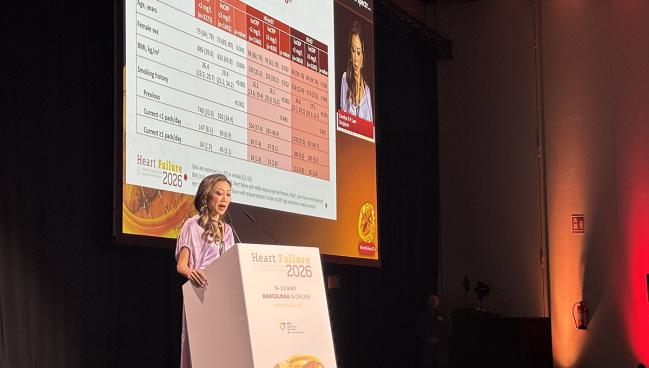
BARCELONA, Spain—Two in five patients with heart failure (HF) have high inflammatory risk, with a similar prevalence across the spectrum of ejection fraction, according to an international snapshot from the POSEIDON study.
Carolyn Lam, MD (National Heart Centre, Singapore), presented the data last weekend at the European Society of Cardiology’s Heart Failure 2026 conference. The results were simultaneously published in the European Journal of Heart Failure.
It’s known that “inflammation contributes to heart failure progression across subtypes,” Lam told attendees of the late-breaking session. However, this process is thought to play out differently depending on whether patients have HF with preserved ejection fraction (HFpEF) or reduced ejection fraction (HFrEF), she continued. “In HFpEF, it is primarily attributed to comorbidities. In HFrEF, it has been traditionally attributed to myocardial damage.”
Earlier studies of inflammatory risk across the EF spectrum have been limited, either by their retrospective design or their selected regional/ethnic representation, said Lam. POSEIDON, however, enrolled a diverse cohort across 317 centers in 18 countries.
Charalambos Antoniades, MD, PhD (University of Oxford, England), was senior author of a recent study that showed signs of inflammation, specifically in epicardial adipose tissue, could be used to predict who might develop HF in the future. Speaking with TCTMD, he said it’s important to consider how the relationship between the two might be leveraged at different stages in the disease’s natural history.
Local inflammation can cause or worsen HF by impacting either blood vessels (nonischemic) or the myocardium/valves (ischemic), but the relationship can also move in the other direction, with heart failure giving rise to inflammation, Antoniades explained. What gets picked up when measuring high-sensitivity C-reactive protein (hs-CRP), he said, is systemic inflammation, but the biomarker does not identify its source.
“This is why it’s important to get the timeline right” when considering the interplay between the inflammation and the disease, stressed Antoniades. “The POSEIDON study gives us good insight into these associations,” he said, “but it will be good to see more long-term prospective data linking systemic inflammation with future development of heart failure.”
A New Target in HF?
Within the POSEIDON study of patients with atherosclerotic cardiovascular disease, which enrolled nearly 19,000 participants between 2023 and 2025 at routine clinic visits, 11,809 individuals had both symptomatic HF and available hs-CRP measurements. None had any hospitalizations, unplanned visits, or infections within the 60 days prior.
Half had HFrEF, 31% had HFpEF, and 18% had heart failure with mildly reduced ejection fraction (HFmrEF). Those with HFpEF were older and more likely to be female and to have atrial fibrillation than those with HFrEF, whereas the HFmrEF patients fell in the middle of that range. On the other hand, the HFrEF and HFmrEF groups had more coronary artery disease than those with HFpEF.
Elevated hs-CRP levels of 2 mg/L or higher were found in 38.8%, 38.1%, and 38.2% of the HFpEF, HFmrEF, and HFrEF groups, respectively. Median hs-CRP values also were similar, at 1.33, 1.26, and 1.28 mg/L.
Within each of the three HF phenotypes, patients with high hs-CRP were more likely to be female and to have lower estimated glomerular filtration rate (eGFR), more dyslipidemia, higher body mass index (BMI), a current or prior smoking history, hypertension, diabetes, worse NYHA functional class, and higher NT-proBNP levels.
Multivariable analyses identified several independent predictors of elevated hs-CRP: smoking, rheumatic/autoimmune/inflammatory disease, obesity, reduced eGFR, dyslipidemia, and worse NYHA class. These factors were consistently predictive for all three HF phenotypes (P for interaction > 0.05). One exception was BMI, which was most tightly tied to hs-CRP levels in the HFpEF subgroup (P for interaction = 0.001).
Given that C-reactive protein is a downstream biomarker of the interleukin-6 (IL-6) signaling cascade, the researchers also looked at IL-6 levels among the EF groups. These levels were “remarkably similar and increased across HF types,” said Lam, with a “moderate correlation” between hs-CRP and IL-6 levels for each group.
Lam pointed out that the equal prevalence of high hs-CRP across HF types challenges the “traditional concept that it’s more HFpEF-centric.” Moreover, the clinical correlates of this inflammation were consistent across the EF spectrum and fit a cardio-kidney-metabolic phenotype.
“The POSEIDON study provides a real-world estimate of the potentially eligible population for therapies directly targeting inflammation,” Lam concluded. She cautioned, however, that the study’s cross-sectional design makes it impossible to draw causal inferences and assess temporal changes in hs-CRP, which can represent either acute or chronic inflammation.
Looking forward, Antoniades suggested that a key research question will be whether using inflammation to identify patients at risk for HF can enable prevention through sodium-glucose cotransporter 2 (SGLT2) inhibitors or other therapies. For patients who already have HF plus inflammation, it might be useful to prescribe an anti-inflammatory—but he cautioned that it’s not yet known whether this is a viable strategy.

Caitlin E. Cox is Executive Editor of TCTMD and Associate Director, Editorial Content at the Cardiovascular Research Foundation. She produces the…
Read Full BioSources
Lam CSP, Contreras J, Darwesh R, et al. Prevalence and predictors of high inflammatory risk in heart failure subtypes: findings from the global POSEIDON study. Eur J Heart Fail. 2026;Epub ahead of print.
Disclosures
- Lam reports receiving research grants from the National Medical Research Council of Singapore, Novo Nordisk, and Roche Diagnostics; serving in advisory, consulting, and trial leadership roles for Alnylam Pharma, AnaCardio AB, Applied Therapeutics, AstraZeneca, Bayer, Boehringer Ingelheim, Boston Scientific, Bristol Myers Squibb, Corteria, CPC Clinical Research, Cytokinetics, Eli Lilly, Impulse Dynamics, Intellia Therapeutics, Janssen Research & Development LLC, Medscape/WebMD Global LLC, Merck, Novartis, Novo Nordisk, Pfizer, Radcliffe Group Ltd, Roche, and Us2.ai; and being a co-founder and nonexecutive director of Us2.ai.
- Antoniades reports being founder and nonexecutive director of Caristo Diagnostics and working with numerous companies that make anti-inflammatory agents and SGLT2 inhibitors (Lexicon Pharmaceuticals, Novartis, and AstraZeneca).
Related News



Comments