LAAO With Amulet 360 Device Provides Positive 1-Year Results
“It’s nice to have more tools in the toolbox so that we’re not trying to fit a square peg in a round hole,” one expert says.

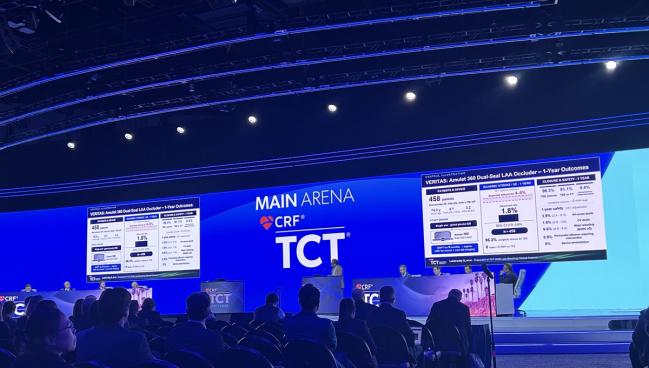
SAN DIEGO, CA—For patients with atrial fibrillation (AF) undergoing left atrial appendage occlusion (LAAO), use of the next-generation Amulet 360 device (Abbott) yields good results through 1 year, additional follow-up from the VERITAS trial shows.
The rate of complete closure of the appendage measured by transesophageal echocardiography (TEE) at 1 year was high at 96.3%, with a low rate of device-related thrombosis (DRT; 3.3%).
In addition, the rate of ischemic stroke/systemic embolism was 1.8% in a population that, based on CHA2DS2-VASc score, would be expected to have such events at an annualized rate of 4-5% without oral anticoagulation, Dhanunjaya Lakkireddy, MD (Kansas City Heart Rhythm Institute, Overland Park, KS), reported at TCT 2026.
“It’s safe to say that the 1-year outcomes from the VERITAS study support the long-term safety and effectiveness of the Amulet 360 device,” Lakkireddy told attendees at a late-breaking clinical science session.
In a media briefing, he described the device as a “very important tool that really adds to the safety and efficacy of the entire left atrial appendage occluder space in a big way.”
The findings were published simultaneously online in JACC: Cardiovascular Interventions.
Commenting for TCTMD, Michael Young, MD (Dartmouth Hitchcock Medical Center, Lebanon, NH), noted that when it comes to achieving complete closure of the LAA while maximizing safety, “that bar is really high. So you want to make sure that it’s a safe, forgiving device that’s going to do what it’s intended to do, which is to seal the appendage.”
In the case of Amulet 360, it appears that there have been a number of improvements compared with the device’s earlier iteration, with favorable safety and effectiveness, said Young, a member of the American College of Cardiology Vascular Disease Section and Leadership Council.
“You feel good that the safety profile of the device, . . . in the population studied, seems to be on par with what we would expect,” he said.
Young noted that most patients considering LAAO will have anatomies suitable for any of the currently available devices, adding that, “in our field, it’s nice to have more tools in the toolbox so that we’re not trying to fit a square peg in a round hole.”
Taking a broader perspective, Young highlighted the need for rigorously conducted studies like VERITAS to help move the field of LAAO forward in the wake of discussions about trials like CLOSURE-AF and CHAMPION-AF.
It’s “important for the integrity of the field because I think that’s where a lot of the consternation lives right now—particularly in the past year and a half, with different trials with discrepant findings—and we just want to make sure that we’re doing the right thing,” he said. “And the only way to do that is to ensure that the innovation is there, the iteration is there, and that it’s in a manner that’s clearly data and scientifically driven.”
A Next-Generation Device
The first-generation Amplatzer Amulet device—which provides a dual seal of the LAA using a lobe in the appendage and a disc covering the orifice—has been used for several years, first getting CE Mark approval in Europe in 2010 and then gaining US Food and Drug Administration approval in 2021 based on the results of the AMULET IDE trial.
Since then, modifications have been made to the device based on clinical experience, resulting in the Amulet 360. The new device has a similar lobe-and-disc design but with a more conformable lobe to improve fit within the LAA, redesigned and smaller anchors, and an inverted distal end screw, improving the overall safety profile, Lakkireddy said.
The Amulet 360 was evaluated in the global, prospective, multicenter, single-arm VERITAS study, which included patients with AF and a CHA2DS2-VASc score of at least 2 for men and 3 for women who could comply with the mandated dual antiplatelet therapy (DAPT) regimen after LAAO.
Previously reported results, published earlier this year in JACC: Clinical Electrophysiology, showed no safety events in the first week following the procedure and, at 45 days, complete LAA closure in 93.9% of patients, a low 0.5% rate of pericardial effusion requiring drainage, and no CV death, systemic embolism, hemorrhagic stroke, or device embolization.
This is going to be a constant race between a sophisticated, well-improved device versus a drug that still continues to have its issues. Dhanunjaya Lakkireddy
AT TCT, Lakkireddy reported results from 458 patients (mean age 74.0 years; 38.4% women) who had the implantation with the Amulet 360 device attempted. Mean CHA2DS2-VASc score was 4.1 and mean HAS-BLED was 3.2, both “pretty high,” according to Lakkireddy. At the time of the procedure, 68.6% of patients were in sinus rhythm. Implant success rate was 99.3%.
Adherence to the post-LAAO medication protocol was high, with 87.1% of patients still on DAPT at 6 months and 89.9% having switched to single antiplatelet therapy by 1 year. There was very little use of oral anticoagulation at all time points.
At 1 year, 3.9% of patients had died from any cause, with a 1.9% rate of CV mortality. BARC ≥ 3 bleeding occurred in 6.6%. Four patients (0.9%) developed pericardial effusion requiring an intervention, all within about 90 days of the procedure; one patient had a malignant pleural effusion related to lung cancer and not the device, Lakkireddy pointed out.
The landing zone for the Amulet 360 device was within 3 mm of the pulmonary artery in 45.6% of cases. This is of particular interest following a September 2026 urgent field safety notice from Abbott detailing changes to the instructions for use for the first-generation Amplatzer Amulet to address the risk of perforating the pulmonary artery. In VERITAS, there were no cases of pulmonary artery injury with the Amulet 360.
At 1 year, 67.6% of patients underwent cardiac imaging with TEE and 32.4% with CT. On TEE, only 3.7% of patients had any leaks around the device and none was larger than 3 mm. When combining the results of TEE and CT, 91.1% of patients had a complete seal, with leaks ≤ 3 mm and > 3 mm in 4.6% and 4.3%, respectively.
DRT was detected in 2.4% of patients at 45 days and 3.3% at 1 year. Rates of clinically relevant DRT—those resulting in an escalation to oral anticoagulation or clinical sequelae—were 0.2% and 0.4%, respectively.
Some Questions About Leaks
Shephal Doshi, MD (Pacific Heart Institute, Santa Monica, CA), discussant for the study, said VERITAS is an important study showing that the Amulet 360 device can be implanted reliably with “excellent safety outcomes.” He noted that the observed rate of pericardial effusion is in line with what has been seen with other next-generation devices.
In addition, the lack of pulmonary artery injury “does offer us cautious optimism, but I do say cautious optimism because it is an uncommon complication. But certainly, we’re [moving] in the right direction,” said Doshi. “We’ll need to follow these patients accordingly.”
He added that “the device should be commercially approved as another device for us to have in our armamentarium for LAA closure.”
Doshi raised a question, however, about leaks behind the disc portion, but not the lobe, of the Amulet 360, which “did not qualify as a leak.” That’s something to keep in mind, he said. “The incidence and implication of leak behind the disc need to be presented and need to be studied if we want to truly establish this as a dual-seal device.”
Lakkireddy responded by noting that the lobe of the device is important for covering the vast majority of the LAA, with the disc being an add-on. The definition of leak used in VERITAS is the “FDA-communicated and -verified definition that we have used all along,” he said, adding that what matters is whether peridevice leaks up the odds of stroke.
“If you haven’t really seen any increased risk of strokes, any amount of flow around the disc doesn’t really matter,” Lakkireddy said. “At the end of the day, did those so-called leaks really increase the risk of embolism and strokes? Absolutely not. So in that case, it’s completely irrelevant.”
Doshi retorted by saying, “We just learned that leaks are important. We published the first paper saying that leaks were not important when we looked at appendage closure, and we learned from our mistake that as you study these devices and the event rate goes up, there is a role for leaks.”
He called for more prospective follow-up data to inform the issue, “because we just can’t make assumptions until we have them.” Lakkireddy agreed: “I think long-term follow-up is definitely much needed.”
Mulling Between-Study Comparisons, DOAC Therapy
In his presentation, Lakkireddy displayed a table putting events in VERITAS next to those from the PINNACLE FLX study of the Watchman FLX device (Boston Scientific), showing rates that matched or were lower with the Amulet 360.
“What this goes to tell you is the advanced generation of left atrial appendage closure devices perform[s] really well,” Lakkireddy said, cautioning that “this is not a randomized controlled trial, so this is really not an absolute comparison of one versus the other. But these two new-generation devices do perform extremely well.”
Doshi indicated that there are challenges to making such comparisons unless the devices are evaluated head-to-head.
As for Amulet 360 and Watchman FLX, “from my perspective, I think they’re very similar,” he said. “If we’re looking at general outcomes, stroke risk does come down with [LAAO]. The lobe is closed on most of these devices. It’s just trying to tease out: are there specific differences?”
For Doshi, the big question is where direct oral anticoagulants (DOACs) will fit in for post-LAAO antithrombotic therapy versus DAPT.
Lakkireddy highlighted the larger debate occurring about the potential role for DOACs not just after LAAO, but instead of the procedure, spurred by results of trials like CHAMPION-AF. The field is evolving, with advancements in both anticoagulants and LAAO devices, he indicated.
“I think this is going to be a constant race between a sophisticated, well-improved device versus a drug that still continues to have its issues,” Lakkireddy said.

Todd Neale is the Associate News Editor for TCTMD and a Senior Medical Journalist. He got his start in journalism at …
Read Full BioSources
Lakkireddy D, Makkar A, Alkhouli M, et al. One-year safety and effectiveness of a next-generation dual-seal left atrial appendage occluder. JACC Cardiovasc Interv. 2026;Epub ahead of print.
Disclosures
- The VERITAS study was funded by Abbott.
- Lakkireddy reports having received research and educational grants to the institution from Abbott, Atricure, AltaThera, Biosense Webster, Biotronik, Boston Scientific, and Medtronic, as well as speaking honoraria from Abbott, Biotronik, Boston Scientific, and Medtronic.
- Doshi reports grant support/research contracts from Abbott, Biosense Webster, Boston Scientific, Conformal Inc, and Philips.
- Young reports having consulted for Boston Scientific in the pulmonary embolism space and being an implanter of LAAO devices from both Abbott and Boston Scientific.
Related News

Comments