New PROMISE Data Spark Conversation Over QPA’s Added Value to CAC
More than one in 10 patients with no coronary calcium had noncalcified plaque, putting them at greater risk for MACE.

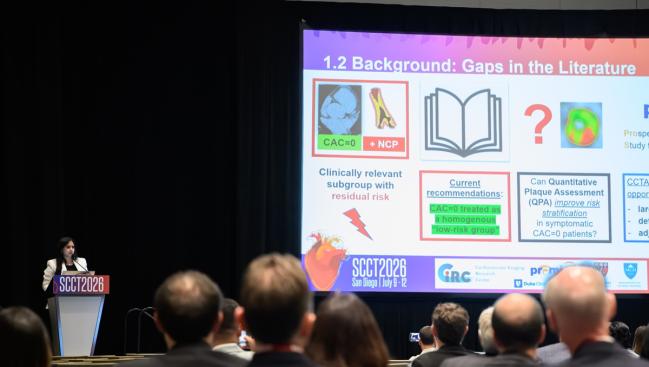
Photo Credit: SCCT
CHULA VISTA, CA—With the proliferation of costly but effective advances in plaque assessment, debate flared anew at the recent 2026 Society of Cardiovascular Computed Tomography meeting about whether coronary computed tomography angiography (CCTA) with quantitative plaque assessment (QPA) should be used to better risk-stratify patients who have stable chest pain but no coronary artery calcium (CAC).
New data presented in the conference’s Best Original Science session indicate that 12% of symptomatic patients with zero CAC in the PROMISE trial had noncalcified plaque on CCTA , which put them at a sixfold higher risk of MACE over a median of 25 months.
Researcher Sara Ersözlü, MD (Massachusetts General Hospital, Boston, MA), told TCTMD that she doesn’t want to see individuals thought to be protected by their zero CAC—the so-called “power of zero”—fall through the cracks.
“I’ve seen patients that were missed because of [their] calcium score of 0—young patients who do have a heart attack,” she said. “And once you experience that, you don’t want to miss them ever again.”
The most recent US dyslipidemia guidelines strengthened recommendations for CAC scoring, and last year the American Heart Association issued a scientific statement urging more nuance in caring for patients with nonobstructive disease—including advice to start statin therapy in patients with CAC considered stage 1 (low risk) or stage 2 (intermediate risk) and adding aspirin for those considered stage 3 (high risk).
“But nobody is stratifying by . . . a CAC of zero,” Ersözlü said. “The recommendations right now are only based on CAC scoring or on total plaque volume. . . . We’re thinking that you need to put the CAC-zero patients also on the map—do assessment of quantitative plaque and then you can most likely downgrade them to truly low risk, which is amazing [and] which I call the power of zero plaque.”
From there, she continued, “we can really look into these 12% of patients who are at higher risk. We can reassure all those who don’t [have plaque] and just do our rescan in 5-7 years as per recommendations. And the others could be treated just as patients with a CAC above zero. The bottom line is the reassurance that we have from the power of zero is not really strong and we need to make a bigger effort to also treat these patients with preventive measures.”
The reassurance that we have from the power of zero is not really strong. Sara Ersözlü
However, Khurram Nasir, MD, MPH (Houston Methodist DeBakey Heart & Vascular Center, TX), advocated for taking a step back before sending all these patients for QPA.
“Firstly, it is well known that zero CAC does not guarantee zero risk,” he told TCTMD. “Higher risk factor burden is linked to relatively higher risk even among asymptomatic subjects with zero CAC. We have shown that even in our original ‘power of zero’ paper. And therefore, it is not surprising to see such signals in these data. There is always going to be minimal residual risk in a CAC-zero group.”
Nasir said that the more important questions surround “how much risk is it, how often is the result seen, how predictive is it, and whether additional testing, costs, and consequences are needed.” For example, in PROMISE, the 1.2% total event rate was “minimal,” with the trial’s original authors cautioning against further testing in patients with no CAC, he said.
PROMISE Data
For the study, Ersözlü and colleagues included 3,722 patients from PROMISE who were evaluated with CCTA and QPA, including 40% with a CAC score of 0.
In the zero-CAC group, the 12% of patients with noncalcified plaque were slightly older (mean age 58.4 vs 57.9 years), less often female (51% vs 65%), and less often of white race (76% vs 81%) compared with those without plaque. The patients with both CAC and noncalcified plaque were generally older (mean age 62 years), male (57%), and white (87%). Compared with both zero-CAC groups, they had greater risk of atherosclerotic cardiovascular disease (ASCVD) and a greater comorbidity burden.
The rate of stenosis of at least 50% was 1.1% in the overall PROMISE cohort with zero CAC. But this was substantially higher in those with noncalcified plaque regardless of whether they had CAC or not (22% vs 9%).
The primary endpoint of MACE—defined as all-cause death, nonfatal MI, or hospitalization for unstable angina—was substantially higher for those with than without CAC (3.9% vs 1.2%; P < 0.001).
However, when plaque was considered, the rates of MACE were comparable for those with noncalcified plaque regardless of whether CAC was absent or present (4.5% vs 3.9%; P = 0.687), with the MACE rate falling to 0.8% for those with no CAC and no plaque. Over a median follow-up period of 25 months, this translated to a trend toward higher risk with increasing total plaque volume. These findings also were similar for the composite endpoint of CV death, nonfatal MI, or unstable angina.
On Cox regression analysis, zero-CAC patients who had noncalcified plaque were almost six times more likely to experience MACE compared with those who lacked noncalcified plaque (HR 5.93; 95% CI 2.34-15.03), though this finding was slightly attenuated when factoring in CCTA measurements, ASCVD risk based on the pooled cohort equations, and baseline statin and aspirin use. Further, there were no differences in risk when comparing patients who had noncalcified plaque with and without CAC, independent of ASCVD risk, baseline statin and aspirin use, significant stenosis, and high-risk plaque features.
Among zero-CAC patients with noncalcified plaque, the risks of MACE increased with total plaque volume as well as the presence of obstructive stenosis of at least 50% (P for trend < 0.001 for both). In a net reclassification improvement analysis, noncalcified plaque volume provided the ability to predict events comparable to total plaque volume, beyond the presence or absence of CAC, Ersözlü reported.
A Question of Cost and Value
The numbers used in this analysis are important, Nasir argued. Ersözlü’s study included 1,476 individuals with no CAC, including 12% with noncalcified plaque, with only 18 events (1.2% of the total) occurring in those with zero CAC, he said.
“Likely 10 out of 18 events (55%) were zero-CAC with no noncalcified plaque. Therefore, one can say: ‘No [noncalcified plaque] is not zero risk.’ Eight out of 18 events (45%) were zero-CAC with noncalcified plaque. The absolute number of events is small, and this is why the wide confidence intervals for hazard ratios are observed.”
It’s clear that the presence of noncalcified plaque in this group is “infrequent,” Nasir continued. “Even with the presence of noncalcified plaque, its predictive value is low. . . . Therefore, the question is not just whether noncalcified plaque allows stratifying CAC-zero patients—it does. The question is whether it is worth to pursue and where to draw the line.”
In another session during the conference, Nasir debated this very issue. The true value of CTA versus CAC scoring comes down to cost, he argued.
Using data from the Swedish CardioPulmonary BioImage Study (SCAPIS), Nasir estimated that slightly more CAC scans than CCTAs are needed to find a single person with a positive test who will have an event (86.6 vs 83). However, the cost differential is about $24,500—3.83 times greater—for CCTA. “Of course, you find 12.5 more events . . . over the next 10 years. But that’s going to cost you nearly $600K,” he said. Beyond what’s available in cash-strapped lower-income countries, Nasir added, “I think we can’t even afford this in the US.”
Adding QPA adds a whole new layer of cost, with a current price tag of about $1,000 beyond the $400 for CCTA, according to Nasir. “This translates into the cost of detection of one noncalcified-plaque-positive patient who will have an event as $280,000, excluding the downstream tests, incidental findings, anxiety, or treatment escalation,” he said. “And not every treated patient will be saved from the event. Those are just facts.”
Even someone driving a Volvo SUV with two airbags [and] two seatbelts at 25 miles per hour can get into an accident. Khurram Nasir
Ultimately, the field needs to weigh total cost, access, downstream testing, and other opportunities for these resources, Nasir said. “I’m not denying the technology, . . . the depth of information, and what it does: FFR, [fat attenuation index], plaque, all of the things.”
Rather, he said, it’s a question of value.
“Also, I would caution, that if this approach is taken out of context, it can be misleading.” Nasir warned against thinking that no plaque means no risk, “because more than half of the events happened in CAC-zero patients without noncalcified plaque. . . . Even someone driving a Volvo SUV with two airbags [and] two seatbelts at 25 miles per hour can get into an accident. It cannot be used as a justification for universal advanced and costly imaging in this well-established lower-risk group.”
Finally, he stressed that the findings here cannot be extrapolated to an asymptomatic lower-risk cohort.
Ersözlü agreed that the cost of QPA is “too high at the moment,” but predicted that this will come down as it becomes more integrated into practice. “We see all these solutions by different vendors, so there is big competition,” she said. “Studies like this can put it on the map, and that can also drive how we are dealing [with it] in our healthcare system.”
More trials with more patients and longer follow-up, as well as outcomes data, are needed in this field, Ersözlü said, adding that this study “is giving us enough information to say that it’s worth looking into it.”

Yael L. Maxwell is Senior Medical Journalist for TCTMD and Section Editor of TCTMD's Fellows Forum. She served as the inaugural…
Read Full BioSources
Ersözlü S. Quantitative plaque assessment reclassifies risk in patients with stable chest pain and zero coronary artery calcium score. Presented at: SCCT 2026. July 11, 2026. Chula Vista, CA.
Nasir K. Should we screen asymptomatic patients with coronary CT (angiography)? Presented at: SCCT 2026. July 11, 2026. Chula Vista, CA.
Disclosures
- Ersözlü reports no relevant conflicts of interest.
- Nasir reports serving on advisory boards for Novartis, Amgen, Novo Nordisk, and Esperion; serving as a consultant to Corsera Health; and receiving research funding from NIH, PCORI, American Heart Association, Esperion, Novartis, and Ionis.
Related News


Comments