No Difference in QoL When PCI Deferred Until After TAVI: PRO-TAVI Subanalysis
It’s “another piece to the puzzle” showing the strategy is safe and improves well-being in these patients, says Julia Mascherbauer.

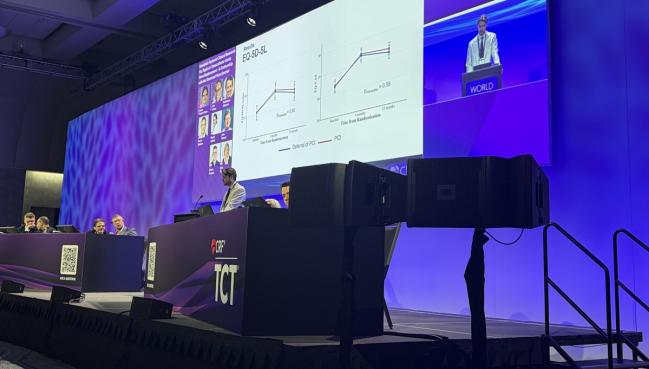
SAN DIEGO, CA—Deferring PCI until after TAVI in patients with both coronary artery disease and aortic stenosis does not negatively impact quality of life (QoL) at 1 year, according to a subanalysis of the PRO-TAVI trial.
On measures of mobility, self-care, usual activities, pain or discomfort, and more, no differences were observed between the group randomized to undergo PCI first and patients who waited until after the TAVI had been performed.
“Both strategies were associated with a significant improvement up to 1 year after randomization in quality-of-life and angina questionnaire scores,” said Gijs Matthias Broeze, MSc (Amsterdam University Medical Center, the Netherlands), in a presentation here at TCT 2026. “Combined with less major bleeding events, which were observed in the deferral of PCI group in the primary trial, these two findings support the strategy of PCI deferral in patients undergoing TAVR.”
Presented earlier this year at the American College of Cardiology 2026 Scientific Session, the main PRO-TAVI trial found no differences in the primary composite endpoint of all-cause mortality, MI, stroke, or major bleeding at 1 year in those assigned to undergo PCI before TAVI compared with those assigned to wait (P = 0.0008 for noninferiority).
“To me, this is all very conclusive,” said discussant Julia Mascherbauer, MD (University Hospital Sankt Pölten, Austria).
She noted that the subgroup analysis adds “another piece to the puzzle” showing that this strategy is safe and improves patient well-being, at least in intermediate-risk patients, given that those with unprotected left main disease were excluded.
“In those patients that are normally presenting to us [at] 85 years of age, on average, with stable coronary artery disease, it is more and more obvious that routine PCI does not add to their outcome, but it does add to the costs, is resource consuming, and [confers] a risk to the patient,” Mascherbauer added.
QoL Measures Assessed
For the trial, the researchers randomized 466 patients (median age 81 years; 36% female) at 12 Dutch centers between 2021 and 2024. They were assigned to undergo PCI first (n = 233) or to wait (n = 233). Patients had a median STS-PROM of 3.1% and a median SYNTAX score of 10. More than 50% had proximal lesions and approximately 60% of patients had a coronary lesion with ≥ 90% stenosis. Only 11% of those in the deferred arm ended up receiving PCI within the 1-year study period, after a median 87 days post-TAVI.
On the EQ-5D-5L, which tracks quality of life across five domains (usual activities, anxiety/depression, mobility, pain/discomfort, and self-care), both groups saw an increase from baseline to 4 months, and that was sustained out to 12 months with no differences (P = 0.92 for interaction). Similarly, for the quantitative EQ-VAS score of overall health, there was an increase in both groups at 4 months that was maintained through 12 months (P = 0.58 for interaction).
Physical component scores, measured by the SF-36 PCS, also followed the same trajectory (P = 0.75 for interaction), as did mental component scores measured by the SF-36 MCS (P = 0.69 for interaction).
Lastly, the Seattle Angina Questionnaire (SAQ) summary score did not deviate from the other results, with similar increases seen in both groups at 4 months that were sustained out to 12 months (P = 0.86 for interaction).
Ronak Delewi, MD, PhD (Amsterdam University Medical Center), lead author of the main PRO-TAVI study and a panelist in the session, said in her daily practice she now sees no reason to routinely perform a PCI before TAVI.
“I think we’re exposing the patients to too much risk and they can get hemodynamic deterioration during the PCI, so I do feel with all the data we have now that we can safely defer and first perform the TAVR and then see how the patient is doing,” she added.
Co-moderator Steven J. Yakubov, MD (OhioHealth Riverside Methodist Hospital, Columbus), pointed out that many physicians may wonder what to expect in terms of clinical presentation beyond 12 months in these patients with a median age of 81, and he questioned whether deferring PCI in the elderly creates more of a challenge than dealing with it earlier.
Broeze said these points are well taken, adding, “I think we really have to look forward to more results of longer follow-up in this trial to be able to solve those sorts of problems.”

L.A. McKeown is a Senior Medical Journalist for TCTMD, the Section Editor of CV Team Forum, and Senior Medical…
Read Full BioSources
Broeze GM. Impact of deferral of PCI on quality of life and angina in patients undergoing TAVR: a PRO-TAVI substudy. Presented at: TCT 2026. October 31, 2026. San Diego, CA.
Disclosures
- Broeze and Mascherbauer report no relevant conflicts of interest.
- Yakubov reports receiving consulting fees/honoraria/speaking fees from Medtronic and grant support/research contracts from Boston Scientific and Medtronic.
- Delewi reports receiving grant support/research contracts from Abiomed, Boston Scientific, Edwards Lifesciences, Meril Life, and Medtronic.
Related News



Comments