Nurse-Led Care Model Optimizes Outcomes in HFrEF: TIME-HF
It’s unclear if individual parts of the intervention or the integrated approach itself contributed to improvement over usual care.

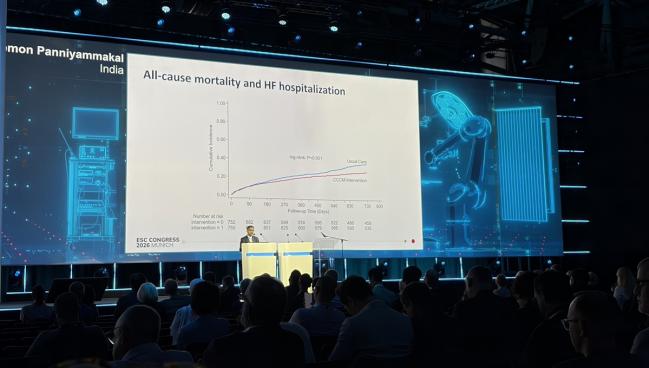
MUNICH, Germany—A nurse-led collaborative care model (CCM) that incorporates mobile health data can increase the number of days alive and out of the hospital in patients who have heart failure with reduced ejection fraction (HFrEF), the TIME-HF study found.
In the India-based RCT, patients in the intervention group had access to pharmacological optimization, nurse-coordinated mobile health (mHealth) support, self-care education, active follow-up, and continuous outpatient monitoring throughout the study. In addition to the nearly 8% increase in the number of days alive and out of the hospital (P = 0.042) compared with the usual-care group, those randomized to the intervention also had a 22% lower risk of death at 24 months (P = 0.028).
“It’s a model ready for wider adoption, not only in Indian settings, but outside Indian settings, especially in the low-resource, low- and middle-income country settings,” said Panniyammakal Jeemon, PhD (Sree Chitra Tirunal Institute for Medical Sciences & Technology, Thiruvananthapuram, India), in a media briefing prior to his presentation at the European Society of Cardiology Congress 2026. The findings were simultaneously published in Circulation.
Notably, nearly 60% of the trial participants lived in rural areas.
To TCTMD, Jeemon said a benefit of the intervention was that it cut down on unnecessary travel to meet with a cardiologist. The nurse-led management allowed for prompt and real-time answering of questions and concerns, triaging which patients needed to be seen in person.
“One of the preconditions is that all the patients should have access to a smartphone, otherwise it’s very difficult to implement this,” he added. “So that’s one of the [potential] limitations in low- and middle-income country settings.”
Jeemon added that the median survival time for patients with HFrEF in India is only about 3.2 years, fueling the need for initiatives to improve quality of care. Additionally, he said there is widespread underuse of guideline-directed medical therapy (GDMT).
Gerasimos Filippatos, MD (National and Kapodistrian University of Athens, Greece), the discussant for the trial, agreed that the need for interventions to increase life expectancy of patients with HF in India is great. An analysis of the REPORT-HF registry found that only one in six patients receive in-hospital GDMT in India, he further noted. That analysis also showed that the 1-year mortality rate after a HFrEF diagnosis was over 17%.
“It’s a nurse-led CCM with remote monitoring, but also there is always the possibility to involve other experts like dieticians, physiotherapists, and psychologists. So, this is a demanding program,” Filippatos said of the TIME-HF intervention. “Even for heart failure clinic networks, at least in ours and in many others, this would be applied in only high-level heart failure units.”
Still, he said the study helps to answer the question of how to remove some barriers to GDMT optimization and adherence in this population, especially in low-resource areas.
TIME-HF Results
The cluster-randomized controlled trial included 1,507 patients (mean age 61.9 years; 22.4% women) with HFrEF who were enrolled shortly after diagnosis and before discharge from 22 hospitals in India. Those in the usual-care group continued to receive routine medical management from their treating physicians, while those in the intervention group had access to the mHealth app, which allowed for real-time patient communication and collection as well as updating of clinical data for risk stratification. Patients could log warning signs, symptoms, and other key clinical information.
“[With] the blood pressure, the pulse, the heart rate, the weight, and also some of the symptoms like breathlessness, there are different scales and [patients] can feed in that information into the mHealth application and that gets an alert to the nurses if it is out of range,” Jeemon told TCTMD.
Nurses also applied standardized risk assessment tools to classify patients’ short- and long-term risk profiles and used that to prioritize follow-up intensity and to individualize care plans. The intervention group received structured counseling on diet and nutrition, tobacco and alcohol cessation, graded physical activity planning, and strategies to improve medication adherence. Behavior changes were supported with educational materials and goal-setting techniques.
Scheduled follow-up visits took place every 3 months for all patients, but those in the intervention group were offered an extra appointment within 15 days of discharge that was intended to support medication adherence and initiate early optimization of GDMT. The extra visit was conducted either in person or via telephone consultation.
At discharge, 12 months, and 24 months, GDMT use was consistently higher in the intervention group than in the usual care group. By 24 months, 64.6% of participants in the intervention group and 58.6% in the usual-care group were adherent to triple GDMT therapy (P = 0.270), while 37.3% and 22.1%, respectively, were adherent to quadruple GDMT therapy (P < 0.001).
Patients in the intervention arm had more adverse safety events than those in the usual-care arm, particularly those receiving quadruple therapy. Among these events were systolic blood pressure < 95 mm Hg, reductions in kidney function, hyperkalemia, and low heart rate.
Technology Extends Reach of Surveillance
In an accompanying editorial, Rajeev Gupta, MD, PhD (Eternal Heart Care Centre & Research Institute, Jaipur, India), notes that fewer than half of all eligible patients were recruited for the study, which limits the external validity of the evidence. Furthermore, while adherence rates are significantly higher in the intervention group than usual care, they are lower than the 80% recommended by most guidelines, Gupta says.
“Adherence to the optimum dose is an important component of GDMT, but in the present study, more patients are at the lower end of the dosage spectrum,” he writes. “The influence of social and commercial determinants on outcomes has also not been studied, and this is also a study limitation. For example, the authors have not reported [a] cost-effectiveness analysis and [the] economic burden on the healthcare system of the present intervention. A high cost could dissuade policymakers from adopting this intervention in resource-constrained settings in India and lower-middle and low-income countries.”
An additional editorial by Lisa A. Kitko, PhD, RN (University of Rochester School of Nursing, NY), says it’s unclear whether optimization of GDMT, individual components, or integration of various functions of the TIME-HF intervention mediated the reductions seen in hospital stay and mortality.
“Technology can extend the reach of surveillance, but nurses and collaborative teams transform information into care,” Kitko notes. “Nursing science must now define the mechanisms, resources, and contextual conditions required to reproduce these outcomes equitably and sustainably across healthcare systems.”
According to Jeemon and colleagues, TIME-HF fits with other successful interventions such as STRONG-HF in demonstrating structured methods for improving GDMT uptake in patients with HF at a crucial timepoint in their care management.
“Together, these studies highlight the continuing gap between evidence and practice in HF care and suggest that a combination of early intensive optimization and sustained, low-cost nurse-led follow-up may be needed to improve long-term uptake of evidence-based therapies and clinical outcomes,” they add.

L.A. McKeown is a Senior Medical Journalist for TCTMD, the Section Editor of CV Team Forum, and Senior Medical…
Read Full BioSources
Jeemon P, Ganapathi S, Anikkady N, et al. Effectiveness of nurse-coordinated, digital-supported collaborative care model in reducing hospital stay and mortality among patients with heart failure: TIME-HF cluster RCT India. Circulation. 2026;Epub ahead of print.
Gupta R. Multimodal collaborative care for heart failure in resource-limited settings. Circulation. 2026;Epub ahead of print.
Kitko LA. Advancing the science of nurse-led collaborative care in heart failure. Circulation. 2026;Epub ahead of print.
Disclosures
- Jeemon reports research grants from the National Heart, Lung, and Blood Institute, the Aus¬tralian National Health and Medical Research Council, the World Diabetes Federation, the National Institute for Health and Care Research, and the Indian Council of Medical Research.
- Filippatos, Gupta, and Kitko report no relevant conflicts of interest.
Related News



Comments