POET II Supports Shorter Antibiotic Course in Infective Endocarditis
(UPDATED) Compared with standard treatment, an abbreviated regimen was associated with more relapses but didn’t compromise safety.


MUNICH, Germany—Tailoring the duration of antibiotics in left-sided infective endocarditis by how well patients respond to therapy could allow them to safely stop taking it much earlier than currently recommended, according to data from the POET II trial.
The primary safety endpoint of all-cause mortality, unplanned heart valve surgery, or symptomatic embolic events within 6 months was 8.2% in patients who, based on response, discontinued antibiotics after a median of 26 days and 10.7% in those who remained on standard therapy for a median of 41 days (noninferiority P < 0.001). The shortened duration is equivalent to about one-third less treatment time.
In the earlier POET trial, investigators had shown that patients with left-sided infective endocarditis could be treated safely and effectively with step-down oral antibiotics once they had met clinical stabilization criteria on a course of high-dose intravenous therapy.
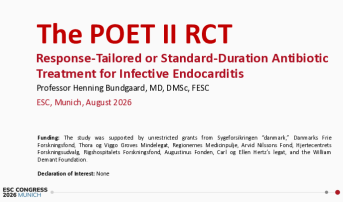
“It seems that from POET I and POET II we have challenged dogmas showing that less intensive antibiotic therapy after stabilization is superior and safe,” said Henning Bundgaard, MD, DMSc (Copenhagen University Hospital, Denmark), during a press conference here at the European Society of Cardiology Congress 2026. “And we think that defining the stabilization point is a kind of personalizing endocarditis treatment.”
During his presentation, Bundgaard said the POET II investigators believe that around 50% of patients with endocarditis may be candidates for tailored antibiotic treatment.
The new study was simultaneously published in the New England Journal of Medicine.
POET II
The POET II trial was conducted at 13 sites in Denmark, Sweden, and the United States and consisted of 508 patients (mean age 70 years; 25% women) with infective endocarditis due to streptococcus species (57.3%), Staphylococcus aureus (24.2%), or Enterococcus faecalis (18.5%). While not inclusive of all pathogens that cause infective endocarditis, these three are generally considered responsible for about 70% of all cases, Bundgaard and colleagues note.
Prior to randomization, all received antibiotic therapy for a minimum of 2 to 4 weeks and were considered by the investigators to have met the study criteria for clinical stabilization. A total of 253 patients were randomized to standard therapy for 4 to 6 weeks while 255 were randomized to the response-tailored therapy arm and immediately discontinued antibiotics.
At 6 months, the median number of days alive without antibiotic treatment (primary efficacy endpoint) was 183 in the tailored-response arm and 169 in the standard therapy arm (P < 0.001 for superiority).
Death from any cause occurred at rates of 5.1% and 4.3% in the response-tailored and standard-therapy arms, respectively (HR 1.18; 95% CI 0.53 to 2.63). Rates of unplanned cardiac surgery were 2% and 4% (HR 0.49; 95% CI 0.17 to 1.45), and rates of symptomatic embolic events were 2.4% and 3.2% (HR 0.75; 95% CI 0.26 to 2.15).
When the outcomes were analyzed by infectious pathogen, streptococcal infection and S. aureus infection favored the response-tailored strategy, while E. faecalis infection favored the standard-duration regimen.
Approximately 5% of patients in the response-tailored arm had relapse of bacteremia or infective endocarditis with the primary pathogen compared with 1.6% in the standard therapy arm (P = 0.04), with the median times to relapse being 28 days and 74 days, respectively. The majority of relapses were assessed as uncomplicated native-valve infection not requiring surgery and were treated by resuming antibiotic therapy. By infectious agent, relapse rates were 6.4% in those with E. faecalis, 3.3% in those with S. aureus, and 2.4% in those with streptococcus species.
When relapse was added to the primary safety endpoint, the results remained consistent with the main analysis. The same was true when patients who had received treatment for concomitant extracardiac infections were excluded.
“The findings appeared to be consistent across prespecified subgroups, including those defined according to the type of valve involved in infective endocarditis (native or prosthetic), treatment (medical or surgical), and certain concurrent conditions,” Bundgaard and colleagues write.
They add that the higher likelihood of relapse with tailored-response therapy should be weighed amid potential benefits of reducing antibiotic exposure.
“A shorter course of antibiotic therapy may reduce the risk of adverse drug effects, healthcare-associated complications, antimicrobial resistance, and costs and may improve quality of life by reducing the physical and psychological toll associated with prolonged antibiotic treatment and hospitalizations,” the investigators note.
Following the presentation, discussant Gilbert Habib, MD (Hospital La Timone of Marseille, France), said despite some limitations, including the need for more information on the strict clinical stabilization criteria used in the study, the balance favors the shortened antibiotic course.
“My opinion is yes, it is a positive study, and antibiotic therapy for endocarditis should move from the fixed-duration therapy to [a] personalized, tailored treatment decision, but in selected patients and in selected centers with high specialization in the field of endocarditis,” he said.
The stabilization criteria consisted of: a temperature < 100.4°F for 2 days or more, a C-reactive protein level of < 50% of peak and < 40 mg/L, a white blood cell count of < 10 x 109/L, procalcitonin < 0.5 ng/mL, no progression on transesophageal echocardiography within 48 hours of randomization, and no further cardiac surgery planned.
As for the higher frequency of relapses in the tailored-response arm, Habib said the lack of a clinical consequence is reassuring overall. However, he noted that for patients with E. faecalis infection driving the endocarditis, the POET II results suggest using caution when selecting a management strategy for this group since they may be at greater risk of relapse on a shortened antibiotic course.

L.A. McKeown is a Senior Medical Journalist for TCTMD, the Section Editor of CV Team Forum, and Senior Medical…
Read Full BioSources
Bundgaard H, Pries‑Heje M, Hjulmand J, et al. Response-tailored or standard-duration antibiotic treatment for infective endocarditis. N Engl J Med. 2026;Epub ahead of print.
Disclosures
- The study was supported by unrestricted grants from Sygeforsikringen “danmark,” Danmarks Frie Forskningsfond, Thora og Viggo Groves Mindelegat, Regionernes Medicinpulje, Arvid Nilssons Fond, Hjertecentrets Forskningsudvalg, Rigshospitalets Forskningsfond, Augustinus Fonden, Carl og Ellen Hertz’s legat, and the William Demant Foundation.
- Bundgaard reports no relevant conflicts of interest.
Related News



Comments