PROGRESS: TAVI Is Effective, Safe in Moderate AS With At-Risk Features
The trial is “a turning point” in the management of moderate AS, says Philippe Généreux, adding that the disease is not benign.

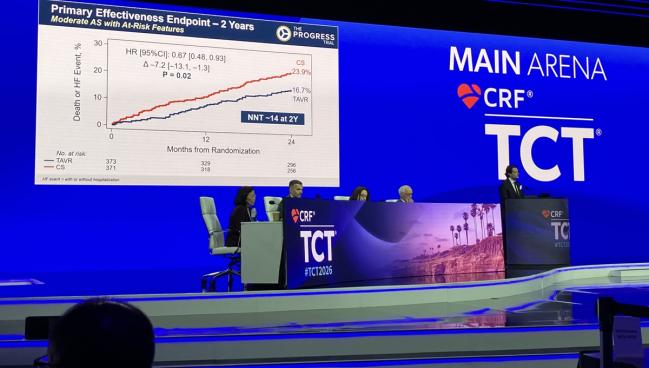
SAN DIEGO, CA—Patients with moderate aortic stenosis (AS) and at-risk features do better over 2 years of follow-up when they are treated with TAVI rather than being managed with routine clinical surveillance, the PROGRESS trial shows.
The proportion of patients who died from any cause or had a heart failure (HF) event—the primary endpoint—was 16.7% in the TAVI group and 23.9% in the surveillance group (HR 0.67; 95% CI 0.48-0.93). That difference was primarily related to a 52% lower relative risk of HF hospitalization in the intervention arm (7.4% vs 14.9%; HR 0.48; 95% CI 0.30-0.77), with no significant impact on all-cause death.
Moreover, TAVI-treated patients had greater gains in quality of life, lead investigator Philippe Généreux, MD (Morristown Medical Center, NJ), reported at TCT 2026 on Monday. The findings were simultaneously published online in the New England Journal of Medicine.
Importantly, the benefits of TAVI were accompanied by favorable safety. By 30 days, no TAVI patients had died or experienced disabling stroke.
“We break the wall of severe [AS] and we show that there is a clear benefit of treating moderate AS with at-risk features with TAVR in the first 2 years,” Généreux told TCTMD, adding that intervening “will prevent a deterioration in quality of life and clinical status.”
The biggest takeaway from the trial, he added, “is that moderate AS is not benign.” He said these patients should be sent to a valve clinic with experts who can comprehensively assess their AS and choose an optimal management strategy.
Surgeon Tsuyoshi Kaneko, MD (Washington University in St. Louis School of Medicine, MO), chair of the American College of Cardiology’s cardiac surgery member section, commented to TCTMD that PROGRESS is “a little bit different from some of these TAVR versus SAVR trials that are ongoing.
“It’s focused more on the disease process,” he explained. “So, rather than comparing the therapy effectiveness, it is actually looking at whether the therapy is effective for certain diseases. For cardiac surgeons, it is exciting research.”
During a TCT press conference, Pinak B. Shah, MD (Mass General Brigham, Boston, MA), called PROGRESS a “practice-changing study” that “really underscores the importance of a close follow-up” in these patients.
“The nice thing here is that we have a device that is durable,” he said. “I think this will be a very reasonable strategy for patients with moderate AS.”
Durability has been an ongoing question as TAVI is increasingly used in lower-risk and younger patients with severe AS. Results thus far have been reassuring, but the field continues to await long-term follow-up.
The PROGRESS Trial
Out of a total of 1,294 patients screened for the trial, 550 (42.5%) were excluded, most commonly because they either didn’t have moderate AS or had unsuitable anatomy for TAVI. The remaining 744 patients were randomized to early transfemoral TAVI (mean age 78.5 years; 38.1% women) or clinical surveillance (mean age 78.3 years; 40.2% women). Baseline characteristics were similar in the two groups. Mean STS score was about 3% and about 45% of patients were considered low risk by a heart team. More than one-third had NYHA class III/IV symptoms.
When looking at the individual components of the composite effectiveness endpoint, rates of all-cause death were similar in the TAVI and surveillance patients (8.4% vs 7.3%; HR 1.14; 95% CI 0.67-1.93), but HF events with or without hospitalization were less frequent in the TAVI group (10.8% vs 19.0%; HR 0.55; 95% CI 0.37-0.81).
The primary 30-day safety endpoint was a composite of death, stroke, life-threatening bleeding, stage 4 acute kidney injury, hospitalization due to device- or procedure-related complications, or valve dysfunction leading to reintervention. At 5.9%, the event rate came in significantly below the performance goal of 13.7% (P < 0.001), with the most common event being hospitalization related to complications (5.6%).
“A very important point is that TAVR in moderate aortic stenosis was safe, it’s the first time we demonstrated 0% mortality and 0% disabling stroke at 30 days. That’s very reassuring because we’ve never been there before,” Généreux told TCTMD.
In the clinical surveillance group, 57.4% of patients underwent aortic valve replacement within 2 years, mostly for guideline-recommended class 1 indications (81.4%).
Généreux highlighted that TAVI patients had better quality of life and health status than did those randomized to watchful waiting, with a higher proportion of patients being alive with an improvement of at least 10 points on the Kansas City Cardiomyopathy Questionnaire (KCCQ) at 1-year and 2-years follow-up (39.0% vs 23.2%; P < 0.001).
Patients in the PROGRESS trial will be followed for up to 10 years.
Applications for Tomorrow
Stephan Windecker, MD (Bern University Hospital, Bern, Switzerland), lead discussant after Généreux’s presentation, highlighted the symptomatic, at-risk, elderly patient population in PROGRESS. The most prevalent at-risk feature was the presence of NYHA class II or worse symptoms (96.4%), followed by diastolic dysfunction (43.8%), an elevated aortic valve calcium score (25.7%), and an LVEF < 60% (25.0%).
The results should encourage clinicians to ditch the binary “severe versus nonsevere AS” diagnosis, Windecker argued, saying that AS should be evaluated based on a multi-dimension assessment of the risk continuum from moderate to severe AS.
Speaking with TCTMD, Généreux said that if practice does change in response to the trial findings, several factors are reassuring. For one, PROGRESS took place at 74 centers across six countries, “ so it was a very, I will say, diverse spectrum of operators.” Moreover, he added, “ I think TAVR has reached a point where it’s a very simple procedure.”
TAVI for moderate AS must now go through the regulatory process before earning US Food and Drug Administration approval, “but what [physicians] can do tomorrow is send their patient with moderate AS to a valve clinic,” Généreux urged. Some patients thought to have moderate AS with further examination are found to have severe AS, he explained.
PROGRESS provides evidence that argues for rethinking previous dogma, said Généreux. “It's a turning point in the history of management of aortic stenosis in terms of awareness of the disease.”
In an editorial accompanying the NEJM paper, Catherine M. Otto, MD (University of Washington School of Medicine, Seattle), notes the importance of recognizing the characteristics of the patients who were enrolled in PROGRESS. She writes that the patients “were atypical” since “moderate aortic stenosis does not usually cause symptoms or left ventricular dysfunction.”
She says that “clearly, TAVR is not appropriate for most adults with moderate aortic stenosis; however, the findings from this trial suggest that it may be considered in selected older patients with coexisting conditions at high risk of adverse outcomes when other treatment approaches are not effective. Confirmatory studies, longer follow-up intervals, data on valve durability, and cost-value analyses are needed.”
It’s important to note that this patient population was specific to moderate AS with at-risk features, Généreux told TCTMD, pointing out that a large number of patients in the moderate-AS population have such characteristics.
Patients are of course enrolled in clinical trials based on specific selection criteria, and “in this particular study, it was meant for TAVR-suitable-anatomy patients,” said Kaneko.
Kaneko said that treatment of aortic valve disease is nuanced, adding that these results are very exciting because they expand the pool of patients who might benefit from treatment.
“I think the one-liner of, ‘Moderate aortic stenosis should be treated with AVR,’ is probably a little bit of a bold statement. I think some of the population will certainly benefit. . . . In those selected patients, I think the effect will be tremendous,” Kaneko said.
Implications for Surgery?
Kaneko predicted that, based on what’s known about the effectiveness of aortic valve replacement, SAVR will have similar effects in the moderate population. He noted that the risks presented by TAVI are more related to patient anatomy, whereas the risks with surgery are more related to comorbidities.
“If you flip it, if the patient’s comorbidities are low, and if we think that the patient can tolerate the procedure with very low risk, and [the patient] has moderate aortic stenosis that is symptomatic or is cardiac damage, and has an anatomy that is not really great for TAVR—say, for instance, really calcified bicuspid valves—they will not benefit from TAVR even if they have moderate aortic stenosis,” he said.
Such patients were excluded from the PROGRESS trial and would likely “not have the best results with TAVR,” but likely would fare better with SAVR, Kaneko said.

Bailey Salimes is a Medical Journalist at TCTMD. Prior to CRF, she was at MedStar Health Research Institute in Washington…
Read Full BioSources
Généreux P. The PROGRESS trial: TAVR or clinical surveillance for moderate AS with at-risk features. Presented at: TCT 2026. November 2, 2026. San Diego, CA.
Disclosures
- Généreux discloses consulting fees for Abbott Vascular, Cardiawave, Egnite, EchoIQ, Edwards Lifesciences, Haemonetics, Medtronic, Pi-Cardia, Puzzle Medical Inc., Spiralis Medical, 4C Medical, Shockwave Medical, Antegrade Medical; and equity in Puzzle Medical Inc., Pi-Cardia, Antegrade Medical, Spiralis Medical, Echo IQ, Cardiawave, Sparrow Biocoustics. He is the Principal Investigator in the EARLY TAVR trial, PROGRESS trial, ECLIPSE trial, 4C Feasibility trial, and ACTIVATE AS.
- Kaneko reports being on an advisory board for Edwards, Abbott, Anteris, and 4C medical; and he is a consultant for Medtronic and Artivion.
Related News


Comments