PROMISE III: Deep Vein Arterialization Reduces Pain at 1 Year
While many operators had never done the procedure, pain scores improved, as did wound healing, with a high limb salvage rate.

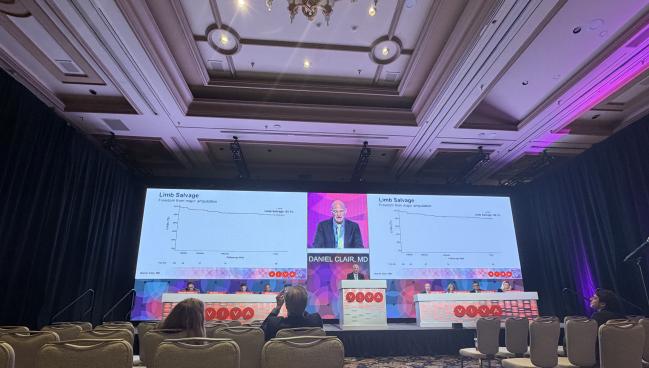
LAS VEGAS, NV—Even among a group of operators who have never used the technique before, transcatheter arterialization of the deep veins (TADV) results in high rates of limb salvage and survival at 1 year in extreme “no-option” patients with chronic limb-threatening ischemia (CLTI), according to results of the PROMISE III trial.
PAD severity and pain scores also improved significantly with TADV, which involves diversion of blood flow through arterialization of deep veins in the foot. What makes the procedure unique is that it leverages healthier veins in the leg as conduits to deliver oxygenated blood to the distal venous tissue.
“There clearly is a subset of patients with CLTI who face poor outcomes because of the vascular anatomy within their feet. They have high rates of mortality and major amputation, and the amputation-free survival can be as low as 40% or lower in this patient population,” said Daniel Clair, MD (Vanderbilt University Medical Center, Nashville, TN), in a presentation recently during a late-breaking trial session at VIVA 2026. “This is a patient population that has high rates of limb loss without something being done, but this technique has shown good rates of limb salvage and amputation-free survival, and this is really the only system purpose-built for this procedure.”
In earlier trials, including PROMISE I and PROMISE II, the novel technique had sustained limb-sparing benefits out to 2 years, even among highly comorbid CLTI patients deemed ineligible for conventional endovascular or surgical revascularization.
Clair explained that PROMISE III sought to expand the use of the procedure and to ensure that most patients could be discharged home rather than to another care facility.
“Half of these sites [involved] new operators, and there are continued improvements in patient selection, procedural techniques, and follow-up and wound care that I think are continuing to show improving outcomes with this technique,” he added.
Highly Comorbid Population
PROMISE III enrolled 100 patients (median age 71 years; 27% women; 16% Black) from 24 sites in the United States. All patients had nonhealing ulcers or gangrene, with about three-quarters of patients deemed Rutherford class 5 and one-quarter deemed Rutherford class 6. The mean pain score was 6 (range 0-10), the mean duration of a nonhealing wound was 5.4 months, and 63% of patients had a mean Society for Vascular Surgery Wound, Ischemia, foot Infection (WIfI) classification score of 3 (scale 0-3). Additionally, 86% of treated limbs had already been treated at least once with a prior revascularization.
Hypertension was present in 95% of patients, diabetes in 80%, hyperlipidemia in 63%, and chronic kidney disease in 46%. Additionally, 13% were on dialysis.
The technical success rate of TADV was 97%, with 75% of all procedures involving the posterior tibial artery. The mean postprocedural hospital stay was 4 days, with 46% of patients being discharged home without additional care and 27% discharged home with additional care.
At 1 year, the primary endpoint of amputation-free survival (freedom from all-cause mortality and major amputation) was 76.3% and the rate of limb salvage was 84.1%. Overall survival was 91.4%.
Looking at wound status, 91.5% had completely healed or healing limbs at 1 year. Rutherford class improved by at least one category in 69%. Approximately 65% of patients were deemed Rutherford class 4 or lower at 1 year, with 45% being asymptomatic at Rutherford class 0. Wound healing was progressive over time—only 5% of patients had fully healed wounds by 3 months, with that figure increasing to 34% at 6 months and 64% by 1 year. Clair said the 3% of patients with unhealed wounds at 1 year remain a concern.
Pain scores also decreased over time, but Clair stressed that the decrease is gradual, which is something he communicates to patients prior to the procedure.
At months 3 and 6, mean pain scores were 3 and 2, respectively (P = 0.05 for both timepoints), down from a mean of 6 at baseline. At 1 year, the mean pain score was 0.
“It is a complicated procedure . . . but the fact is any experienced interventionalist who’s doing complex interventions in the calf can do this,” Clair said, explaining the good outcomes seen among the interventionalists for whom this was a new procedure. He added that as TADV becomes more widely performed, operators also are learning how to select those most likely to benefit from among their no-option CLTI patients.
“It seems like now you’ve got more data that you can confidently say [to a patient], ‘Within a year, you won’t have pain,’ and it seems like that’s a big thing, that initial pain that they have,” noted panelist Niten Singh, MD (Harborview Medical Center, Seattle, WA). He asked how counseling regarding pain and the procedure have changed as experience with the procedure has grown.
“I think there are two things,” Clair said. “One, we’re getting better at just treating patients for pain up front. I use a multimodal pain strategy from the time we do the procedure to after. And that’s one of the things I talk with them about ahead of time. This doesn’t immediately resolve their pain. It’s going to be 2 to 3 months for them to notice an improvement in pain.”
He added that while there is a group of patients who see significant early improvement, they are not the majority.
“The other part of that, too, in my own practice, is if I have someone that I’m doing a TADV [in] the posterior tibial circulation, and they have an anterior tibial or they have a peroneal that’s contributing some flow to the foot, I’ll try to optimize that portion of the circulation at the same time that I’m doing the transcatheter arterialization, and I think that helps with their pain as well,” Clair concluded.

L.A. McKeown is a Senior Medical Journalist for TCTMD, the Section Editor of CV Team Forum, and Senior Medical…
Read Full BioSources
Clair D. 1-year outcomes from the PROMISE III trial of transcatheter arterialization of the deep veins. Presented at: VIVA 2026. October 6, 2026. Las Vegas, NV.
Disclosures
- Clair reports consulting for BD, Boston Scientific, Caeli Vascular, Cook Medical, Cordis, Deerfield EGLX Accelerator, Elastimed, Endologix, Getinge, Inaria, LimFlow, Medtronic, Nectero, Penumbra, Pylon, Shockwave, and Vesteck.
Related News


Comments