Quality-Improvement Initiative Spurs Imaging-Guided PCI Use
Though women have lower rates of PCI guided by intracoronary imaging, the initiative increased use dramatically in both sexes.

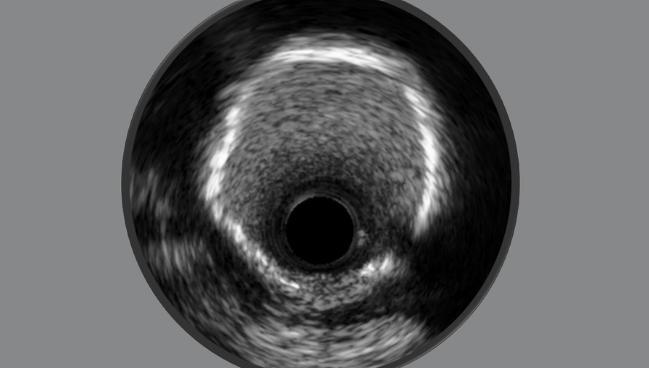
Photo Credit: Adapted from Nolte C. TCT 1889: Physiology and imaging-guided management of diffuse calcified coronary disease: a case of IVL-facilitated PCI with iFR and IVUS integration. Presented at: TCT 2025. San Francisco, CA.
After implementation of a multifaceted quality-improvement initiative, the rate of intracoronary imaging (ICI) dramatically increased in patients undergoing PCI in Michigan, researchers report.
Prior work has shown female sex to independently predict a lower likelihood that ICI will be used to guide and optimize coronary revascularization. Under the Michigan initiative, the rate of ICI-guided PCI in all-comers women—which was initially below the national average—increased from 7.0% in 2019 to 54.2% in 2024, with a similar increase from 7.3% to 56.0% in all-comers men. There was no significant difference in trends by sex (P = 0.21) after adjustment for clinical covariates.
The authors, led by Sabina Kumar, DO (Icahn School of Medicine at Mount Sinai, New York, NY), say improvement efforts like theirs may be a step toward closing the gap for women and ensuring that more female patients get procedures guided by either intravascular ultrasound or optical coherence tomography.
“We encourage other states to implement similar quality-improvement initiatives to facilitate equitable increases in ICI-guided PCI,” they write in a research letter published in JSCAI.
“Intracoronary imaging uptake has been slow, and there are a lot of reasons for that,” noted Andrew M. Goldsweig, MD (Baystate Medical Center, Springfield, MA), who was not involved in the study. “Some physicians feel that angiography guidance is adequate for experienced operators, [and] many older operators aren’t comfortable with intracoronary imaging because it just hasn’t been part of their practice. And of course it’s time-consuming, and it’s poorly reimbursed.”
In a meta-analysis of over 14,000 patients published last year, Goldsweig and colleagues found that although women have been largely underrepresented in clinical trials of ICI guidance, they see reductions in MACE that match those of men when undergoing PCI with the technology compared with angiography. Goldsweig pointed to the lack of any dramatic sex difference in use of ICI by sex in the Michigan experience.
“I think the takeaway from this is not that there is a sex difference, but that there’s a very small sex difference, and that disparity that has existed for decades is starting to narrow in terms of access to care,” he told TCTMD. “So, there may be reasons not to use [ICI], but those reasons are not sex-specific. Men and women benefit equally from it, and therefore it should be equally applied. If you’re a believer that intracoronary imaging improves outcomes in everybody, then you should use IVUS in everybody regardless of sex.”
Similar Increases Seen in Subgroups
As part of the initiative through the Blue Cross Blue Shield of Michigan Cardiovascular Consortium (BMC2), sites and operators received frequent feedback on their use of ICI to optimize PCI. There also were physician-led educational sessions on ICI use, a best practice protocol document, and a poster to hang in the cath lab that featured an algorithm for ICI use.
The study included 171,976 PCI procedures performed from 2019 through 2024 at 51 nonfederal hospitals. Approximately 32% of these cases were performed in women.
Among women with either left main disease, in-stent restenosis, or in-stent thrombosis, the use of imaging-guided PCI increased from 10.4% to 65.3% over the study period (P for trend < 0.001). A similar increase in this subgroup also was observed in men, with imaging guidance rates of 11.4% at the beginning of the study period and just under 70% by the end of the study. As with the main results, no significant difference in trends was seen by sex (P = 0.61) after adjusting for clinical covariates.
The authors also observed a consistent increase each calendar year in the odds of ICI-guided PCI in women with left main disease, in-stent restenosis, or in-stent thrombosis (adjusted OR 1.69; 95% CI, 1.63-1.74).
While the initiative and support from the interventional community in Michigan is likely responsible for much of the change that was seen over the study period, Kumar and colleagues say it may not be the only factor in play. They note that the findings “may be influenced by the robust and expanding body of literature highlighting the importance of ICI-guided PCI, which have led to changes in societal guidelines.”
In 2025, updated ACS guidelines from the American College of Cardiology and the American Heart Association upgraded ICI guidance to a class 1 recommendation. That came in response to trials like OCTOBER, which showed that using ICI was associated with a lower incidence of MACE at 2 years compared with angiography-guided PCI in complex bifurcation lesions.
Still other factors, including enhanced imaging education during interventional cardiology fellowships and the integration of ICI technology in a growing number of cath labs, also may be responsible for some of the improvements the Michigan investigators saw.
Goldsweig agreed, noting that things have been changing rapidly in the years since the study began.
“There is more experience [with ICI] among operators, especially younger operators. The field of operators is turning over, so it’s an interesting template to apply nationally to try to increase intracoronary imaging use, which then by extension, we hope, improves outcomes at a national level,” he said. “The passage of time, the guidelines, the new operators replacing the old operators [all] are probably the most influential features here.”
Importantly, Goldsweig said, while the Michigan quality-improvement program is laudable and shows progress in terms of breaking through sex-based differences in access to care, “the Achilles’ heel is that we still don’t understand exactly which patients benefit most from imaging because we have had some recent studies that don’t show that benefit.”
Early this year, OPTIMAL and IVUS-CHIP, an unprotected left main trial and a complex lesion trial, respectively, both showed no improvement in overall clinical outcomes with IVUS compared with angiography alone.
“When we’re trying to improve outcomes, the question is always one of whether surrogate outcomes are legitimate to guide our therapeutic decisions,” Goldsweig added. “I don’t know that a huge nationwide campaign to increase intracoronary imaging use is necessarily indicated for every single PCI because the data are still not certain.”
Kumar and colleagues say they believe the favorable trends observed as a result of the initiative “reinforce the value of such coordinated efforts and highlight the need for future initiatives to address remaining gaps in PCI practice and to assess their impact on clinical outcomes.”

L.A. McKeown is a Senior Medical Journalist for TCTMD, the Section Editor of CV Team Forum, and Senior Medical…
Read Full BioSources
Kumar S, Seth M, Zainea MA, et al. Uptake of intracoronary imaging-guided percutaneous coronary intervention among female patients in the state of Michigan: an analysis of a BMC2 initiative. JSCAI. 2026;Epub ahead of print.
Disclosures
- The study was supported by Blue Cross Blue Shield of Michigan (BCBSM) and Blue Care Network as part of the BCBSM Value Partnerships program.
- Kumar reports no relevant conflicts of interest.
- Goldsweig reports receiving speaking fees from Boston Scientific and consulting for Abbott and Gore.
Related News


Comments