RCT, Real-world Data Show TAVI Durability Up to 7 Years in Low-risk Patients
The results were framed as reassuring, although experts made it clear that longer-term follow-up is needed.

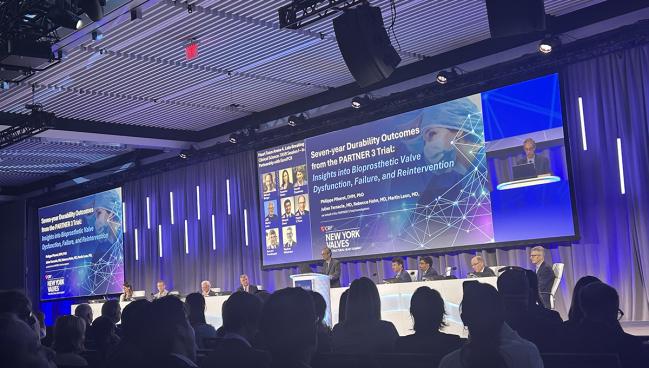
NEW YORK, NY—Additional data from the PARTNER 3 trial of low-risk patients with symptomatic severe aortic stenosis (AS), as well as real-world data from the TVT Registry, suggest that balloon-expandable TAVI valves are holding up well through at least 7 years of follow-up and providing results similar to those seen with surgical valves.
Details on echocardiographic and clinical outcomes at 7 years in PARTNER 3, which follow the main 7-year results released last year, indicate no substantial differences in structural valve deterioration (SVD), bioprosthetic valve failure (BVF), or aortic valve reintervention when comparing TAVI patients treated with the Sapien 3 valve (Edwards Lifesciences) and those treated with SAVR, with rates that were low overall.
Although thrombosis-related bioprosthetic valve dysfunction (BVD) was more common in the TAVI arm, it “occurred early, was often reversible, and very rarely progressed to failure or reintervention,” Philippe Pibarot, DVM, PhD (Université Laval, Quebec City, Canada), reported during a late-breaking clinical science session focused on TAVI durability here at New York Valves 2026. The results were published simultaneously online in JAMA Cardiology.
“TAVR with the Sapien 3 platform demonstrated comparable 7-year durability to surgery, supporting its use as a treatment option in lifetime management of low-risk patients with symptomatic severe AS,” Pibarot concluded.
Also during the session, Sreek Vemulapalli, MD (Duke Clinical Research Institute, Durham, NC), presented data from the STS/ACC TVT Registry on low-risk patients who underwent TAVI with the Sapien 3, Sapien 3 Ultra, or Sapien 3 Ultra Resilia valves. Mortality rates were high, which Vemulapalli attributed to the age of the population and the large proportion with frailty, but reintervention rates were low at 7 years.
“When considered alongside recently published 7-year results from the PARTNER 3 trial, these findings support the durability of Sapien balloon-expandable TAVR in low-risk patients,” Vemulapalli said.
Leading the discussion after Pibarot’s presentation, Patrick O’Gara, MD (Brigham and Women’s Hospital, Boston, MA), said the additional data from PARTNER 3 “add terrific granularity” to the information published last year.
“These data actually draw further attention to the potential differences between transcatheter valve platforms and long-term durability, as well as the potential differences with respect to the mechanism of structural valve deterioration and bioprosthetic valve failure that may befall one type of valve platform versus another,” he said. “We can take some assurance here at 7 years that a balloon-expandable valve seemed to be of comparable durability to a variety of surgical valves, some of which are no longer actually in clinical practice.”
He underscored the need for longer-term data, however.
“We know from our surgical experiences that we should be patient. We need to wait. We need to wait another 10 years,” O’Gara said, citing the durability problems that surfaced with surgical valves like the Trifecta and Mitroflow after around 8 years of follow-up.
Suzanne Baron, MD (Massachusetts General Hospital, Boston), agreed that 7 years of follow-up is not enough to assess durability.
“We can’t just rely on 7-year data. We know that we’re going to need [longer-term data], especially because we know our patients are living longer,” she said, noting that the average life expectancy for a 70-year-old patient is 14 to 16 years. “It’s good data, it’s granular, it’s definitely reassuring, but I agree, I want to see more to come.”
PARTNER 3 at 7 Years
With TAVI being increasingly used in lower-risk and younger patients, prosthetic valve durability takes on greater importance, Pibarot said. There is, however, limited long-term durability data.
PARTNER 3 randomized 1,000 low-risk patients with symptomatic severe AS to TAVI with the Sapien 3 valve or SAVR. Seven-year outcomes presented at TCT 2025 and published in the New England Journal of Medicine, showed similar outcomes in the two groups and no differences in rates of BVF or aortic valve reinterventions.
Here at New York Valves, Pibarot presented an analysis digging deeper into the durability issues, with VARC-3 definitions used for BVD and BVF.
The etiology of stage 2/3 BVD—ie, accompanied by moderate or severe hemodynamic valve deterioration—observed in the study was largely similar in the TAVI and SAVR groups, with the exception of more cases related to thrombosis in the TAVI arm (5.2% vs 0.9%; P < 0.001). The “vast majority” of thromboses were subclinical, Pibarot said.
The cumulative incidence of stage 2/3 SVD-related BVD was 7.3% in TAVI-treated patients and 7.6% in the surgical group (P = 0.88). This finding, which was more frequent in patients with small annulus (≤ 430 mm2), was associated with greater risks of all-cause mortality (HR 2.16; 95% CI 1.15-4.04) and aortic valve reintervention (HR 37.98; 95% CI 20.47-70.46).
All-cause BVF, which encompasses irreversible stage 3 hemodynamic valve deterioration, aortic valve reintervention, and valve-related death, is “probably the most comprehensive endpoint of valve durability,” Pibarot said. This occurred at a numerically but nonsignificantly lower rate in the TAVI arm than in the SAVR arm (6.9% vs 7.5%; P = 0.69), with the lack of a significant difference persisting even after excluding patients treated with problematic surgical valves.
The etiology of BVF did not significantly differ between the TAVI and SAVR groups, although there were numerically fewer cases related to SVD in TAVI-treated patients (3.9% vs 5.3%; P = 0.31).
As with SVD, a small annulus was associated with a greater risk of BVF, along with mild or greater total aortic regurgitation at 30 days.
There were similar rates of site-reported valve-related reintervention in the TAVI and SAVR arms (5.4% vs 5.5%; P = 0.90), with most reinterventions done in response to progressive bioprosthetic valve stenosis, irrespective of initial treatment. Roughly 70% of reinterventions were performed electively in both the TAVI and SAVR groups, with low rates of 30-day mortality (0 for TAVI and 4.4% for surgery).
The issue of bioprosthetic valve durability is a topic “that is highly relevant to clinical practice, to informed consent, and to shared decision-making,” O’Gara said, adding that all members of the multidisciplinary teams caring for these patients should participate in these discussions.
He highlighted the challenges associated with obtaining detailed echocardiographic data on patients over several years of follow-up. “Patients get tired. They drop out. There’s a differential loss of patients here in the surgical arm,” he said. “More importantly, we have to rank these kinds of results against the competing risk of death and the reality that the platforms that we utilize for valve replacement change so quickly that the data that pertain here to valve platforms that were used nearly 10 years ago may be obsolete at this particular time.”
High Mortality in the STS/ACC TVT Registry
Vemulapalli’s presentation added a real-world perspective to the issue of TAVI durability. He and his colleagues examined data from the STS/ACC TVT Registry on 68,071 patients ages 65 and older (mean age 76.5 years; 31.6% women) who underwent transfemoral TAVI with one of the Sapien 3 family of valves between 2015 and 2024. All were deemed to be at low risk by a heart team and had an STS score < 4% (mean 1.9%).
Overall, about half of the population had NYHA class III/IV heart failure symptoms and 40% had frailty based on a 5-meter walk speed greater than 6 seconds.
Patients were linked to Medicare fee-for-service and Medicare Advantage claims data for follow-up lasting up to 7 years. Over that span, the overall death rate was 45.1%, and 2.2% of patients required a reintervention.
The researchers performed subgroup analyses by age and valve type, with follow-up cut off at 5 years due to the low number of patients who had information available beyond that point.
The 5-year mortality rate was 29.5% in patients treated with the Sapien 3 valve and 25.1% in those treated with the Sapien 3 Ultra. Only 2 years of follow-up were available for the Sapien 3 Ultra Resilia valve due to its later introduction—at that point, the mortality rate was 7.1%. Corresponding reintervention rates across the three valves—at 5 years for the Sapien 3 and Sapien 3 Ultra and at 2 years for the Sapien 3 Ultra Resilia—were 1.4%, 1.7%, and 0.8%.
The 5-year mortality rate was greatest in patients ages 80 years and older (39.5%) and lowest in those ages 65 to 74 years (19.1%), with those ages 75 to 79 years falling in between (24.4%). The reintervention rate was inversely related to age, with the youngest patients having the highest rate (2.5%) and the oldest having the lowest (0.8%). Still, even in the patients ages 65 to 74 years, the reintervention rate was low, Vemulapalli said.
Discussant Nimesh Desai, MD, PhD (Hospital of the University of Pennsylvania, Philadelphia), was struck by the high mortality rate in this cohort, saying that even in the youngest individuals, the proportion who died was “grossly abnormal for that group of patients or for human beings in North America.”
The mortality burden was much greater than what has been seen in studies of contemporary surgical heart valves, he noted. “I think a lot of this has to do with patient selection of surgical versus transcatheter therapies for patients with aortic stenosis.”
Vemulapalli pointed out that the real-world patients were sicker than those seen in, for example, the PARTNER 3 trial, with a substantial percentage having frailty. In an analysis matching real-world patients with trial participants, those with frailty would be excluded, and the real-world patients would therefore have a lower risk overall.
“But the fact of the matter [is], this is the real world,” he said. “This is what we’re dealing with. In fact, cardiovascular mortality in the United States is going up, so this is probably going to get worse over time.”
Equating registry patients with those from PARTNER 3 “is comparing apples to oranges,” Baron commented, adding that the data presented by Vemulapalli are complementary to those presented by Pibarot. “I think it gives us a signal. It allows us to see what’s actually happening. And I think that that’s an important thing. But I don’t think that it is a fair comparison between [the PARTNER 3] and real-world data. There’s just no way you could do that.”

Todd Neale is the Associate News Editor for TCTMD and a Senior Medical Journalist. He got his start in journalism at …
Read Full BioSources
Ternacle J, Hahn RT, Silva I, et al. Seven-year valve durability with transcatheter or surgical aortic valve replacement: an ad hoc analysis of the PARTNER 3 randomized clinical trial. JAMA Cardiol. 2026;Epub ahead of print.
Vemulapalli S. Seven-year TAVR outcomes in low-risk patients treated with balloon-expandable valves in the United States. Presented at: New York Valves 2026. June 24, 2026. New York, NY.
Disclosures
- PARTNER 3 was sponsored by Edwards Lifesciences.
- Pibarot reports grants from Edwards Lifesciences for institutional funding for echo core laboratory services during the conduct of the study; and grants from Cardia, Novartis, and Boston Scientific for institutional funding for echo core laboratory services outside the submitted work.
- Vemulapalli reports grants/contracts from the American College of Cardiology, American Heart Association, National Institutes of Health, Edwards Lifesciences, US Food and Drug Administration, and Abbott Vascular; and advisory/consulting fees from Edwards Lifesciences, Medtronic, Abbott Vascular, Eli Lilly, and Cytokinetics.
- Desai reports grant support/research contracts from W.L. Gore & Associates, Edwards Lifesciences, and Medtronic; and consulting/speaking fees or honoraria from W.L. Gore & Associates, Edwards Lifesciences, Medtronic, and Terumo.
- Baron reports serving on advisory boards for Boston Scientific, Zoll Medical, and Medtronic; receiving grant/research support from Boston Scientific, Abiomed, and Acarix; and receiving consulting fees/honoraria/speaker’s fees from Edwards Lifesciences, Medtronic, Zoll Medical, Shockwave Medical, Pi-Cardia, Boston Scientific, HeartFlow, Abbott, Janssen Pharmaceuticals, and Chiesi.
- O’Gara reports no relevant conflicts of interest.
Related News



Comments