Real-world TriClip Data Show Reduced TR, Good Procedural Success
The findings were site-reported and limited to 30 days of follow-up, but this reflects a successful rollout, Wayne Batchelor says.

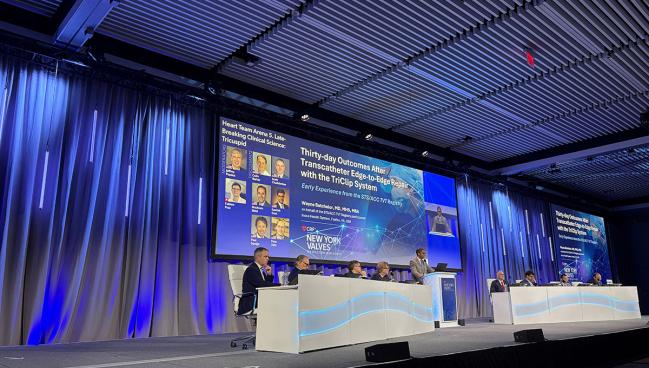
NEW YORK, NY—Tricuspid transcatheter edge-to-edge repair (T-TEER) with the TriClip G4 system (Abbott) yields good procedural success, short hospital stays, encouraging short-term safety and efficacy outcomes, and improvements in symptoms and quality of life (QoL), according to real-world data from the STS/ACC TVT Registry.
Among more than 3,000 patients with severe tricuspid regurgitation (TR) treated at 278 US sites between April 2024, when the device was approved by the US Food and Drug Administration, and September 2025, device success was 98% and the 30-day all-cause mortality rate was 1.4%. Findings from the TRILUMINATE Pivotal trial—which put T-TEER ahead of medical therapy alone regarding a composite outcome of all-cause death or tricuspid valve surgery, hospitalization for heart failure, and improvement in QoL—supported the device’s use in clinical practice, with positive results also coming from the Tri.Fr trial.
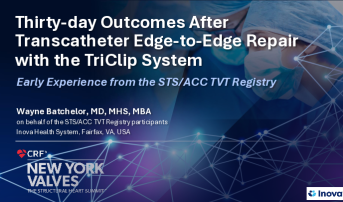
These new registry results “provide generalizability for the randomized clinical trial findings from two major trials and support TriClip as an effective therapy for anatomically suitable patients with severe symptomatic tricuspid regurgitation,” said Wayne Batchelor, MD (Inova Health System, Fairfax, VA), who presented the findings last week at New York Valves 2026. “Of course, the results are limited to short-term outcomes. We would want to see these outcomes evaluated at longer-term endpoints, including 1 year and beyond.”
Discussant Mackram Eleid, MD (Mayo Clinic, Rochester, MN), called the findings “very impressive,” adding that the study “expands our evidence base for T-TEER, and it builds on prior . . . clinical trials and registries, but it also shows continuous quality improvement in the T-TEER outcomes.”
This is a very safe procedure and it’s efficacious in selected candidates with appropriate site and team training. Mackram Eleid
Even with a median site volume of only seven procedures over the course of the study, Eleid said it was “striking” to see technical outcomes on par with those seen in clinical trials.
30-Day Site-Reported Outcomes
For the analysis, Batchelor and colleagues included 3,035 patients with severe TR (mean age 78 years; 59% female) who were treated with TriClip T-TEER. Most (84%) had atrial fibrillation, and half had been hospitalized for heart failure in the preceding year—double that seen in TRILUMINATE. Mean LVEF at baseline was 55%.
Three-quarters of patients received the extra wide (XTW) device, with the remaining having the XT (23%), NTW (1%), and NT (1%) clips. The median number of clips implanted per patient was 2 (mean 1.8 clips), and the median hospital length of stay was 1 day (mean 1.9 days). Almost all patients (96%) were discharged home.
At 30 days, follow-up data were available for 92.5% of patients. The rate of cardiovascular mortality was 0.8%, and 2.3% of patients were hospitalized for heart failure. Single leaflet device attachment (SLDA) occurred in 1.5%, and the rates of major bleeding, TV reintervention, stroke, endocarditis, MI, and need for new permanent pacemaker were all less than 1%.
By 30 days, 87% of patients had moderate or less TR on echocardiography (including 51% with mild or less), compared with 4% at baseline (P < 0.0001). QoL as defined by the Kansas City Cardiomyopathy Questionnaire overall summary score improved by a mean of 22 points by 30 days, as did NYHA symptom class: 80% of patients reported class I/II symptoms at the end of the study compared with 2% at baseline (P < 0.0001 for both).
“I would note the TRILUMINATE Pivotal [trial] had an independent core lab adjudicating it, but [we saw] very similar results,” Batchelor said.
A Success Story
Eleid commended the device manufacturer for a successful commercial rollout with proper training, highlighting the very low SLDA rate. “I think the lowest I had seen recently was 4% in prior registries,” he said. “Across the board, the outcomes look very favorable. And granted, it’s site-reported . . . but it just further emphasizes that this is a very safe procedure and it’s efficacious in selected candidates with appropriate site and team training.”
That so many new sites were brought on board with positive outcomes represents a success story of scaling “randomized clinical trial training at really high-level sites and operators into the community effectively,” Batchelor said. “I think this speaks to the way that we educate and train physicians to do this procedure.”
We can quibble about site-related responses versus CEC adjudication and core labs, but I think it’s pretty clear: it’s very safe and quite effective. Wayne Batchelor
Improvements in imaging have made T-TEER drastically safer with time, he continued. “I remember doing my first TriClip versus the one I did earlier this week, and it’s like night and day in terms of the image quality. So this also speaks to some of our imaging colleagues who’ve done a really fantastic job of just getting better images, and I think that’s baked into this commercial observation.”
The safety outcomes, though, are the highlight of the dataset, according to Batchelor. “This is a very safe procedure, and we can quibble about site-related responses versus CEC adjudication and core labs, but I think it’s pretty clear: it’s very safe and quite effective.”
‘We Can’t Stop Here’
Session co-moderator Fabien Praz, MD (Bern University Hospital, Switzerland), agreed that the data “are absolutely crazy in terms of safety and results.” But compared with TRILUMINATE, “the real-world data are slightly, just slightly, worse in terms of mortality and in terms of TR reduction,” he said. This is the opposite with what was seen for transcatheter tricuspid valve replacement, where real-world data showed better outcomes than in the TRISCEND II trial.
Batchelor noted, though, that the level of TR reduction seen in real-world patients was the same as in TRILUMINATE. Also, with double the rate of HF hospitalization seen here compared with patients in the trial, “these patients, I think, were sicker, and I think that’s pretty typical. We tend to cherry-pick a little bit more for clinical trials, but once this is released into the commercial realm, it’s a different setting.”
Panelist Paul Sorajja, MD (Banner Health, Phoenix, AZ), said while he doesn’t “have an explanation for the trend for replacement,” there are obvious differences between how patients were cared for in TRILUMINATE—with mandatory right heart cath, optimal medical therapy, and a waiting period before treatment—and how they are assessed in clinical practice. “In real-world practice, I’m guilty of it as well, we get called for acute heart failure patients [and] we tend to just do it,” he said. “We’re not as good about doing the right heart caths like we used to. We’re not as good as tuning them up.”
The procedure isn’t causing problems, Sorajja continued. “The efficacy is about the same. Safety I think could be explained by patient selection, and it’s just a different cohort of patients, and we’re probably not as good about the medical arm as we think we are.”
Kashish Goel, MD (Vanderbilt University Medical Center, Nashville, TN), another panelist, added that the real-world data are “fascinating” and show “that the procedure is safe and we can achieve results similar to the trial.” Still, he stressed, while “we all try to achieve mild [TR] if possible, I think 50% [having mild or less here] is not acceptable in my opinion.” Likely, this will improve with site experience, Goel added.
Batchelor agreed. “This is a dynamic phenomenon,” he said. “We’re looking at rolling something out for the first time, new technology into the commercial space with all of the heterogeneity around site experience, imaging, and case selection. . . . We should be proud of this, but we can’t stop here. We’ve got to do better, and I think with device iterations and improvements in technique [and] imaging, hopefully we’ll get there.”

Yael L. Maxwell is Senior Medical Journalist for TCTMD and Section Editor of TCTMD's Fellows Forum. She served as the inaugural…
Read Full BioSources
Batchelor W. Thirty-day outcomes after transcatheter edge-to-edge repair with the TriClip system: early experience from the STS/ACC TVT Registry. Presented at: New York Valves 2026. June 24, 2026. New York, NY.
Disclosures
- The study was sponsored by Abbott.
- Batchelor reports receiving grant/research support from Abbott Medical and consultant fees/honoraria from Medtronic, Boston Scientific, Abbott, J&J MedTech, and Recor.
- Eleid reports no relevant conflicts of interest.
- Praz reports receiving travel expenses from Abbott, Edwards Lifesciences, Siemens Healthineers, Medira, and Polares Medical.
- Sorajja reports receiving consulting/speaking fees or honoraria from Boston Scientific, Medtronic, Abbott, 4C Medical, Laza, Philips, GE Healthcare, and Adona.
- Goel reports receiving consulting/speaking fees or honoraria from Edwards Lifesciences, Abbott, Laplace, and Nyra Medical; serving on the advisory board for Trisol; and receiving grant/research support from Abbott, Edwards Lifesciences, Medtronic, Teleflex, and Laplace.
Related News


Comments