Registry Analysis Tempers Difference Between TAVI and SAVR Seen in DEDICATE-DZHK6
Some say observational data can’t explain RCT findings, but others argue there are important insights here.

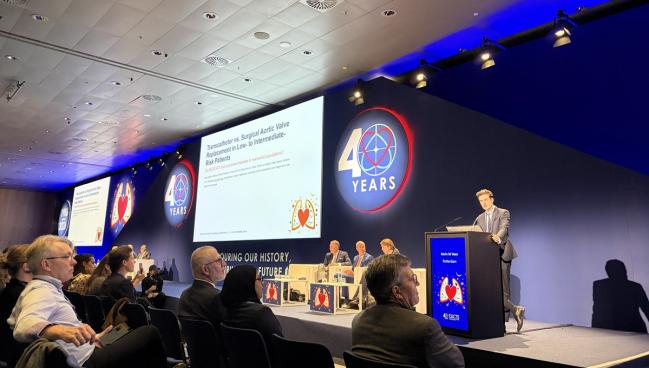
BARCELONA, Spain—The DEDICATE-DZHK6 trial comparing TAVI with SAVR in low-to-intermediate-risk German patients with aortic stenosis originally perplexed surgeons with worse-than-expected surgical outcomes, but new data suggest that the differences between the two procedures might not be so striking in the real world.
The trial, released in 2024, “found noninferiority for TAVR at 1 year [for the] composite of stroke and all-cause mortality and was cited in the current guidelines,” said Kevin Veen, MD, PhD (Erasmus MC, Rotterdam, the Netherlands), in his presentation here at the 2026 European Association for Cardio-Thoracic Surgery (EACTS) meeting. “However, the event rates in the SAVR arm were unexpectedly high, and it was said that it did not reflect surgical practice.”
The new study used audited Dutch National Registry Data to compare 3,389 SAVR patients (mean age 72 years; 57.9% male) considered eligible for DEDICATE-DZHK6 inclusion with 557 patients from the trial who were randomized to SAVR (mean age 75 years; 58.0% male) and 654 patients who were randomized to TAVI (mean age 75 years; 55.8% male).
When pitting the registry and trial SAVR patients against each other using propensity-score matching, Veen and colleagues found the trial participants had significantly higher risks of the composite of stroke and all-cause death (HR 1.63; 95% CI 1.02-2.26) and stroke (HR 2.96; 95% CI 1.37-6.37), but not death alone (HR 1.15; 95% CI 0.65-2.02). Additionally, they were not able to replicate the trial findings when comparing patients treated with TAVI in DEDICATE-DZHK6 with those treated with SAVR in the registry for either stroke and all-cause death (HR 0.71; 95% CI 0.44-1.14) or stroke alone (HR 1.36; 95% CI 0.62-2.90). The TAVI benefit, though, remained significant for mortality (HR 0.46; 95% CI 0.24-0.87).
There will always be a gray area. Kevin Veen
“The DEDICATE trial population seems to be a selected subset that is higher risk compared to the Dutch trial-eligible SAVR population,” Veen said. “The relative effects of stroke and the composite could not be reproduced, and this suggests unmeasured confounding. And that can be due to the fact that there are limitations in the measuring variables or differences in event adjudication, because we are comparing registry data with trial data here, or real differences between Dutch and German practice.”
Additionally, Veen presented a transportability analysis that reweighed the trial population to be more in line with the registry population. “Patients that look like the registry get a higher weight and patients that do not look like the registry get a lower weight,” he explained. “Now it is as if you conducted the trial in the registry population.”
After doing so, the absolute risk reduction for mortality shifted from 3.8% in favor of TAVI to 2.1%, suggesting “a diminished benefit” for the transcatheter procedure, Veen said.
The analysis received the EACTS 2026 President’s Choice award.
‘A Lot of Calculation and Theory’
Gloria Färber, MD (University Hospital Würzburg, Germany), who served as the study’s discussant, said the analysis was important given how many discussions the surgical community has had in the wake of the DEDICATE-DZHK6 findings. “However, it’s a bit complex to understand,” she said. “There is a lot of calculation and theory behind it.”
To TCTMD, Patrick Myers, MD (Lausanne University Hospital, Switzerland), secretary general of EACTS, agreed that Veen and colleagues “use some very interesting statistical methods,” but highlighted that they show “that actually you can’t transport that [DEDICATE-DZHK6] data. So it’s probably not applicable to daily practice.”
I personally am not sure to what extent registry data can add in this space, as we must account for the many potential limitations when analyzing and interpreting the findings. Mortiz Seiffert
Moritz Seiffert, MD (BG University Hospital Bergmannsheil Bochum, Germany), who originally presented the DEDICATE-DZHK6 results at the 2024 American College of Cardiology Scientific Sessions, said he had mixed feelings.
“Although interesting, the findings illustrate the challenges of comparing an RCT with a registry: the included registry data already reflect a treatment decision made by the Heart Team—the allocation to SAVR—which cannot be adjusted away,” he told TCTMD in an email. “A major unknown remains: how comparable the groups ultimately are, given many potential unmeasured confounders and the known limitations of matching.”
Individual patient-level data have many strengths, “particularly in the context of large academic meta-analyses of the many RCTs in the TAVI-versus-SAVR field,” Seiffert continued. “I personally am not sure to what extent registry data can add in this space, as we must account for the many potential limitations when analyzing and interpreting the findings. This will be particularly relevant for the anticipated 5- and 10-year data in this field.”
Michael Borger, MD, PhD (Leipzig Heart Center, Germany), another DEDICATE-DZHK6 investigator, stressed that the primary efficacy results for the trial won’t yet be released until the 5-year data are available. “What was actually presented thus far in DEDICATE—a lot of people forget about this—was the safety data,” he told TCTMD. “That was the reason why at 1 year we as investigators did not say that TAVI was superior to SAVR, because in our prespecified protocol, that depends on the efficacy data at 5 years.”
He also attributed some of the results seen in this analysis to inherent differences in the hierarchical German system and the consultant-based Dutch one. “That may explain one of the reasons why the surgical patients in the Netherlands and in the US have done better than in the DEDICATE group from Germany,” he said. “It raises the question: what can we do better in Germany?”
The latest European valvular heart disease guidelines, released last year, shifted the recommendation to consider TAVI in patients older than 70 years, down from 75, but they stress consideration of life expectancy and comorbidities. “What this research does is that it adds some other dimension to that thinking because this research asks the question: does the patient sitting in front of me fit the trial evidence?” Veen said. “So I think in the future, we should explore more life expectancy models to make decisions on that. But there will always be a gray area—let’s say that is now between 70 and 75—and in that gray area, I think the heart team and shared decision-making become really important.”

Yael L. Maxwell is Senior Medical Journalist for TCTMD and Section Editor of TCTMD's Fellows Forum. She served as the inaugural…
Read Full BioSources
Veen KM. Transcatheter vs. surgical aortic valve replacement in low- to intermediate-risk patients: do DEDICATE trial outcomes translate to real-world populations? Presented at: EACTS 2026. October 8, 2026. Barcelona, Spain.
Disclosures
- Veen reports no relevant conflicts of interest.
- Borger reports that his hospital has received speakers’ honoraria and consulting fees on his behalf from Edwards Lifesciences, Medtronic, Abbott, and Artivion.
- Seiffert reports serving as coordinating investigator of the DEDICATE-DZHK6 trial and receiving lecture fees from Edwards Lifesciences and Medtronic.
Related News


Comments