Registry Results Validate Transseptal BATMAN in High-risk TMVR Patients
The data reflect a high degree of technical success, clinical efficacy, and safety of the new technique, says Gennaro Giustino.

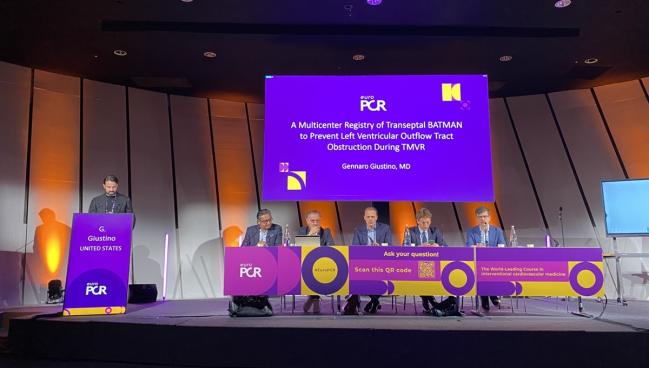
PARIS, France—New registry data support the feasibility and safety of a novel technique for enabling transcatheter mitral valve replacement (TMVR) in patients with failed surgical valves, surgical rings, or severe mitral annular calcification (MAC) who are at high risk of left ventricular outflow tract (LVOT) obstruction.
The modification technique, known as transseptal balloon-assisted anterior mitral leaflet modification (BATMAN), has made its way into practice despite little clinical evidence to support its use, said Gennaro Giustino, MD (Atlantic Health System, Morristown, NJ), in a presentation here at EuroPCR 2026. The study was simultaneously published in JACC: Cardiovascular Interventions.
Using BATMAN enabled a 95.1% rate of successful TMVR and freedom from LVOT obstruction, with no procedural deaths. It was technically successful in 98.8%, with a 7.3% rate of the primary safety endpoint, a composite of in-hospital death, stroke, or major cardiac structural complications. Of the 83 patients, 30.1% underwent a valve-in-valve (ViV) procedure, 47% a valve-in-ring (ViR), and 22.9% a valve-in-MAC (ViMAC) procedure.
“There were no safety events in the valve-in-ring group. In the valve-in-valve group, the primary safety endpoint occurred in 8% of the patients, and valve-in-MAC in 20% of the patients,” Giustino said. He noted that there was one major structural complication in the ViMAC group, which occurred due to laceration of the aortic mitral curtain.
These data add to those Giustino presented last year from a 42-patient study that suggested the BATMAN technique may be a reasonable alternative to the more complicated LAMPOON strategy. In essence, BATMAN is more streamlined, requiring only electrosurgery for the anterior mitral leaflet traversal followed by balloon-assisted laceration.
LAMPOON involves electrosurgical traversal and laceration, and according to Giustino, takes twice as long as BATMAN. A case can be made that LAMPOON has some advantages over BATMAN, with one of those being that in its simplified version, leaflet modification can be done without needing to traverse the base. However, it can result in damage to the aorto-mitral curtain and the aortic valve, which is why Giustino and colleagues say it should not be used in those without a protected mitral annulus.
“BATMAN compares well with LAMPOON, in my opinion, because after you traverse the leaflet, you can use the same wire to implant the valve,” Giustino noted. That reduces both the number of catheter and wire exchanges as well as the potential period of hemodynamic instability while the anterior mitral leaflet is being lacerated.
Session spokesperson Thomas Modine, MD (CHU de Bordeaux-Haut-Leveque, France), asked Giustino how operators should be making the choice between BATMAN and LAMPOON in these situations.
“I believe the two techniques are complementary,” Giustino said. “It's actually more effective than LAMPOON in patients that have high risk of LVOT obstruction for one single reason: it really clears the leaflet in the LVOT space. With LAMPOON, you can have residual tissue around the frame of the valve that can lead to elevated gradients.”
BATMAN Registry Data
The international registry included 83 consecutive patients (median age 77 years; 66.3% women; median STS score for mortality 8.8%) undergoing transseptal BATMAN TMVR. More than 50% had moderate-to-severe or severe mitral regurgitation and 48.2% had severe mitral stenosis. All were deemed at high risk of LVOT obstruction from balloon-expandable TMVR based on a median predicted neo-LVOT area of 155 mm2. In the ViMAC cohort, all but one patient had severe annular calcification ≥ 270°.
Rates of the primary efficacy endpoint, the composite of successful TMVR, procedural survival, and final peak LVOT gradient < 50 mm Hg, were 100% in those undergoing a ViR procedure, 95.8% in the ViV group, and 84.2% in the ViMAC group.
According to Giustino, the median time between the initial leaflet traversal to valve implantation was under 20 minutes, with a total fluoroscopic time of approximately 40 minutes in most cases.
Following the presentation, discussant Lenard Conradi, MD (Cologne University Hospital, Germany), noted that a dedicated device would make things much easier for operators.
“LVOT obstruction is one of the main reasons that renders these patients ineligible for TMVR,” he noted. “So, if you have something on the shelf which is easy to use, this is what we need and it will open this therapy to more patients.”
A potential drawback of the registry study and other investigations into the BATMAN technique is that it is not standardized across centers or operators. For the time being, Giustino and colleagues say further studies are still needed to evaluate the comparative effectiveness of BATMAN versus LAMPOON “and to inform clinical decision-making between the two techniques according to the substrate of mitral valve disease.”

L.A. McKeown is a Senior Medical Journalist for TCTMD, the Section Editor of CV Team Forum, and Senior Medical…
Read Full BioSources
Giustino G, Beneduce A, Fam N, et al. Balloon-assisted translocation of the mitral anterior leaflet to prevent outflow tract obstruction during TMVR: BATMAN-registry. JACC: Cardiovasc Intv. 2026;Epub ahead of print.
Disclosures
- Giustino reports honoraria or consultant fees from Edwards Lifesciences, Medtronic, Shockwave Medical, 4C Medical, and MurmurMD; and being a stock shareholder in Antegrade Medical.
Related News



Comments