Routine Protamine Reduces Minor Bleeding Compared With Selective Use: POPular ACE TAVI
Without reducing death or major bleeding, Toby Rogers says the results can be interpreted based on one’s ‘starting perspective.’

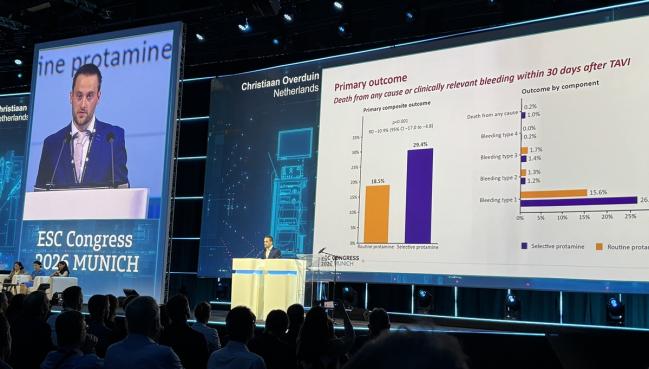
Routinely administering protamine to all patients after TAVI is superior to injecting it selectively, according to results from the POPular ACE TAVI trial, with the strategy reducing the composite outcome of all-cause death and bleeding.
The benefit was driven by less clinically relevant bleeding (VARC-3, type 1-4) with routine versus selective protamine (18.3% vs 29.2%; P < 0.001). Giving the heparin reversal agent to all patients did not come at the cost of more anaphylaxis (1.3% vs 0), a fear of which may have been holding back physicians from offering the drug more widely.
“Most operators give protamine to prevent bleeding,” said Christiaan Overduin, MD (St. Antonius Ziekenhuis, Nieuwegein, the Netherlands), who presented the findings over the weekend at the European Society of Cardiology Congress 2026 in Munich, Germany. He cited evidence from the ACE-PROTAVI trial that confirmed an earlier time to hemostasis with the drug.
“Then you have the operators who only give protamine to patients who keep bleeding, and the rationale behind their approach is they have seen once or more than once an anaphylactic shock,” Overduin told TCTMD. “This is really a holdback for some operators to give patients protamine, because if you have seen a full-blown anaphylactic shock, at least some operators become cautious of giving this medicine knowing what a reaction it could cause.”
While he has long leaned liberal in giving protamine, Overduin said, the new findings have shifted his mentality to administer it to “even more patients.” He added: “For me personally, this is the definitive answer on whether to give protamine, yes or no.”
However, Toby Rogers, MD (MedStar Washington Hospital Center, Washington, DC), who was not involved in the study, said the results are not practice changing.
“This is one of those studies that you can interpret from whichever your starting perspective is,” he commented to TCTMD. “If you’re a person who uses it routinely, you can, I think, look at this and say, ‘Look, it’s safe, and although there was an instance of anaphylaxis, it was small. There was no significant morbidity or certainly mortality related to anaphylaxis, and it probably does prevent minor bleeds and groin oozes and things like that.’
“If you’re in the selective category,” he continued, “then you can say, ‘It didn’t save any lives. It didn’t prevent any major vascular complications. It didn’t prevent any major bleeding. It just deals with sort of nuisance bleeding, minor bleeds. And in the grand scheme of things, in those patients, I can continue to use it selectively.’”
POPular ACE TAVI Findings
For the study, Overduin and colleagues randomized 1,000 patients undergoing transfemoral TAVI (mean age 81 years; 41.2% women) to receive placebo (selective group) or protamine (routine group) injections before sheath removal. Patients were excluded if they were allergic to protamine or recently had PCI. At baseline, more than half of all patients were at high or very high risk of bleeding, and about two in three were on antiplatelet therapy. Vascular closure at the primary access site was suture-based in about one-third of patients, plug-based in about one-fifth, and a combination in the remaining half.
If hemostasis was not achieved within 10 minutes, bailout placebo or protamine was allowed depending on the study group assignment. This occurred in 7.9% of patients assigned to the routine protamine group and 17.7% of those assigned to the selective protamine group.
The primary composite outcome of all-cause death or clinically relevant bleeding within 30 days was lower in those in the routine protamine group compared with selective protamine (18.5% vs 29.4%; P < 0.001). Individually, bleeding type 1 was the driving component (15.6% vs 26.5%), and there were no differences in major bleeding (2.9% vs 2.9%), major vascular complications (4.0% vs 2.7%), cardiovascular death (0.2% vs 1.0%), or all-cause death (0.2% vs 1.0%). There was also no difference in thromboembolic events between the groups (4.2% vs 4.3%), and no instances of anaphylaxis-related mortality overall.
The results were maintained in all subgroup analyses, with the exception of patients taking dual antiplatelet or oral anticoagulation therapy not benefitting from routine protamine administration.
One limitation of the study is that the researchers used a 1:1 heparin-protamine ratio, though the optimal ratio remains unclear, Overduin said.
Beyond obviously not giving protamine to patients with an allergy, he added that physicians might want to be cautious offering it to those with bad LV function because of the risk of protamine-induced hypotension, although more research is needed there.
Otherwise, Overduin said, in his mind these data provide a “good enough” answer regarding routine protamine and that he’d like to see guidelines adopt this recommendation.
‘Case-by-Case Approach’
Nicole Karam, MD, PhD (Clemenceau Medical Center Beirut, Lebanon), who served as a discussant for the study, said “there is still room for a case-by-case approach when thinking about the patient, and we should weigh the risk of bleeding versus thromboembolic risks when we are considering whether or not to give protamine.”
Given how short some TAVI procedures have become, she added, “maybe one thing that we can start considering . . . is whether it’s time to reconsider the initial dose of heparin and maybe just give protamine in some cases.”
Karam commented on the differences in need for bailout therapy in the study, noting that while “twice more operators felt the need for another syringe of, supposedly, protamine after the procedure, . . . this also meant that 83% of the [selectively treated] patients did undergo the procedure without actually needing protamine, without major complications. So we could see the glass half empty or half full, but still, 83% is a huge number.”
Her take-home message is that “routine protamine can decrease the risk of minor bleeding, but we don’t have any proof that it will decrease severe bleedings or mortality,” she said. “We still have some concern regarding the safety in terms of anaphylaxis and also maybe in thromboembolic events.”
For Rogers, protamine comes in most handy for “the patient where you don’t have complete hemostasis with your closure device, and there’s just a bit of ooze from the access site.” With some heterogeneity in the use of closure devices in the study, it’s hard to know how much of the minor bleeding could have been affected by the closure type, he said. “I personally like to combine suture and a plug, . . . and I think in many cases you do get complete hemostasis with that, and you’re done.”
At that point, Rogers continued, the choice to give protamine is a challenging one “because what am I trying to achieve?” he said. “But there are some patients in whom you do have persistent ooze and it can be extremely useful [to] reverse the heparin, wait a few minutes, and everything dries up and you’re done.”
Also, he said, while the bailout procedures in the study were important, clinicians don’t usually wait for 10 minutes. Rather, they would give the protamine if hemostasis wasn’t immediately achieved. “In that 10 minutes, you may have triggered an event,” Rogers said.
Lastly, protamine has been at the crux of the decision for many operators to not want to offer PCI and TAVI simultaneously, Rogers said. New data have indicated that waiting to offer PCI might be beneficial otherwise, but “many operators, myself included, have not been keen on doing it in the same procedure [because] if you’ve got a fresh stent in the left main, for example, do the TAVR immediately, and then you have a groin problem, you feel a lot less comfortable giving protamine with a fresh coronary stent.”
During the session, Stephan Windecker, MD (University Hospital Bern, Switzerland), commented that it would be useful to see the subgroup findings of those who received PCI more than 3 months prior to the study.
“In the current analysis, we did not look yet at these outcomes, but we plan to do that, yes,” Overduin said.

Yael L. Maxwell is Senior Medical Journalist for TCTMD and Section Editor of TCTMD's Fellows Forum. She served as the inaugural…
Read Full BioSources
Overduin C. Routine vs selective protamine after TAVI: POPular ACE TAVI. Presented at: ESC 2026. August 30, 2026. Munich, Germany.
Disclosures
- POPular ACE TAVI was funded by the St. Antonius Research Fund.
- Overduin and Rogers reports no relevant conflicts of interest.
Related News


Comments