Scarring Doesn’t Tip the Scale Towards ICDs in Cardiomyopathy With LVEF of 36-50%
The CMR GUIDE trial didn’t meet its primary endpoint but did point to possible positives, especially in younger patients.

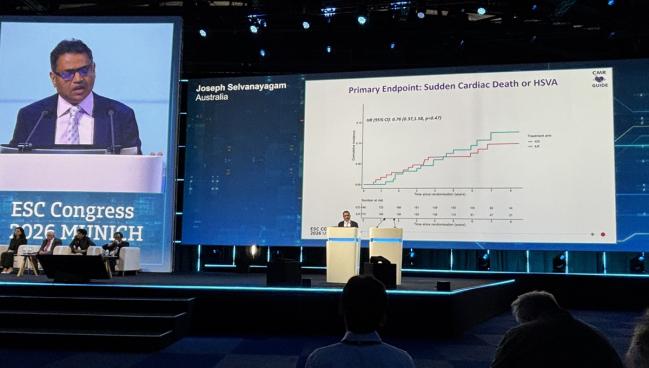
MUNICH, Germany—Patients with an LVEF in the range of 36% to 50% and myocardial scar on cardiac magnetic resonance (CMR) imaging do not experience an overall reduction in sudden cardiac death (SCD) and hemodynamically significant ventricular arrhythmias when treated with a primary-prevention implantable cardioverter-defibrillator (ICD) versus an implantable loop recorder (ILR), according to data from the CMR GUIDE trial.
However, there were some signs of benefit apart from that primary endpoint. Specifically, SCD as a stand-alone outcome was significantly reduced by 72% among patients assigned to receive an ICD. The devices also held an advantage over ILRs for the subset of patients younger than 70 years, but not for their older peers.
Joseph B. Selvanayagam, DPhil (Flinders Medical Centre, Adelaide, Australia), presented the trial today in a Hot Line session at the European Society of Cardiology Congress 2026, with the findings simultaneously published in JAMA.
At an ESC media briefing, Selvanayagam pointed out that while ICDs are known to be effective at preventing sudden cardiac death, current US and European ventricular-arrhythmia guidelines recommend their use only for primary prevention in patients with an LVEF of 35% or less based on existing randomized trials. This misses many at-risk patients with only mild-to-moderate LV systolic dysfunction. “There is a big clinical gap,” he noted.
“Cardiac MRI visualizes the scar that drives ventricular arrhythmia,” Selvanayagam explained, adding that in cardiomyopathy—whether ischemic or nonischemic—prior research has shown such scars predict the arrhythmias independent of ejection fraction and predict the risk of sudden cardiac death.
CMR GUIDE is the first trial to provide randomized evidence for a scar-guided approach in cardiomyopathy patients with an LVEF of 36% to 50%.
Christopher Kramer, MD (University of Virginia, Charlottesville), immediate past president of the American College of Cardiology, said that this approach hasn’t taken off in practice due to the limited evidence base and the resulting clinical guidelines.
He told TCTMD: “That’s the importance of this study, really. It’s for the first time testing the hypothesis—there have been a lot of observational studies that suggested scar is more important than ejection fraction at predicting sudden cardiac death.” In short, said Kramer, “It was a negative study,” with each of the primary endpoint components pointing in different directions for benefit versus harm.
Primary Endpoint Not Met
CMR GUIDE investigators enrolled 353 patients who had ischemic or nonischemic cardiomyopathy, an LVEF of 36% to 50%, and myocardial scar on late gadolinium-enhanced (LGE) CMR and who had already been receiving guideline-directed medical therapy. The open-label trial took place at 18 sites in Australia, Germany, and the UK.
Participants were randomized to receive either an ICD or an ILR. Their median age was 65 years, and 18% were female. Nearly three-quarters (72%) had an ischemic etiology, and 70% had an LVEF of 40% or greater.
Over a median follow-up of 6.3 years, the primary composite outcome occurred in 7.8% of the ICD group and 9.2% of the ILR group (HR 0.76; 95% CI 0.37-1.58). As an individual endpoint, SCD was less common with ICDs than with ILRs (1.7% vs 5.8%; HR 0.26; 95% CI 0.07-0.95). The rate of hemodynamically significant ventricular arrhythmia, on the other hand, did not differ between groups but trended higher with ICDs, at 6.7% versus 3.5% with ILRs (HR 1.77; 95% CI 0.65-4.81).
Also similar between groups were the rates of all-cause mortality, cardiovascular mortality, and heart failure-related hospitalization.
Prespecified subgroup analyses showed no interactions related to sex, LVEF, etiology of cardiomyopathy, NYHA class, or QRS duration, but did reveal an age-related difference (P for interaction = 0.01). For those younger than 70 years, the primary outcome was lower for the ICD group than for the ILR group (3.3% vs 10.0%; HR 0.28; 95% CI 0.09-0.89). The same was not true for those ages 70 and older, where rates were 16.9% and 7.5%, respectively (HR 2.33; 95% CI 0.75-7.26).
The investigators suggest in the paper that several factors may have led to the trial being negative for the primary endpoint: crossover between study arms (11% of patients assigned to an ICD and 6% of those assigned to an ILR), fewer participants than planned, an unexpectedly low number of events, and enrollment of both ischemic and nonischemic etiologies.
Brian Halliday, MBChB, PhD (Royal Brompton & Harefield Hospitals, London), the discussant for CMR GUIDE, said this investigator-initiated trial has been long awaited. While the study didn’t meet its primary endpoint, he said, “my interpretation is that this is absence of evidence of an effect, rather than strong evidence of absence of an effect, because the power of 80% was not quite achieved due to fewer events in less patients.”
The secondary endpoints highlight “some very interesting hypotheses and questions that should be taken forward in the future,” said Halliday.
Potential Takeaways
Selvanayagam boiled the results down to two main takeaways when speaking with the media. Patients with a previous MI and/or nonischemic cardiomyopathy plus reduced LVEF should undergo LGE CMR to assess myocardial scar, he said. “Secondly, there needs to be shared decision-making . . . , particularly if you’re less than 70 [years old and] ticking both those boxes.”
When asked about the strength of the data and how that might affect real-world applications, he told TCTMD that it’s important to consider that these are relatively young individuals, approximately half of whom are in NYHA functional class I. “These are patients that are productive, they are working, they are well, they do not have heart failure,” he said.
For clinicians seeking to weigh risk versus benefit, “we found an absolute risk reduction per year of 0.65 and a number needed to treat across the duration of the trial, which was a median follow-up 6.3 years, of 24 patients. But ICDs are usually inserted for 10 years,” he explained. Extended to that time, the number needed to treat comes down to 15.
“That is up for the community to debate whether that is a significant number or not,” added Selvanayagam.
He acknowledged, though, that ICDs do carry a risk of adverse events and may slightly worsen quality of life. “In an individualized discussion with your patient, you need to trade off the risk of sudden death with potentially having a great burden, particularly on mental health domains, on your quality-of-life score,” he said.
Kramer, for his part, framed the lower-than-expected event rate in CMR GUIDE as good news, in that it shows patients are doing pretty well with current management despite having mild-to-moderate LV systolic dysfunction.
He said he sees limited clinical implications arising from the trial results. Even for patients younger than 70 years, he doesn’t expect guidelines to change. “There probably needs to be another, properly powered study to answer that question [using] an age cutoff of 70,” Kramer said. Given the cost and difficulty of recruiting enough participants who meet entry criteria, though, “it may be a long shot for a similar study to get done.”

Caitlin E. Cox is Executive Editor of TCTMD and Associate Director, Editorial Content at the Cardiovascular Research Foundation. She produces the…
Read Full BioSources
Selvanayagam JB, Cleland JGF, Hillis GS, et al. Cardiovascular magnetic resonance to guide defibrillator implantation for LVEF of 36% to 50%: the CMR GUIDE randomized clinical trial. JAMA. 2026;Epub ahead of print.
Disclosures
- Selvanayagam reports receiving grants from the National Heart Foundation of Australia, the Australian National Health and Medical Research Council, Sanofi, Pfizer, and Attralus as well as receiving personal fees from Sanofi, AstraZeneca, Bristol Myers Squibb, Pfizer, Novartis, Bayer, Amicus, CSL, and Boehringer Ingelheim for consulting or advisory board participation.
- Kramer reports no relevant conflicts of interest.
Related News


Comments