Screening, Legislation, and AI May Help Close Gaps in PAD Care
LAS VEGAS, NV—Vascular specialists have long known that patients with PAD are often overlooked and underserved by current medical pathways, so to combat this, they are increasingly pursuing ways to implement widespread PAD screening coupled with innovative solutions to find those most in need.
In a presentation here last week at VIVA 2026, Foluso Fakorede, MD (Cardiovascular Solutions of Central Mississippi, Cleveland), noted that PAD disparity is no longer confined to disease prevalence, but rather reaches across the entire treatment continuum, from detection and preventive pharmacotherapy to procedures. Recent data show that even after undergoing a peripheral vascular intervention, only about half of patients receive full guideline-directed medical therapy (GDMT), despite evidence showing that it can reduce future events and symptoms, he added.
Fakorede’s own work in CV screening and referral support among mostly Black and poor patients living in rural Mississippi has sought to understand key hurdles standing in the way of timely early detection and care. Financial strain, food insecurity, housing instability, limited social support, and transportation issues all were found to be significant social determinants of health-related barriers to accessing essential medical care for many of these patients.
“But one in two patients reported difficulty understanding medical information in healthcare, highlighting the health literacy issue,” he added.
These patient-level needs become intertwined with clinical needs, and without response pathways for documenting and referring patients for help in dealing with them, there is no way to properly close the gap.
“The goal is not just to document on EHRs [electronic health records] that our patients have transportation issues,” Fakorede added. “The goal is to make sure that they document their transportation problem so the problem doesn’t become the reason that their heart failure decompensates, leading to death or organ failure.”
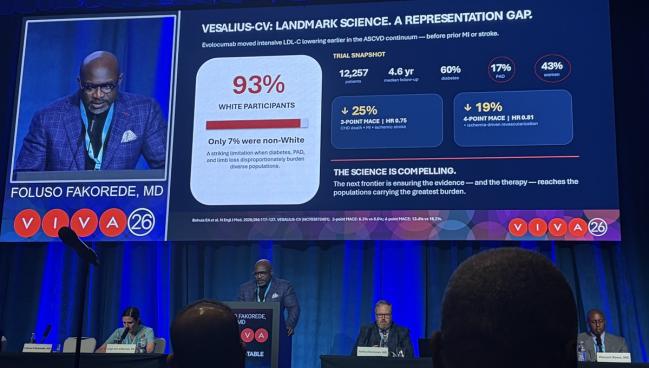
In addition to documenting the problems, researchers need to invest more effort to enroll minority patients in landmark trials of CV prevention, which could move the needle in the direction of improving early PAD care in those with the highest disease burden, he said. In the VESALIUS-CV trial, adding the PCSK9 inhibitor evolocumab (Repatha; Amgen) on top of statins reduced the risk of MACE in patients with a prior CABG, but only 7% of the trial participants were nonwhite. There also is good evidence from the STRIDE trial that in patients with diabetes and PAD, treatment with semaglutide (Wegovy; Novo Nordisk) can improve their walking distance, pain-free walking ability, and PAD-related quality of life.
One major issue that Fakorede said is important to keep in mind regarding PAD detection is that it must be seen as a complete care pathway, not just an ankle-brachial index test to establish that a patient has the disease.
“A more clinically relevant question should be: can targeted early PAD detection in high-risk people prevent cardiovascular deaths, CLTI [chronic limb-threatening ischemia], disability, major amputations, and death across the continuum from awareness to risk identification, detection, diagnosis, referral, limb preservation, and outcomes,” he added.
AI and Heatmap Data Can Help
Also in the session, Elsie Ross, MD (University of California, San Diego), said artificial intelligence (AI) is emerging as another potentially important avenue to improve care pathways.
The 7,800-patient AID-PAD study beginning this month will combine EHRs and machine learning to automatically flag patients with vascular disease. But importantly, the flag will have an action item attached, which will recommend appropriate GDMT. Another study, PAD-ALERT, will compare alert-based decision support versus standard care in PAD patients not on lipid-lowering therapy to see if it can reduce clinical inertia and prompt greater initiation of appropriate therapy.
Similarly, Leigh Ann O’Banion, MD (University of California San Francisco, Fresno), noted in her presentation that much of vascular care has historically been reactive rather than proactive, with advanced technologies and limb salvage often coming too late for many patients.
“Our current model is that we intervene after years of progressive disease. Patients are already coming in with gangrene, with tissue loss, with rest pain, when the real thing that we need to be doing is addressing it on the front end . . . where we modify the risk factors,” she said. “I truly do think that the best opportunity to preserve a limb is before a patient ever develops CLTI, [by providing] education, modifying their risk factors, and linking them to primary care.”
While catching patients early when they’re asymptomatic is crucial, lack of comprehensive PAD screening services in the United States is a significant barrier to doing that. Recently, the PAD Collaborative, which consists of 17 professional organizations including VIVA, created an interactive “heatmap” of the country that provides data on rates of lower-limb amputation both geographically and by congressional district.
In a recent study, O’Banion and colleagues examined heatmaps for California and found that 6.4 million residents live in regions where there are no vascular providers. They identified one of these vascular deserts and organized targeted outreach efforts to provide peripheral vascular and cardiovascular screening to at-risk patients through a program called CHAMPIONS. Fully 27% had no primary care provider, 30% had undiagnosed diabetes, 38% had undiagnosed hypertension, 21% had intermittent claudication, 81% made less than $30,000 annually, and 28% had no health insurance. Those enrolled received free comprehensive cardiovascular screening and education on PAD and CAD.
“These are really, I think, missed opportunities and a signal that we can do better,” O’Banion noted. “We are using these maps to successfully reach these underserved populations, but we also have to make sure we’re reaching the right population. And that’s where the research continues, where basically you’re not just finding risk, but you’re finding disease.”
She added that the research already has picked up some useful clues about patient demographics, including a signal that compared with men, women in areas underserved by vascular providers may have higher odds of PAD detection at screening despite having a similar at-risk profile.
Another important finding coming out of this type of work, O’Banion said, is the realization that medical school curriculums need to pivot to include outreach and community engagement, both for educational purposes and to help instill the need for patient advocacy in new physicians.
Momentum in PAD Screening
“I think the emphasis is basically making sure that the primary care doctors or the gatekeepers have the investment and what they need to be incentivized to screen these patients [for PAD],” Fakorede noted. “If you don’t do that, you’re not going to see the results. We’re going to continue to see amputation or morbidity and mortality rise.”
Joshua A. Beckman, MD (UT Southwestern Medical Center, Dallas, TX), who moderated the session, said the problem is amplified because many internists don’t understand the need for this type of preventive screening.
“How did we ever end up in a world where people are more concerned with your cholesterol level than what a high cholesterol level could cause to occur? How, how do we begin to attack that stupidity?” he added.
Last year, Illinois enacted Senate bill 1418, which requires health insurance plans to cover routine PAD screenings for at-risk individuals every year. Fakorede was co-chair of the effort in partnership with the American College of Cardiology’s Illinois chapter and the Association of Black Cardiologists, which advocated for the legislation.
Speaking with TCTMD, Fakorede said he’s optimistic that other states will follow Illinois’ example.
“I’m happy to report to you that the Association of Black Cardiologists and the American College of Cardiology have now coalesced again to target about eight states that are high-burden diabetic states,” he said. “So we’re targeting Mississippi, Alabama, Louisiana, Georgia, Virginia, Tennessee, Arkansas, and Michigan. We sent out letters to legislators in those states who we think could impact and take on the bills, and we’ve gotten responses from three of them. We hope that by this time next year, we’ll have great news regarding other states as well.”
Echoing what Beckman said, Fakorede noted that the greatest challenge in the legislative space is getting policymakers to understand why screening bills like this are important by launching educational campaigns to help them make the connection.
“You have to really explain what PAD is. You have to help them understand the impact of it on their constituency, and you have to find the right people to be championing these bills. Then you have to find the doctors who have the same passion to go and be available to teach these legislatures what we’re trying to talk about,” he said. “We’re trying to find those agents of change. We’ve been lucky in Illinois, and hopefully we can find the same in other states.”

L.A. McKeown is a Senior Medical Journalist for TCTMD, the Section Editor of CV Team Forum, and Senior Medical…
Read Full BioSources
Fakorede F. Have we moved the needle? Measuring progress in closing gaps in vascular care. Presented at: VIVA 2026. October 6, 2026. Las Vegas, NV.
O’Banion LA. Closing the gap in limb salvage: programs that actually work. Presented at: VIVA 2026. October 6, 2026. Las Vegas, NV.
Ross E. Can AI help close the gap? Using data to reduce variation and missed care in vascular disease.
Disclosures
- Fakorede reports no relevant conflicts of interest.
- Ross reports receiving honoraria from Cook Medical and consulting for Novartis.
- O’Banion reports consulting for Gore, Medtronic, and Shockwave; and serving on the speakers’ bureau for Huntleigh and Penumbra.
Related News



Comments