SELUTION De Novo Data Support ‘Keeping It Simple’ With DCB in Complex PCI
The curves for TVF separated early and remained parallel in the complex cases, giving an advantage to the DCB group at 1 year.


PARIS, France—The Selution sirolimus-eluting balloon (Cordis) is safe and effective in complex PCI as an alternative strategy to systematic stenting, according to a subgroup analysis of the SELUTION De Novo trial.
At 1 year, the primary endpoint of target vessel failure—which included cardiac death, target-vessel MI, and clinically driven target-vessel revascularization—was 7.2% in the drug-coated balloon (DCB) group and 10.2% in the DES group, with the difference driven by lower rates of both target-vessel MI (2.6% vs 7.5%) and cardiac death (0.7% vs 1.9%).
As presenter Simon Eccleshall, MD (Norfolk and Norwich University Hospitals NHS Foundation Trust, England), showed here at EuroPCR 2026, the TVF event curves “don’t then seem to either come together or move further apart. They remain parallel throughout the year, which we think is of interest.”
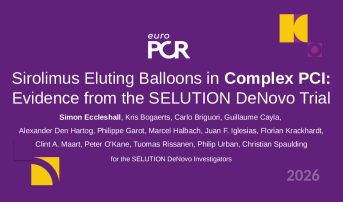
The findings are in line with the main SELUTION De Novo trial results presented last year at TCT 2025. A subgroup analysis of ACS patients presented recently at the Society for Cardiovascular Angiography and Interventions 2026 meeting provided further support for using the DCB.
“In certain parts of the world, a lot of this complex work would, in experienced centers with experienced operators, already be [pursued with] a balloon strategy rather than a stent strategy,” Eccleshall told TCTMD.
“We’re now moving much more down that route, partly because there are now trials coming out showing that in large-vessel angioplasty, such as the SELUTION De Novo trial overall, that there’s noninferiority at a year,” he added. “I think the hidden benefit probably comes out best in these sorts of complex subgroups in that when it gets more complicated, keeping it simpler seems to benefit the patient and therefore the outcomes.”
Complex PCI Subgroup Findings
In SELUTION De Novo, 3,323 patients with reference vessel diameters of 2.0 to 5.0 mm, with no limit of the number of lesions or vessels, were enrolled. Of those, 421 patients randomized to the DCB strategy underwent complex PCI, as did 414 of those randomized to the DES strategy. The mean age was 67 years and approximately 21% were women.
Complex PCI was defined as patients meeting at least one of the following criteria: treatment in all three coronary vessels, treatment of three or more lesions, use of three or more DCB or DES, bifurcation lesions with both main branch and side branch treated, chronic total occlusion, or total device length exceeding 60 mm.
The trial mandated predilatation and a minimum DCB inflation of 30 seconds. Minimal DES use was allowed for residual stenosis/recoil exceeding 30%, a high-risk dissection, or a lesion that remained hemodynamically significant.
When it gets more complicated, keeping it simpler seems to benefit the patient and therefore the outcomes. Simon Eccleshall
The mean number of lesions treated per patient was two. In the DCB group 42.3% had multivessel procedures, as did 45.7% of those in the DES group. Bifurcation lesions were present in 37.8% and 43.3%, respectively, and more than one-quarter of patients in each group had a moderate or severely calcified lesion. The use of specialty balloons was low overall, but they were used more frequently in the balloon arm than the stent arm during lesion preparation. Rates of intracoronary imaging also were generally low at 18% in the DCB group and 26% of the DES group.
The criteria for complex PCI that were met with the greatest frequency in both groups were total device length exceeding 60 mm, use of at least three devices, and bifurcation lesion with treatment of main and side branches.
Among the secondary endpoints, several favored the DCB over the DES strategy: any MI (3.3% vs 8.5%), periprocedural MI (2.1% vs 5.1%), late lesion thrombosis (0 vs 0.7%), and BARC 3-5 bleeding (0.7% vs 2.4%).
While there were no early or late safety concerns in the DCB group at the 1-year time point, Eccleshall noted that the study patients will be followed out to 5 years.
Lessons From a Strategy Trial
Other trials have similarly shown more clinically driven TVR with the DCB, “and here we seem to see virtually identical results,” said Eccleshall. In the complex subgroup, rates of TVR were 4.3% with the DCB vs 4.1% with DES.
He added that SELUTION De Novo was a strategy trial, not a device randomization trial. When the main analysis showing noninferiority of the DCB compared with DES at 1 year was originally presented, a point of contention was that without clear separation of the curves in favor of the DCB, it is difficult to make a case for changing practice.
So, seeing the separation of the curves in this subgroup at 1 year equates to “impressive results,” noted discussant Helen Routledge, MB ChB (Worcestershire Royal Hospital, England), following the presentation.
“It kind of plays into what the believers, I think, have thought about this for a long time, that the more complex the lesion, the less you’ve got to gain by putting a lot of metalwork in there, or the less you want to put a lot of metalwork in there,” she added.
Commenting on the parallel nature of the curves, Routledge asked if the advantage with DCB was due to periprocedural MI. “Was it an enzyme rise? Was it a real MI?” she asked. “What was going on there?”
Eccleshall believes the findings “reflect clinically driven periprocedural MI, where the operators are looking at this because the patient has the relevant symptoms. They’re having ECG changes. They’re having substantial myocardial damage along with an enzyme rise of 35 times, and it’s clinically driven, I think that’s the point. That was the main advantage then in the balloon group in this first year,” he said.
While it was almost all driven by periprocedural, there are subsequent benefits then on endpoints such as cardiac death and lesion thrombosis, he added.
Panelist Sripal Bangalore, MD (NYU Langone Health, New York, NY), also was curious about the periprocedural MI difference. “In one arm we are keeping the balloon up for 60 seconds,” he observed. “What is driving the difference in favor of a DCB to [have] lower periprocedural MI? Is it because we are closing some side branches with DES?”
Eccleshall said he isn’t sure.
“I think certainly some of this will be related to side branch loss because the rate of bifurcations in both arms was high,” he said. “And we know that you’re much more likely to lose a side branch when you stent across it than when you use a drug-eluting balloon. Possibly, there are other things coming into play, such as distal embolization, if you’re working in a patient with acute coronary syndrome, and perhaps, just the complete vessel trauma of doing very complex stenting in patients. Perhaps all of these things.
“I honestly don’t think we know the answer yet,” Eccleshall continued. “But it does really make the point that complexity makes everybody’s life more difficult, and if we can simplify, then that’s really important.”

L.A. McKeown is a Senior Medical Journalist for TCTMD, the Section Editor of CV Team Forum, and Senior Medical…
Read Full BioSources
Eccleshall S. Sirolimus eluting balloons in complex PCI: evidence from the SELUTION De Novo trial. Presented at: EuroPCR 2026. May 20, 2026. Paris, France.
Disclosures
- Eccleshall reports grant/research support from B. Braun; honoraria/consulting fees from B. Braun, Cordis, and Medtronic; and participating in company-sponsored speakers bureau for B. Braun, Cordis, and Medtronic.
Related News



Comments