SIMPLAAFY Supports Antithrombotic Monotherapy After LAAO
Accumulating evidence indicates that patients don’t benefit from DAPT after the procedure, Saibal Kar says.

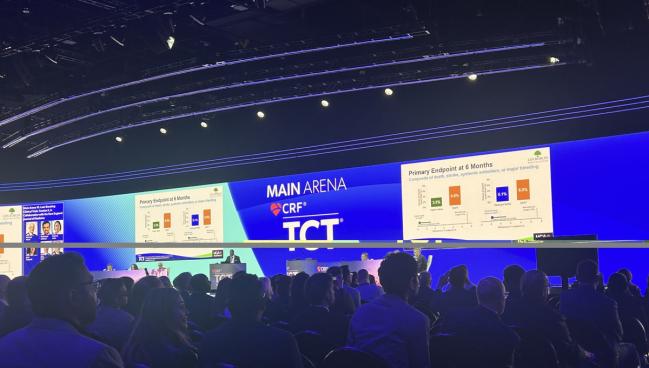
SAN DIEGO, CA—Two single antithrombotic therapy regimens each provide favorable results compared with dual antiplatelet therapy (DAPT) after an uncomplicated left atrial appendage occlusion (LAAO) procedure in patients with atrial fibrillation (AF), according to results of the SIMPLAAFY trial.
The composite rate of death, stroke, systemic embolism, or major bleeding at 6 months—the primary endpoint—was 6.9% among those treated with DAPT, 5.1% among those treated with a low-dose direct oral anticoagulant (DOAC), and 3.3% among those treated with low-dose aspirin. Both monotherapies were noninferior to DAPT using a 7.2% margin (P < 0.0001 for both).
Moreover, aspirin and low-dose DOACs reduced clinically relevant bleeding versus DAPT, with patients in the DOAC arm having the lowest rate of device-related thrombosis (DRT) at 45 days. The ischemic stroke rate was very low across all groups.
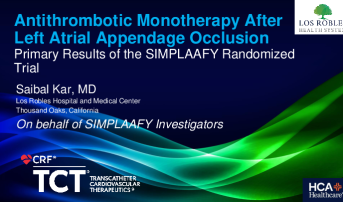
Saibal Kar, MD (Los Robles Hospital and Medical Center, Thousand Oaks, CA), who reported the results here at TCT 2026, said at a media briefing that “these findings support the simplification of antithrombotic management of uncomplicated left atrial appendage closure, [which] may be individualized according to competing bleeding and device-thrombotic risks and patient preferences.”
Kar said in a discussion following his presentation, for example, that he’d probably reach for low-dose aspirin for a patient coming in for LAAO primarily due to a history of bleeding, whereas a patient with a history of stroke and a reduced ejection fraction might be preferentially treated with low-dose DOACs.
SIMPLAAFY was published simultaneously in JAMA.
The SIMPLAAFY Trial
The optimal post-LAAO antithrombotic regimen is still up for debate. Many centers use 6 months of DAPT followed by single antiplatelet therapy, while others use full-dose DOACs for a short period of time, with both strategies intended to cover the period of device endothelialization. There is limited randomized evidence on the potential utility of simplified antithrombotic approaches, Kar said.
SIMPLAAFY was a multicenter, open-label trial that included 1,857 patients (mean age 76 years; 43% women) with AF who underwent LAAO with the Watchman FLX Pro device (Boston Scientific) without complications or peridevice leak after the procedure. They were randomized within 24 hours to one of three antithrombotic regimens:
- DAPT for 6 months, followed by aspirin alone
- Reduced-dose DOAC (either apixaban 2.5 mg twice daily or rivaroxaban 10 mg once daily) for 3 months, followed by aspirin alone
- Aspirin monotherapy at a dose of 81-100 mg
Both monotherapies were compared with DAPT, with no prespecified comparison of reduced-dose DOAC with aspirin monotherapy.
Clinical follow-up was conducted at 45 days, 3 months, and 6 months, with imaging conducted at 45 days. The researchers plan on performing additional clinical and imaging follow-ups at 12 months.
Through 6 months, adherence to the assigned antithrombotic regimen was higher among patients treated with aspirin (87.9%) and reduced-dose DOAC (85.3%) than among those treated with DAPT (76.8%), likely indicating better tolerance.
Acute safety was good across the three groups, with low rates of events during the first 7 days. Those included two noncardiovascular deaths (one in the DAPT group and one in the low-dose DOAC group), two ischemic strokes (both in the aspirin group), and two pericardial effusions requiring intervention (both in the aspirin group). Major bleeding occurred in one patient each in the monotherapy arms and three in the DAPT arm. No systemic embolism or device embolization was observed.
For the primary composite endpoint, the findings were generally consistent across subgroups, albeit with a significant interaction (P = 0.03) indicating that patients 75 years and older derived greater benefits from aspirin versus DAPT than their younger counterparts.
At 6 months, rates of death and stroke were low across groups, with no systemic embolisms. Any ISTH bleeding was lower among patients treated with aspirin or a low-dose DOAC (5.5% and 7.3%, respectively) than among those treated with DAPT (12.8%). Rates of both major and clinically relevant nonmajor bleeding were each numerically lower with the monotherapies versus DAPT.
At 45 days, transesophageal echocardiography or CT showed that about 79% of patients across groups had a completely sealed LAA, about 15% had peridevice leaks up to 3 mm in size, and the remainder had larger leaks. The rate of DRT was 0.9% in the low-dose DOAC group, 2.7% in the aspirin group, and 3.4% in the DAPT group. DRT was followed by a stroke in only one case, in a DAPT-treated patient.
Kar noted that the study was limited by having an imaging assessment at only 45 days—before patients on a low-dose DOAC switched to aspirin—for this analysis, meaning that later DRTs may have been missed. Repeat scans will be performed for the 1-year analysis.
What’s the Preferred Approach?
Earlier at the TCT meeting, attendees heard the 1-year results of the ANDES trial, showing that patients treated with 2 months of DOAC therapy after LAAO had less bleeding than did those treated with 2 months of DAPT, with both regimens followed by a switch to single antiplatelet therapy in most cases. There was, however, a higher rate of DRT in the DOAC arm.
Asked how to contextualize the ANDES and SIMPLAAFY findings, Kar focused on the growing body of evidence from these and other studies of LAAO “clearly showing you that dual antiplatelet therapy for a prolonged period of time, or 6 months, doesn’t benefit the patients. It actually leads to significant bleeding without benefits.”
As for the higher rate of DRT in the DOAC group in ANDES, Kar said “it’s a small study, so we don’t know whether this is noise or this is real.”
Overall, “we can say that monotherapy is probably the way to go—I’ll simplify it—for most patients,” he said, stressing that the SIMPLAAFY results apply to patients with uncomplicated procedures and a complete seal of the LAA immediately after the device is implanted.
Although a comparison of aspirin and low-dose DOAC was not prespecified, it did appear that aspirin had the lowest bleeding risk of the three regimens in the trial, along with a rate of DRT in between the other two regimens.
Those bleeding and thromboembolic risks need to be balanced, “and that’s why we didn’t want to come out straightaway and say that single antiplatelet [therapy] is the right way to go for all patients,” Kar said, adding, too, that the SIMPLAAFY findings may not apply to other LAAO devices.
There are few things in structural heart interventions that are more confusing to the interventionalist than antithrombotic therapy after left atrial appendage occlusion. Mohamad Alkhouli
Pinak Shah, MD (Mass General Brigham, Boston, MA), a panelist at the media briefing, acknowledged those caveats, and said, “I think we now have very good data saying that . . . monotherapy is appropriate,” expressing some skepticism about advising aspirin for most of these patients. That might make sense for patients with low bleeding risk, “but the higher DRT [versus low-dose DOAC therapy] is something to think about. So I would think that most of these patients ought to get a [DOAC], but if they are at higher bleeding risk, maybe think about aspirin.”
Mohamad Alkhouli, MD, MBA (Mayo Clinic, Rochester, MN), lead discussant for the trial, said “there are few things in structural heart interventions that are more confusing to the interventionalist than antithrombotic therapy after left atrial appendage occlusion. If you survey physicians globally, you’ll find heterogeneous practices mostly emerging from the lack of any definitive evidence to guide our approaches.”
Interpretation of the SIMPLAAFY findings is muddied somewhat by the lower-than-expected event rates, indicated Alkhouli, who was on the trial’s steering committee.
Even so, “aspirin seems to emerge as a winner,” with much lower rates of the primary endpoint versus DAPT, he said, adding that “the jury is still out” when it comes to low-dose DOAC.
Taking a broader view, Alkhouli noted that “we have been trying to force standardization in A-fib care for decades, and it seems that has not worked out. Maybe the way to go within the age of AI and multimodality imaging and sensing and omics is to take a step back and think about a different strategy—not a population-medicine strategy, but more of an individualized-patient strategy.”
He also highlighted the need for additional basic research into the process of device endothelialization after LAAO and questions about DRT. Even with Watchman FLX Pro, a new-generation device with a coating meant to reduce thrombogenicity, “still we haven’t been able to get rid of DRT,” Alkhouli added. “So is this something that would stick with us for life, and how are we going to approach it?”

Todd Neale is the Associate News Editor for TCTMD and a Senior Medical Journalist. He got his start in journalism at …
Read Full BioSources
Reddy VY, Saliba WI, Waggoner T, et al. Antithrombotic therapy after left atrial appendage occlusion: the SIMPLAAFY randomized clinical trial. JAMA. 2026;Epub ahead of print.
Disclosures
- SIMPLAAFY was funded by Boston Scientific.
- Kar reports receiving consulting fees/honoraria/speaking fees from Boston Scientific, Abbott Vascular, and W.L. Gore & Associates; receiving grant support/research contracts from Abbott Vascular, Boston Scientific, Edwards Lifesciences, Medtronic, and HiLife; serving as principal investigator (PI) of the CHAMPION-AF and PINNACLE FLX trials (Boston Scientific) and the REPAIR MR trial and EXPAND registry (Abbott Vascular); serving as a member of the scientific advisory board for InterShunt Technologies; and serving as an advisor and co-PI of the pivotal IDE trial of the Laminar LAAO device.
- Alkhouli reports receiving consulting fees/honoraria/speaking fees from Boston Scientific and Abbott; receiving grant support/research contracts from Boston Scientific; and holding equity/stocks/options in SandboxAQ.
- Shah reports receiving consulting fees/honoraria/speaking fees from Edwards Lifesciences and holding equity/stocks/options in Xenter.
Related News


Comments