Single Heartbeat CCTA Acquisition Suffices in Many Young, Low-risk Patients
(UPDATED) The FLASH protocol, associated with less radiation than a CAC scan, should be used more often in this cohort, a researcher says.
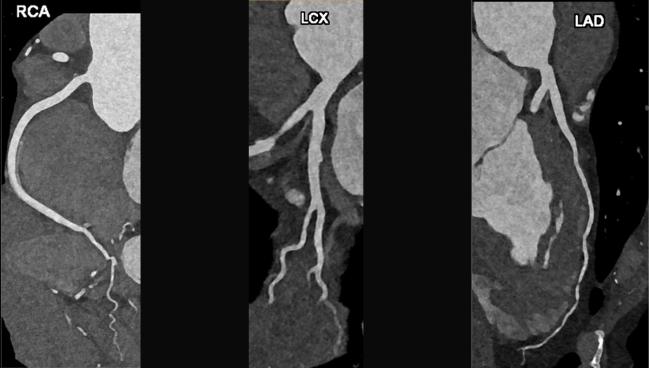
Curved planar reformats of the coronary arteries. Photo Credit: Avinainder Singh
CHULA VISTA, CA—For low-risk patients with no known coronary artery disease sent for coronary computed tomography angiography (CCTA), using single-heartbeat versus standard acquisition settings on new-generation scanners can drastically cut radiation exposure without sacrificing diagnostic effectiveness, according to new data.
High-pitch prospective helical acquisition, known as FLASH, is available on most CT scanners, but many imagers are reluctant to use it given the lack of a multiphase buffer provided by traditional acquisition settings.
Researchers led by Avinainder Singh, MD (Brigham and Women’s Hospital, Boston, MA), who presented the findings recently at the 2026 Society of Cardiovascular Computed Tomography meeting, show a median effective radiation dose of 0.82 mSv among patients analyzed in their prospective registry, with 97% of patients ultimately classified to CAD-RADS scores of 0 or 1.
The FLASH protocol is “a single heartbeat, single-phase acquisition,” Singh explained. “Once the patient . . . lays down on the scanner, the scanner just goes. It’s almost like hitting the eject button because it goes so fast.” Until now, he added, there has been little data on its effectiveness on newer-generation, photon-counting scanners, especially in younger patients in whom radiation exposure has potentially greater implications.
“So, we said, ‘Why don’t we create a low-radiation protocol for low-risk, young patients who are unlikely to have disease and see how it goes?’” Singh said. Ultimately, “our radiation was so low that it was less than a calcium score, which is a noncontrast scan. It worked wonders.”
Orly Goitein, MD (Sheba Medical Center, Ramat Gan, Israel), who served as a moderator for the poster session in which the data were presented, said the findings are intriguing. “I must say that we hardly use the FLASH mode, definitely not enough,” she told TCTMD. “We should definitely do that. It’s very fast and efficient and a great way to use the scanner. This is super attractive.”
That said, Goitein continued, “you need to be on board, your techs need to be on board, [and] you need to identify the correct patient.” Both the patient’s body size and their heart rate will affect candidacy for this protocol, she explained. Using FLASH mode is “like gambling,” she said. “You get what you get. You get only one phase.”
Low Radiation, High Quality
Singh and colleagues analyzed 70 patients (mean age 36 years; 41% women) referred for CCTA using FLASH acquisition on a fourth-generation dual-source photon-counting scanner (NAEOTOM Alpha; Siemens). Mean patient body mass index was 26.5 kg/m2 and mean heart rate was 58 beats per minute. More than half of patients (59%) had dyslipidemia, and 51% had a family history of premature CAD.
Effective dose of radiation was below 1 mSv, which is the typical radiation exposure with a coronary artery calcium (CAC) scan, in 70% of patients. Image quality was largely deemed excellent (51%) or good (27%), with six scans (9%) considered nondiagnostic and repeated using either a second FLASH protocol or conventional prospective multiphase scanning.
Ultimately, 81% had a CAD-RADS score of 0 and 16% had a score of 1. One patient each had scores of 2 and 4A, with the latter confirmed by invasive coronary angiography.
“The very small amount of nondiagnostic scans [was] really encouraging,” Goitein said.
Even with taking a chance on a FLASH protocol, if the scan is deemed to be nondiagnostic, “frankly, the radiation penalty is so small, [that] you don’t lose much,” Singh said. “The caveat there is most of the time it works really well, and even if it doesn’t, the price you pay is not that high.”
Singh’s team plans to continue using this protocol primarily for younger patients with chest pain who are referred to ensure they don’t have anomalous coronary arteries. “It’s in clinical practice now,” he said. “The main thing is the heart rate. The heart rate needs to be really low.”
Goitein asked how heart rate variability might affect results, and Singh responded by acknowledging that many of these younger patients have sinus arrhythmias. “We so far have been lucky enough to ignore it, and we push IV beta-blockers or give oral beta-blockers for most patients [to] help regulate that variability a little bit,” he said. “We did run into a few issues with [premature ventricular contractions] early on, but it’s been largely okay. . . . If the resting heart rate is above 70, then we’ll just switch to prospective [scanning].”
To TCTMD, senior author Arthur Shiyovich, MD (Brigham and Women’s Hospital), said he is most excited about the implications of using FLASH imaging in younger patients. “Historically, there has been understandable hesitation to perform coronary CTA in younger individuals because of concerns about radiation exposure,” he said in an email. Other new research has shown that “coronary atherosclerosis is far from rare in this population, with a substantial proportion of young adults harboring both nonobstructive and obstructive plaque associated with adverse long-term outcomes.”
With increasing reliance on CCTA for not only evaluating symptomatic patients but also preventing CVD and personalizing care in young adults, “minimizing radiation exposure becomes even more critical,” Shiyovich continued. “By combining FLASH acquisition with photon-counting CT, we can achieve diagnostic image quality at exceptionally low radiation doses while leveraging the superior spatial resolution, improved contrast-to-noise ratio, and reduced blooming artifacts offered by photon-counting technology.”

Yael L. Maxwell is Senior Medical Journalist for TCTMD and Section Editor of TCTMD's Fellows Forum. She served as the inaugural…
Read Full BioSources
Singh A. How low can you go? Photon-counting CCTA for less radiation than a CAC score. Presented at: SCCT 2026. July 10, 2026. Chula Vista, CA.
Disclosures
- Singh and Goitein report no relevant conflicts of interest.
Related News

Comments