Sirolimus DCB Holds Up Well at 1 Year vs Standard DES in TRANSFORM II
The rates of TLF were considerably lower than the investigators expected, leading to questions about experience and selection.

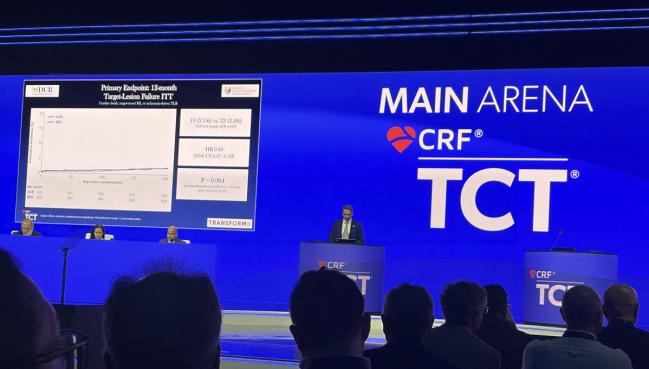
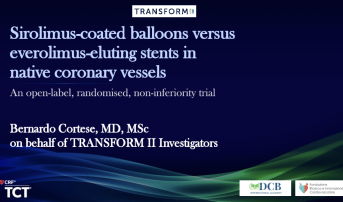
SAN DIEGO, CA—In a head-to-head trial, a sirolimus-based drug-coated balloon (DCB) was noninferior to a standard-of-care everolimus DES, with similar rates of target lesion failure (TLF) at 1 year and low rates of bail-out stenting, results of the TRANSFORM II trial show.
TLF, characterized as cardiac death, target-vessel MI, or ischemia-driven TLR, occurred at rates of 2.1% at 12 months in patients randomized to the sirolimus DCB and 2.4% in those randomized to the everolimus DES (P = 0.004 for noninferiority). The results were consistent across intention-to-treat, per-protocol, and device-received analyses.
Investigators were struck by the low event rates, particularly since they expected to see rates of about 6%, said Bernardo Cortese, MD (Case Western Reserve University School of Medicine, Cleveland, OH, and Fondazione Ricerca e Innovazione Cardiovascolare, Milan, Italy), in a media briefing prior his presentation in a late-breaking trial session at TCT 2026. With that in mind, they’d set the noninferiority margin at 1.5%.
“The centers were experienced in DCB PCI, so we cannot say that any [other] center can perform as well as these centers, and we only have 1-year follow-up,” he cautioned. Overall, Cortese said the results suggest that “the DCB approach is a safe and effective alternative to stents in a select population of de novo lesions.”
Prior evidence for how contemporary coronary DCBs perform compared with stents in de novo disease has been mixed. In REC-CAGEFREE I, a paclitaxel-coated balloon (Swide DCB; Shenqi) did not perform as well as a DES at 3 years, while SELUTION DeNovo found that a sirolimus-coated balloon (Selution; Cordis) was noninferior for the primary endpoint of TLF at 1 year compared with a DES.
In the media briefing, Kyung Woo Park, MD, PhD (Seoul National University Hospital, Republic of Korea), said he was struck by the difference between the clinically driven TLR rates in TRANSFORM II, which were 0.9% with DCB and 0.8% with DES (HR 1.15; 95% CI 0.42-3.17), and the rates of any TLR, which were 2.5% and 1.1%, respectively (HR 2.31; 95% CI 1.10-4.85).
“Our interpretation is that the physicians, when they see an angiogram [that is not good], they tend to re-treat it after a DCB,” Cortese noted. “[W]ith the stents, they are a little bit more conservative. But the numbers were very low, so this is very, very speculative.”
Discussant Margaret McEntegart, MD, PhD (NewYork-Presbyterian/Columbia University Irving Medical Center, New York, NY), noted the bailout stenting rate of 7.6% in TRANSFORM II, which was much lower than the 20% seen in SELUTION DeNovo—a strategy trial—but was consistent with the 9.4% rate seen in REC-CAGEFREE I.
To TCTMD, Cortese explained that in SELUTION DeNovo, patients were randomized before lesion preparation, whereas TRANSFORM II excluded patients whose lesion preparation was not successful.
“And so in this case, the bailout stenting is usually lower,” he said. That’s why the rates in this trial are in line with those of REC-CAGEFREE I, which followed a similar methodology.
McEntegart also noted that patients in the DCB group had fewer left anterior descending artery lesions treated than did those who received DES and more complex lesions.
”For clinicians not used to using DCB in their practice, for instance like here in the USA, the two things people say they’re concerned about is acute vessel closure . . . and the other thing they’re concerned about is TLR,” McEntegart added.
Cortese said there were “zero cases in the DCB arm of acute, subacute, or late occlusion within the year, but very few also in the DES arm, to be honest. But again, this is a super selective population.”
Secondary Endpoints and Other Questions
After successful lesion preparation, the TRANSFORM II investigators randomized 922 patients from 52 sites to the sirolimus-coated balloon (MagicTouch; Concept Medical) and 920 to an everolimus-eluting stent. Approximately half of the cohort had ACS, one-third had diabetes, and around one-third had Academic Research Consortium-defined high bleeding risk.
Cortese pointed out that significant percentages of patients in the DCB and DES groups underwent multivessel PCI (40.3% and 33.7%, respectively). Mean lesion lengths were 19.4 and 21.4 mm, respectively—with lesions up to 50 mm allowed—and mean reference vessel diameters were 2.76 and 2.82 mm, respectively, with more than 40% in each group having a diameter of 3.0 mm or greater. Rates of intravascular imaging were approximately 25% in each arm.
Looking at secondary endpoints at 12 months, the rate of net adverse clinical events (NACE; all-cause death, MI, ischemic stroke, or BARC-defined major bleeding) was 4.1% in the DCB group versus 5.3% in the DES group (HR 0.77; 95% CI 0.50-1.17). Despite the lack of statistical difference, the DCB group had numerically fewer NACE compared with the DES group (38 vs 49).
The rate of screening failures was 17%. Asked what the investigators learned from those screening failures that could help operators understand who might best benefit from this therapy, Cortese told TCTMD that they are likely an artifact of where the study was conducted, adding that he suspects that the rate would have been lower if it had been done in the US.
“Here, the screening is done appropriately, and by dedicated staff. In Europe and in Asia, it’s not like that,” he added, noting that some of the factors that would qualify for screening failure likely were not observed until the patient was on the table. Most screening failures were related to the vessel length being outside the inclusion criteria, but there also were about 40 patients who had a prior stent placed and 40 who had an LVEF below 80%.
Cost Considerations
Session moderator Ajay Kirtane, MD (NewYork-Presbyterian/Columbia University Irving Medical Center), said it’s important, especially in the US, to recognize the high costs of coronary DCBs in comparison with DES.
“Financial reimbursement is still a big issue for centers and I think it will continue to be, particularly as we get farther along and all the Medicare mandates end,” agreed panelist Jennifer A. Tremmel, MD (Stanford University School of Medicine, CA). “This data is very important to that and especially the long-term data, because we’re going to have to decide who gets DCB, who gets DES, when do they get it, and the financials are going to make a difference. So, I’m curious to see how things go over the long term, and ultimately which patients we decide to use this in first.”
Panelist Emmanouil S. Brilakis, MD, PhD (Minneapolis Heart Institute Foundation, MN), said the positive sirolimus DCB data now may leave some clinicians wondering about paclitaxel.
Cortese noted the recent success of sirolimus DCBs in the treatment of PAD are hinting that the drug may have a more consistent effect in terms of reduction of events over the long term compared with paclitaxel.
“So this is an advantage of this drug, but that said, I’m also a big fan of paclitaxel,” he added. “We have a huge amount of data for small-vessel disease, for side branch management, so I don’t think that we should forget about paclitaxel at this point.”
Kirtane added that it’s also important to keep in mind that specific formulations that have thus far been used in the various devices and pivotal trials vary. “So rather than simplifying it to say it’s one drug versus another, it’s really the drug plus the tissue concentration, and how that gets done is dependent upon the excipient,” he observed. “A lot of it remains to be seen, but certainly 2 years now in a row, DCB trials are really making an impact here in the US.”

L.A. McKeown is a Senior Medical Journalist for TCTMD, the Section Editor of CV Team Forum, and Senior Medical…
Read Full BioSources
Cortese B. Sirolimus-coated balloons versus everolimus-eluting stents in native coronary vessels: an open-label, randomized, non-inferiority trial. Presented at: TCT 2026. November 1, 2026. San Diego, CA.
Disclosures
- Cortese reports participation in a company sponsored speaker’s bureau with Cordis, Concept Medical, Angiodynamics and Cardionovum; grants/research support from B.Braun Melsungen AG, iVascular, Cordis, Concept Medical, and ANT; and honoraria or consultation fees from iVascular, Concept Medical, Boston Scientific, Abbott Vascular, Cordis, Cardionovum, ANT, Abbott, Angiodynamics, and Gentuity.
Related News


Comments