Sirolimus DCBs in PAD and CLTI: Three Studies Add Support
The evolving data now show clear biological efficacy with impact on hard clinical outcomes, says Sahil Parikh.

LAS VEGAS, NV—Data from three studies add more evidence of the efficacy and safety of sirolimus-eluting drug-coated balloons (DCBs) in the treatment of lower-extremity peripheral artery disease. All three were presented here at the VIVA 2026 meeting.
These include a secondary analysis from the SirPAD trial of the MagicTouch DCB (Concept Medical) as well as the SELUTION4SFA trial of the Selution SLR (Cordis) DCB and international postmarket data on the latter device.
“I think it’s indisputably real. There is a biological efficacy,” Sahil Parikh, MD (NewYork-Presbyterian/Columbia University Irving Medical Center, New York, NY), who was a panelist in the late-breaking session, told TCTMD.
While there had previously been clear efficacy signals in support of sirolimus, including data from the SIRONA trial showing MagicTouch to be noninferior to paclitaxel-coated DCBs for the treatment of femoropopliteal artery disease, the ongoing data generation combined with no signals of harm positions it as a serious competitor to paclitaxel, which has been the mainstay DCB choice until fairly recently, he added.
The evidence “also lays to rest whether [sirolimus] improves hard clinical endpoints such as amputation, which is something that has been debated,” Parikh said.
SirPAD Subgroups
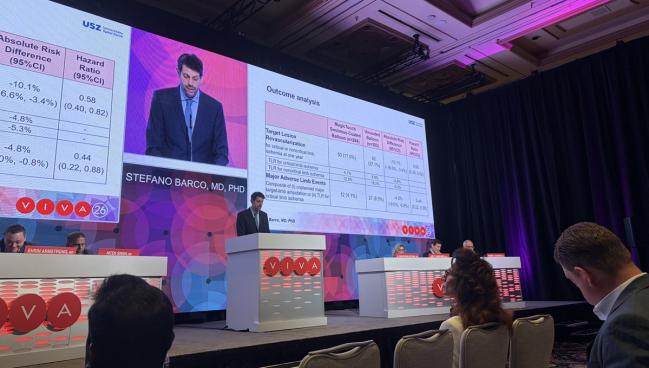
In a secondary analysis from the randomized SirPAD trial looking at only the patients without tissue loss, the rate of target lesion revascularization was lower with a the MagicTouch than with an uncoated balloon at 1 year (17.0% vs. 27.1%). Major adverse limb events also were less frequent (4.1% vs. 8.9%) with the DCB, as was the composite of any amputation or revascularization (17.7% vs. 27.1%).
Presenter Stefano Barco, MD, PhD (University Hospital Zurich, Switzerland), presented a secondary analysis from the randomized SirPAD trial looking at only the 421 patients in the study without tissue loss (baseline Rutherford stage up to 4 or Fontaine stage up to III), who had a median age of 71 years.
He noted that the main trial enrolled an all-comers population in which patients with below-the-knee (BTK) disease comprised 30% of participants and more than 40% had acute or chronic limb threatening ischemia (CLTI). The decision to focus on patients without tissue loss was made bearing in mind that revascularization decisions in this patient group are more likely to take into account practical benefits like freedom from reintervention and symptom-related goals rather than limb salvage.
The difference in TLR in favor of sirolimus emerged early, ”with the persistence of benefit up to year one and no catch-up effect in the final 6 months of observation,” Barco added. The reduction in any TLR was consistent in the sirolimus group across sex, age, and lesion type, and regardless of any prior interventions.
The study was simultaneously published in JACC.
Selution SLR in PAD
SELUTION4SFA, meanwhile compared the Selution SLR with uncoated balloon in 300 patients with symptomatic PAD (mean age 70 years). At 1 year, the composite primary efficacy endpoint of freedom from TLR and restenosis had occurred at rates of 78.6% in the DCB group and 65.2% in the uncoated balloon group, which met superiority for efficacy (P = 0.019). The primary safety endpoint also was met, with rates of the composite of freedom from perioperative death at 30 days, and freedom from target limb amputation and TLR at 1 year of 92.8% versus 84.2% in the uncoated group (P < 0.0001).
In Kaplan Meier analyses, the primary patency at 1 year was 90.3% in DEB vs. 79.4% in the uncoated group (P = 0.006), and freedom from TLR was 94.6% and 85.3%, respectively (P = 0.006).
Study presenter Jay Mathews, MD (Manatee Memorial Hospital, Bradenton, FL), noted that while a common criticism of both paclitaxel and sirolimus device trials is that the comparator is often an uncoated balloon, studies like this suggest that even that group is now tough competition due to technical improvements that have led to better outcomes for plain old balloon angioplasty compared with older trials.
The third study, presented by Thomas Zeller, MD, PhD (Universitäts-Herzzentrum Freiburg-Bad Krozingen, Germany), gave insight into long-term outcomes for the Selution SLR from a postmarket registry of 720 patients (mean age 70.7 years) with claudication and CLTI treated in Europe, Asia, and South America. At 24 months, freedom from TLR was 86.1% in the overall group and 83.0% in those with CLTI.
Zeller said there were no safety concerns in this registry population.
Signals Support Sirolimus
Following his presentation, Barco said his group is exclusively using sirolimus DCBs now in light of the SirPAD results as well as the fact that paclitaxel-based devices for PAD are difficult to source in Europe. Safety issues associated with the drug were first proposed in a meta-analysis published in 2018. More recently, a clinical and regulatory pivot occurred in Europe when renewed questions about safety were raised by the SWEDEPAD trial. In a focused guideline update published in June, the European Society for Vascular Surgery concluded that paclitaxel “may be considered only for selected cases with restenosis following transparent discussion of uncertain long-term safety and, at best, modest symptomatic benefit.”
There also are suggestions from the SirPAD data and other studies that sirolimus may have some advantages over paclitaxel that aren’t yet fully understood.
“With paclitaxel we see generally about a 10% year-over-year drop-off in primary patency TLR rates. We’re not seeing that as much with sirolimus and that’s a little bit surprising,” Parikh noted. “But, it is reminiscent of what we see in the coronaries, where after the first year you have pretty low steady state event rates. I think we’ll know more as we get a few more years out, but that is intriguing and that would be a very important value proposition for the use of one drug over another.”
My hunch is that . . . we’re going to need more than one drug to get it just right for all of these different indications. Peter A. Schneider
Subgroup analyses from some of the studies may help researchers understand more about drug elution and how sirolimus is working in peripheral arteries, perhaps differently from paclitaxel. Since SELUTION4SFA allowed vessel preparation with a variety of methods, Mathews said looking at these nuances could yield important clues.
“I’m certainly very interested in seeing how we tease out these groups based on the degree of calcification in terms of what algorithm or strategy was used, whether or not there was some potential changes in terms of outcomes,” he said. “I think there’s a large enough number of patients within the trial that we can actually try to at least have hints or some answers for us to that question.”
As to the question of what will be needed to support regulatory approval in the United States, Barco said he believes the SirPAD data are “the best evidence we have on clinical outcomes, and this should be level one evidence for any approval in any country.”
In a separate session, Peter A. Schneider, MD (University of California, San Francisco), said the question of whether sirolimus will supplant paclitaxel in PAD and CLTI or will become an equivalent choice “is absolutely germane to our future and also to our patients’ future.”
In a fairly short period of time, PAD treatment has progressed to a point where vascular medicine specialists have and need options, he added.
“The truth is that we deal with such a variety of lesions, whether it’s calcified, whether it’s a long fem-pop, whether it’s a BTK lesion, whether it’s in-stent restenosis. My hunch is that, life being more complicated than we often envision, we’re going to need more than one drug to get it just right for all of these different indications,” Schneider added.

L.A. McKeown is a Senior Medical Journalist for TCTMD, the Section Editor of CV Team Forum, and Senior Medical…
Read Full BioSources
Tsaftaridis N, Wolf S, Engelberger RP, et al. Sirolimus-coated balloon angioplasty for femoropopliteal artery disease without tissue loss: a secondary analysis of the SirPAD trial. JACC. 2026;Epub ahead of print.
Mathews J. First report of the 12-month results from the SELUTION4SFA RCT: comparison of a sirolimus-eluting balloon versus balloon angioplasty for the treatment of femoropopliteal artery lesions. Presented at: VIVA 2026. October 5, 2026. Las Vegas, NV.
Zeller T. 24-month data from the SUCCESS PTA study: performance of a novel sirolimus eluting balloon in real-world peripheral artery disease patients. Presented at: VIVA 2026. October 5, 2026. Las Vegas, NV.
Disclosures
- SirPAD was funded by Concept Medical.
- Barco has received a research grant from Concept Medical and serves as a consultant for Boston Scientific, Concept Medical, Inari Medical, andPenumbra with honoraria paid to his institution.
Related News

Comments