SIRONA: Sirolimus DCB Efficacy Extends to 3 Years in PAD
Patient-reported improvements in walking distance, pain, and QoL were not different between groups.

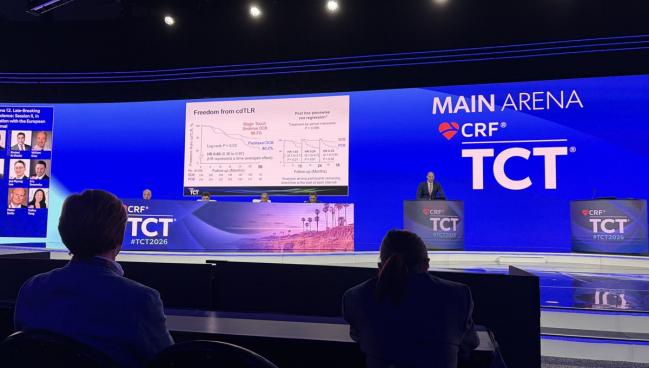
SAN DIEGO, CA—Longer-term data from the SIRONA trial continue to show no clinical, functional, or quality-of-life (QoL) differences in patients with symptomatic femoropopliteal artery disease treated with a sirolimus versus a paclitaxel drug-coated balloon (DCB).
At 3 years, freedom from clinically driven target lesion revascularization (TLR) was higher at 88.2% with the sirolimus DCB (MagicTouch; Concept Medical) compared with 80.2% with any of the several commercially available paclitaxel DCBs permitted for use in Germany and Austria during the trial (log-rank P = 0.03).
“The patient-reported outcomes at 3 years do not differ between the groups and all-cause mortality and major amputation [were] very low and nearly identical in both groups,” said Ulf Teichgräber, MD (University Hospital Jena, Germany), who presented the findings during a late-breaking trial session at TCT 2026. He noted that the findings remain exploratory and will require further confirmation at 4- and 5-year follow-up.
The study was simultaneously published in JACC: Cardiovascular Interventions.
Discussant Eric Secemsky, MD (Beth Israel Deaconess Medical Center, Boston, MA), said extrapolation to US practice is challenging because there are no approved sirolimus devices as yet for peripheral use and some of the devices in the paclitaxel arm also are not available.
Still, he said the 3-year SIRONA data provide an answer to remaining questions about the potential of sirolimus DCBs in routine PAD therapy.
“Our fempop patients aren’t coming in just to heal, they’re coming in to get their lives back. We want to extend that as far out as possible,” Secemsky observed. “I think today we’ve answered these questions. We now see data out to 3 years showing a persistent effect of the sirolimus MagicTouch balloon compared to a mix of paclitaxel DCBs. We’re starting to learn more about these balloon platforms. We’ve seen in other limus platforms as well that the long-term plateau of that curve tends to stabilize, [whereas] we see a degradation of the paclitaxel curve over time.”
Secemsky added that the real question to come now is: “is it time for limus to take over DCBs as we saw in coronary stents? And what is the future of paclitaxel devices?”
Our fempop patients aren’t coming in just to heal, they’re coming in to get their lives back. Eric Secemsky
Speaking with TCTMD, Sahil Parikh, MD (NewYork-Presbyterian/Columbia University Irving Medical Center, New York, NY), the session moderator, said the SIRONA data add to accumulating evidence from other trials like SirPAD and SELUTION4SFA showing that limus-based devices are shaping up to be potentially serious contenders to gold-standard paclitaxel in the treatment of lower-extremity PAD. In addition to sirolimus, the LIFE-BTK trial demonstrated that everolimus in the form of a drug-eluting resorbable scaffold is safe and effective in the treatment of infrapopliteal chronic limb-threatening ischemia (CLTI).
“There’s some momentum now developing with the limus devices that’s showing efficacy that’s pretty interesting and good, and if it’s continued, that would be encouraging,” Parikh commented.
“As far as the value of SIRONA at this point, 3 years is a horizon where you can look a patient in their eyes and say, ‘Yeah, okay, we can give you good relief from symptoms without a repeat procedure now for 3 years,’” he said. “Since these patients are claudicants, we’re less focused on limb salvage, so the efficacy signal and the idea that there is a very good chance that they won’t need to come back for another procedure—which we know these patients do not want to have to do—is important to them and to us.”
SIRONA at 3 Years
SIRONA tested the sirolimus DCB against seven commercially available paclitaxel DCBs. The study randomized 482 patients (mean age 68 years; 35% female) from 25 clinical sites in Germany and Austria who had a mean lesion length of 84 mm. The majority of patients (96%) had Rutherford category 2 or 3 intermittent claudication.
Total occlusions were present in approximately one-third of patients, 45% had grade 3 calcification on the peripheral artery calcification scoring system (PACSS), and nearly 30% had grade 4 calcification. Mean diameter stenosis was 83% in the sirolimus arm and 82% in the paclitaxel arm, with about 40% of the cohort having fewer than two runoff vessels.
Patient-reported changes in pain-free and maximum walking distance improved in both treatment groups, with no between-group differences at 3 years. Quality of life, as measured by the EQ-5D-3L, improved similarly in both groups.
In terms of safety, the rate of all-cause mortality was 7.4% in both groups (HR 1.16, 95% CI 0.59-2.28), and amputation-free survival was 92.1% in the sirolimus group and 92.2% in the paclitaxel group. There was one major amputation in the sirolimus group and two in the paclitaxel group (HR 0.54; 95% CI 0.04-5.97). The 3-year Kaplan-Meier estimate for freedom from clinically driven TVR was not significantly different between groups (log-rank P = 0.27).
Sirolimus vs Paclitaxel: Still Many Questions
To TCTMD, Parikh cautioned that there is nothing to indicate that there is a class effect for limus-based therapies used in the superficial femoral artery (SFA).
“It’s natural to wonder about that, but I think they all have their own little nuances [because] there are differences in the excipient, the drug, the technology, the balloon, et cetera,” he added.
Teichgräber admitted to being somewhat “astonished” by the signal for sustained efficacy that has been seen in SIRONA thus far and now is eager to look for further reasons why sirolimus may be so effective in femoropopliteal disease, with a particular interest in the idea that it may induce durable modulation of the vascular smooth muscle cell (VSMC) phenotype beyond active drug exposure.
“We have to rethink if there are also epigenetic effects,” he told TCTMD.
While the VSMC theory is biologically plausible, it’s complex and relies on a number of unproven factors that include multiple interacting signaling, transcriptional, and epigenetic mechanisms that are currently unclear. Teichgräber said he holds out hope of one day defining a mechanism through which “reprogramming,” as a result of exposure to sirolimus, demonstrably reduces neointimal proliferation in response to vascular injury, which in turn could explain fewer late restenotic events and lower rates of target lesion revascularization.
Asked by TCTMD what the next steps may be to go deeper to uncover more about the differences in response to sirolimus, he said, “I think we have to go back to the roots, especially for long-term results.”
What is known is that compared with paclitaxel, sirolimus is less aggressively cytotoxic and poses less likelihood of vessel-wall degradation.
Parikh said differences in drug efficacy by lesion subsets may be an interesting future area to pursue.
Similarly, Teichgräber raised the issue of the impact of calcification on drug response given that the SIRONA patients for the most part had high rates of calcification.
“I was also wondering how it is working in patients [in whom] lesions are less calcified. Do we see the same effect? So therefore, we really need more clinical trials on that,” he added.
Douglas E. Drachman, MD (Mass General Brigham, Boston), commented on the findings in the media briefing.
“On the one hand, the paclitaxel camp will say it has better residence time in the tissues because it is more lipophilic, and so . . . it stays there and can have durable impact. Sirolimus, on the other hand, [some] will argue it is not cytotoxic, it is cytostatic, and we can have a better effect with less toxicity,” he said.
“To see a new formulation of sirolimus that can have durable impact, can be delivered and presumably set up residence in tissues, [and] that can have sustained impact and benefit for patients is truly impressive,” Drachman continued. “And to see this out to 3 years is something that is commendable.”
He reiterated that the SIRONA population encompassed claudicants and was therefore different from those with CLTI who often have multisegmental disease, including vessels below the knee, in which there may also be benefit for durable patency of vessels to allow wounds to heal.
“These are areas that continue to plague us, questions that remain unanswered,” Drachman noted. “And so while I think that this is a huge win, it’s a tale also of patient selection, a specific cohort, specific application. I’ll look forward to future studies in which we can identify if this could be brought into other patient [populations] as well.”

L.A. McKeown is a Senior Medical Journalist for TCTMD, the Section Editor of CV Team Forum, and Senior Medical…
Read Full BioSources
Teichgräber U, Ingwersen M, Lehmann T, et al. 3-year comparison of sirolimus- versus paclitaxel-coated balloon angioplasty in femoropopliteal artery disease: the SIRONA trial. JACC: Cardiovasc Interv. 2026;Epub ahead of print.
Disclosures
- Teichgräber reports receiving speaker honoraria and consulting fees from Concept Medical.
- Parikh reports serving on advisory boards for Abbott, Boston Scientific, Cordis, Medtronic, and Philips; receiving institutional research funding from Abbott, Boston Scientific, Surmodics, TriReme Medical, Shockwave Medical, Reflow Medical, Acotec, R3 Vascular, and Concept Medical; consulting for Terumo, Inari, Penumbra, Canon, and Abiomed; and having equity in Advanced Nanotherapies, eFemoral, and Encompass Vascular.
- Secemsky reports receiving grants to his institution from Abbott, Boston Scientific, CathWorks, Medtronic, Philips, and Shockwave Medical and serving as a consultant for Abbott, Asahi, BD, Boston Scientific, Conavi, Concept Medical, Cook, Cordis, Endovascular Engineering, Evident Vascular, GE, Gore, InfraRedx, Medtronic, Penumbra, Philips, RapidAI, Rampart IC, R3, Regeneron, Shockwave Medical, Siemens, SoniVie, Teleflex, Terumo, Thrombolex, VentureMed, Verve, and Zoll.
- Drachman reports receiving consultant/speaker fees from Shockwave Medical, Abiomed, and Abbott.
Related News


Comments