SPYRAL-AFFIRM: Renal Denervation Safe, Effective in Patients Who Are Often Overlooked
The postapproval study makes the case that Symplicity Spyral reduces BP across a wide swath of real-world populations.

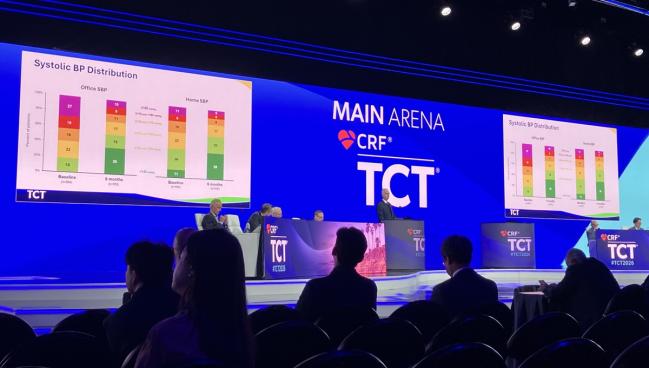
SAN DIEGO, CA—Radiofrequency renal denervation (RDN) lowers blood pressure through 6 months for a wide spectrum of patients with uncontrolled hypertension, an analysis of the United States cohort in the SPYRAL AFFIRM postapproval study shows.
The patients, many from minority populations, also had an improvement in self-reported quality of life, with low rates of adverse clinical outcomes after radiofrequency RDN with the Symplicity Spyral system (Medtronic).
“We’re observing meaningful, significant reductions in systolic blood pressure [and] diastolic blood pressure, but also across all different measures of how we check blood pressure, meaning office, home, [and] ambulatory criteria, so quite a concordance,” said David Kandzari, MD (Piedmont Heart Institute, Atlanta, GA), who presented the data on Tuesday at TCT 2026.
Prior studies that led to the approval of the Symplicity Spyral system, such as SPYRAL HTN-OFF MED and SPYRAL HTN-ON MED, had very specific patient inclusion criteria, Kandzari told TCTMD, emphasizing that the SPYRAL AFFIRM study included a broader real-world population.
“Importantly, in this study population, we also focused on underrepresented patient populations that haven’t been fully represented in major clinical trials,” he said, adding that investigators focused on enrolling women, older individuals, patients with chronic kidney disease and diabetes, and those who were Black, Asian, and Hispanic.
“This is the largest US RDN trial to date with nearly 600 patients,” said Kandzari. Referring to the underrepresented subsets of patients, he added that there was a “similar magnitude of blood pressure-lowering in those groups as compared with the overall population.”
Clyde Yancy, MD (Northwestern Memorial Hospital, Chicago, IL), lead discussant after the presentation, agreed with Kandzari on the value of SPYRAL AFFIRM.
“What makes this study interesting . . . is the inclusion of a more complex patient profile, including patients who come to offices on a daily basis. This means patients who were not typically enrolled in clinical trials,” said Yancy.
The findings were published simultaneously in Circulation: Cardiovascular Interventions.
Promising Outcomes
For SPYRAL AFFIRM, the investigators enrolled patients with uncontrolled hypertension from 89 sites in the United States, Europe, and Australia. The current analysis focused on the US cohort, which included 594 patients at 73 sites. The average age of these patients was 56.5 years, and 45.3% were female. Most patients were white (68.5%), 27.1% were Black, 10.6% were Hispanic, and 2.5% were Asian. Average body mass index was 32.5 kg/m2, and 19.4% of patients had well-controlled type 2 diabetes. Patients with uncontrolled type 2 diabetes or type 1 diabetes were excluded.
At baseline, the average readings for office, home, and 24-hour ambulatory blood pressure were 169/106 mm Hg, 158/101 mm Hg, and 151/96 mm Hg, respectively.
Most patients (51%) were on four or more antihypertensives at baseline, “so it was quite a hypertensive patient population,” Kandzari said. This differs from the SPYRAL HTN-OFF MED and -ON MED trials, in which patients were either not allowed to take BP-lowering medications until after the primary endpoint was assessed or could be taking no more than three antihypertensives.
No change was found in the number of antihypertensive medications taken over the course of SPYRAL AFFIRM, “meaning that any reduction . . . in blood pressure could not be explained by an escalation in medications,” Kandzari said.
The primary endpoint was the change in office systolic blood pressure from baseline to 6 months. After RDN, this fell by mean of 18.2 mm Hg. Home and 24-hour ambulatory readings declined as well, by 9.4 and 9.7 mm Hg, respectively (P < 0.001 for all).
Additionally, at 6 months, 86.1% of patients experienced one or more of the following prespecified clinical benefits: an office systolic blood pressure reduction ≥ 10 mm Hg, a home systolic blood pressure reduction ≥ 5 mm Hg, or taking at least one fewer antihypertensive medication.
Patients also reported improved quality of life, as assessed using the EuroQoL-5 dimensions 3-level questionnaire. Quality of life improved by a mean 2.7 points from baseline to 6 months (P < 0.001).
Kandzari noted the safety of the procedure, too, with less than 1% of patients experiencing an adverse event.
In SPYRAL AFFIRM, treatment with RDN “led to meaningful reductions in blood pressure across all different measures. . . . Nine out of 10 patients had a clinical benefit,” Kandzari commented to TCTMD.
Yancy emphasized the clinical need, given that “hypertension is the leading cardiovascular condition worldwide—it is causal for cardiac dysfunction [and] heart failure, and it is an important risk factor for ischemic heart disease.
“It is imperative that we understand how best to treat hypertension,” he stressed, asking Kandzari, “Are we willing to think about this not as adjunctive therapy, but as a primary intervention?”
Kandzari said RDN is not currently endorsed as a primary therapy. However, he added, RDN alongside lifestyle interventions and medications can bring patients better outcomes than with medicine and lifestyle changes alone.

Bailey Salimes is a Medical Journalist at TCTMD. Prior to CRF, she was at MedStar Health Research Institute in Washington…
Read Full BioSources
Kandzari DE, Kario K, Weber MA, et al. Effectiveness of radiofrequency renal denervation in the United States: six-month primary end point results from the SPYRAL AFFIRM study. Circ Cardiovasc Interv. 2026;19:e017422.
Disclosures
- Kandzari reports institutional research/grant support from Abbott Vascular, Biotronik, Boston Scientific, Orbus Neich, Teleflex, Supira Medical, and Medtronic; and personal consulting honoraria from Boston Scientific, Brattea Medical, Medtronic, and HyperQure.
- Yancy reports no relevant conflicts of interest.
Related News



Comments