STAREE: Statins Cut MACE Risk by 30% in Older Adults With No CVD History
While there was no change in disability-free survival, the results should impact guidelines, says François Mach.

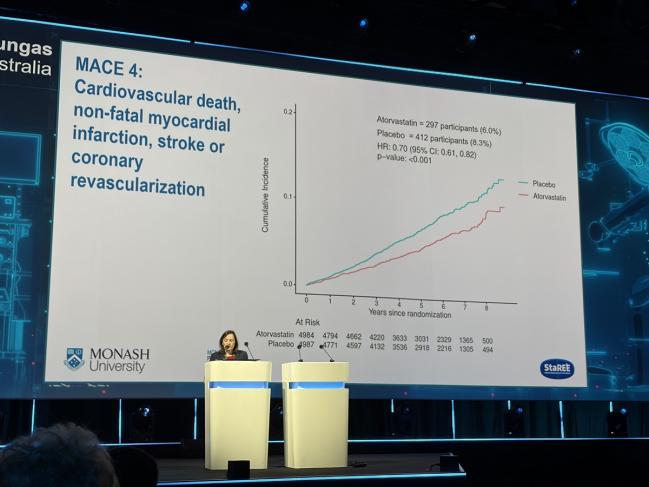
MUNICH, Germany—People over age 70 with no history of cardiovascular disease see dramatic reductions in major adverse cardiovascular events when newly prescribed statin therapy for primary prevention, according to results of the STAREE trial.
Compared with those given placebo, patients taking 40 mg of atorvastatin once daily had a 30% lower incidence of CV death, nonfatal MI, stroke, or coronary revascularization (6.0% vs 8.3%; P < 0.001) over the 6-year study period. There was, however, no difference between groups in the incidence of disability-free survival, defined as a composite of death from any cause, dementia, or persistent physical disability.
In a media briefing here prior to the presentation at the European Society of Cardiology Congress 2026, lead author Sophia Zoungas, MBBS, PhD (The George Institute for Global Health, Sydney, Australia), said the data answer important questions about the safety and efficacy of statins in older people.
“There was clearly insufficient evidence to recommend statins for primary prevention in people over 70,” she said. “And due to the lack of evidence, there was also concern regarding possible side effects.”
Indeed, statins are known for their long list of potential problems, including muscle-related issues. Earlier this year, a large analysis from the Cholesterol Treatment Trialists’ (CTT) Collaboration concluded that most side effects linked to statin therapy are not supported by evidence from randomized, controlled trials, but questions persist.
To TCTMD, Zoungas said going into the trial, the potential for increasing muscle aches was a concern when giving a statin to otherwise healthy older individuals with no CV history.
“About 50% of the participants in our trial actually did note some form of musculoskeletal issue at baseline, and we didn’t see a massive increase in that adverse event amongst our participants,” she added. “I think it’s a conversation that a person needs to have with their treating physician and weighing up the risks and benefits and understanding whether they will be able to tolerate a statin.”
Zoungas said the topic is a relevant one for clinical practice because opinions are not consistent. The American College of Cardiology/American Heart Association primary-prevention guidelines do not make specific recommendations for statin therapy in older adults, and the US Preventive Services Task Force has said the evidence is insufficient to assess relative risks and benefits of statins for primary prevention in anyone age 76 and older. About 40% of the STAREE participants were age 75 and older.
As Zoungas showed, the statin benefits were similar whether patients were in their early or mid 70s, or older than 75.
It’s great for the field of CV aging that more evidence is building in this special population. Abdulla A. Damluji
François Mach, MD (Geneva University Hospital, Switzerland), the discussant for the trial, said the results demonstrate that age should no longer be used as a reason to withhold statin therapy for primary prevention.
“National and international guidelines have to be adapted accordingly,” he added. “But STAREE does not mean that every person 70 years old or older should automatically receive a statin treatment. Decisions should integrate life expectancy, competing risk, treatment burden, and patient priority.”
Commenting for TCTMD, Abdulla A. Damluji, MD, PhD (Cleveland Clinic, OH), noted that given the unchanged disability free-survival, the key takeaway from STAREE is that statins prescribed to older patients living independently results in event reduction, but not preserved independence.
“That makes remaining life expectancy discussions very important for older adults. The curves separate after roughly 2 years, so a patient unlikely to survive 5 more years, or who is already frail and carrying substantial polypharmacy, may gain little from a statin,” he noted in an email. “That said, the trial was not powered for mortality only. It really is an outstanding achievement to enroll nearly 10,000 people above 70 years of age. It’s great for the field of CV aging that more evidence is building in this special population.”
STAREE Results
The trial, which was simultaneously published in the New England Journal of Medicine, enrolled patients ages 70 years and older (mean age 74.7 years; 52% women) from general practices across Australia and randomized them to atorvastatin (n = 4,984) or placebo (n = 4,987). Patients were mailed the study medication and advised to begin taking one 20-mg dose per day, increasing to two 20-mg doses per day after 1 month, if tolerated, to achieve a total daily dose of 40 mg. The median follow-up was 5.9 years.
At baseline, lipid levels were similar in both groups, with a mean total cholesterol level of 211 mg/dL, LDL-cholesterol level of 127 mg/dL, HDL-cholesterol level of 62 mg/dL, and triglyceride concentration of 113 mg/dL.
By 5.9 years, there was a mean reduction in total cholesterol of 53 mg/dL in the atorvastatin group, with a corresponding reduction of 18 mg/dL in the placebo group. LDL cholesterol was reduced by a mean of 48 mg/dL and 16 mg/dL, respectively.
The rate of serious adverse events was similar in both groups, with musculoskeletal, hepatobiliary, and diabetes-related adverse events occurring more commonly in the atorvastatin group. Overall, musculoskeletal adverse events were only modestly higher on atorvastatin compared with placebo (32.0% vs 29.4%), however.
“We should anchor that number for the patient: most new aches after starting will not be [due to] the drug, which is precisely why a planned rechallenge or dose de-escalation beats abrupt discontinuation,” noted Damluji, who is chair of the American College of Cardiology’s Geriatric Cardiology Leadership Council. “The differences that are worth discussion with patients are hepatobiliary events (3.3% vs 0.9%) and new diabetes-related events (4.0% vs 2.7%), along with the fact that 7.2% stopped the trial regimen for an adverse event.”
He advised letting older patients who are starting a statin know about the things they should report urgently: proximal weakness, dark urine, and systemic illness.
Ongoing Questions
Zoungas and colleagues note that the large treatment effects observed in the trial were driven primarily by a lower incidence of nonfatal events, especially MI and coronary revascularization.
Overall, the benefits seen in STAREE outpace those of the earlier PROSPER trial, which also reported an impact of statin therapy in patients with a mean age of 75.4 years. They also are similar to those of JUPITER, which demonstrated a significant reduction in MACE in apparently healthy adults without hyperlipidemia starting statins at a median age of 66 years.
Mach said the additional data from STAREE now make it important to understand “which old adults should we treat, for how long, and does preventing an event give them a more meaningful life?”
Despite the lack of impact on disability-free survival, Damluji said there is reason to be optimistic that the ongoing PREVENTABLE trial may provide evidence that statin therapy can help prevent dementia or disability in addition to CV events in older adults. With a planned enrollment of 20,000 patients and the same therapeutic dose of 40 mg per day of atorvastatin, PREVENTABLE should have more power to detect hard clinical outcomes than STAREE, he added.

L.A. McKeown is a Senior Medical Journalist for TCTMD, the Section Editor of CV Team Forum, and Senior Medical…
Read Full BioSources
Zoungas S, Wolfe R, Moran C, et al. Atorvastatin, cardiovascular events, and disability-free survival in older adults. N Engl J Med. 2026;Epub ahead of print.
Disclosures
- Zoungas reports previous payments to her institution from AstraZeneca, Boehringer Ingelheim, Eli Lilly Australia, GlaxoSmithKline, Novo Nordisk, and Sanofi for participation in advisory boards, steering committees, and educational meetings.
- Damluji reports serving as a consultant to Edwards Lifesciences.
Related News



Comments