Sublingual Nitroglycerin Appears Safe, Helpful for Pre-TAVI CCTA
Long contraindicated in patients with severe AS, the vasodilator may improve image quality with careful monitoring.

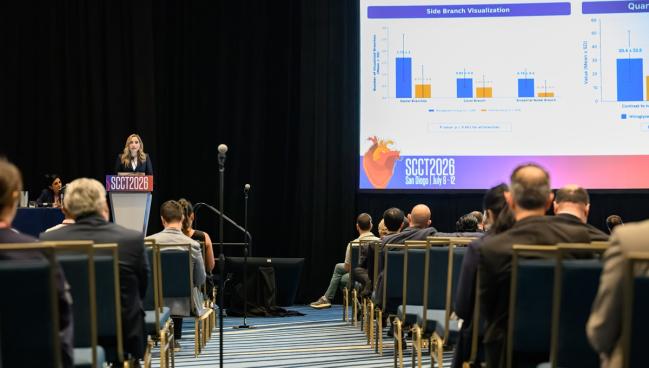
Photo Credit: SCCT
CHULA VISTA, CA—Giving sublingual nitroglycerin to patients with severe aortic stenosis (AS) in pre-TAVI coronary computed tomography angiography (CCTA) assessments appears safe and can improve image quality, new prospective data show.
Nitroglycerin is often given to patients ahead of CCTA to induce coronary vasodilation, thereby increasing diagnostic accuracy, but it’s contraindicated in patients with severe AS due to its hypotensive effects, according to the 2019 Society for Cardiovascular Computed Tomography (SCCT) guidelines for CT imaging in TAVI.
Given the high prevalence of CAD among patients with AS and recommendations for routine CTA assessment before TAVI, there is a “knowledge gap” that might be limiting image quality, said Linda Zakkak Monayer, MD (Edith Wolfson Medical Center, Holon, Israel), who presented the findings recently at the 2026 SCCT annual scientific meeting.
“In this prospective study, sublingual nitroglycerin prior to CTA in patients with severe AS undergoing TAVR is safe and well tolerated,” she said. “It significantly improves coronary artery image quality and visualization, improves diagnostic performance, and reduces unnecessary invasive coronary angiography. It improves the positive predictive value and accuracy of coronary CTA.
“Taken together, our findings support the incorporation of sublingual nitroglycerin in routine pre-TAVR CTA protocols in appropriately selected patients,” Zakkak Monayer concluded.
SCCT President Ronen Rubinshtein, MD (Edith Wolfson Medical Center), who co-moderated the Best Original Science session in which the data were presented, said the findings will change his practice. “We are always building on old hypotheses, which may be right and may be wrong,” he told TCTMD.
The study, for which he was a co-investigator, shows that the previous notions about nitroglycerin in this population were wrong, Rubinshtein continued.
“Even patients with severe, even significant, aortic stenosis could receive nitroglycerin [and] have a better visualization of the coronary arteries, because in those patients with severe aortic stenosis, we are able to exclude obstructive coronary disease just based on the CT, sparing another coronary angiogram before TAVR,” he said. “It’s also clinically significant that you can appreciate the coronary arteries and avoid [an] unnecessary invasive procedure in a patient that anyway is going to an invasive procedure.”
Safe, Effective
For the study, Zakkak Monayer and colleagues included 109 patients (mean age 79.4 years; 45.9% female) with severe AS slated for CTA assessment ahead of TAVI. All patients in the cohort—which did not include those with baseline hypotension, severe left ventricular dysfunction, critical AS, or other contraindications to nitroglycerin—received 0.8 mg of sublingual nitroglycerin prior to CTA.
Systolic blood pressure dropped from a mean of 158 mm Hg at baseline to 140 mm Hg post-CTA (P < 0.001) and remained stable through discharge (136 mm Hg; P = 0.32). More than one-third of patients (38.5%) experienced drops in systolic BP of more than 20 mm Hg without associated symptoms, though headaches (8.2%) and mild dizziness (7.3%) were reported.
Compared with a propensity-matched cohort of 109 controls, the study group had superior image quality with higher contrast-to-noise (30.4 vs 18.5) and signal-to-noise ratios (25.5 vs 15.1); greater side branch visualization; and higher coronary blood volume index (3.1 vs 2.0; P < 0.001 for all). Additionally, those receiving nitroglycerin had fewer false-positive scans (8 vs 23), an increased positive predictive value (75.0% vs 48.9%; P = 0.033), and higher diagnostic accuracy (84.9% vs 67.6%; P = 0.036).
Fewer patients in the nitroglycerin group were classified as CAD-RADS 3 compared with controls (P < 0.001), reflecting “better coronary visualization with nitroglycerin and fewer equivocal CTA findings,” Zakkak Monayer said.
Moreover, researchers saw a nonsignificant 27% relative risk reduction in the rate of invasive coronary angiography in the study group (35.6% vs 49.3%; P = 0.078).
Zakkak Monayer told TCTMD her institution has changed practice because of this analysis. “We now routinely administer sublingual nitroglycerin before pre-TAVR CT in elective, clinically stable patients with severe aortic stenosis,” she said. “As in our study, we exclude patients with baseline systolic blood pressure < 100 mm Hg, left ventricular ejection fraction < 30%, critical aortic stenosis, [and] any other contraindications to nitroglycerin.”

Yael L. Maxwell is Senior Medical Journalist for TCTMD and Section Editor of TCTMD's Fellows Forum. She served as the inaugural…
Read Full BioSources
Zakkak Monayer L. Sublingual nitroglycerin in severe aortic stenosis. Presented at: SCCT 2026. July 11, 2026. Chula Vista, CA.
Disclosures
- Zakkak Monayer and Rubinshtein report no relevant conflicts of interest.
Related News


Comments