TARGET-CTCA: When MI’s Already Ruled Out in Chest Pain, Imaging Doesn’t Add Much
The lack of impact on outcomes was surprising, says the investigator, though the FAST-CTCA trial may still come through.

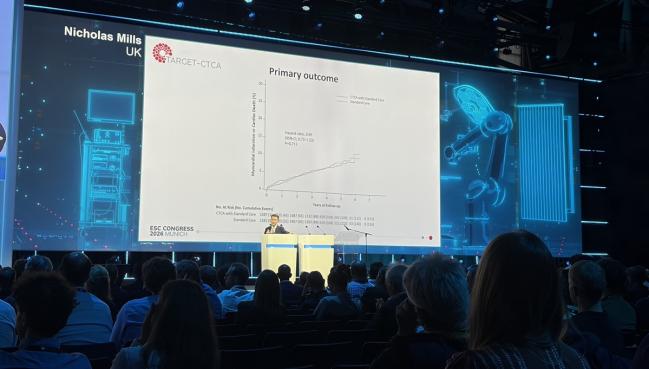
MUNICH, Germany—In patients with acute chest pain for whom MI has been ruled out and troponin values suggest intermediate risk, coronary CT angiography (CCTA) does not help clinicians then intervene in ways that prevent subsequent events, the TARGET-CTCA trial suggests.
At a median of 3 years after patients presented to an emergency department, the composite of MI or death from a cardiac cause was 7.1% in those who had been randomized to undergo CCTA and 7.3% in those randomized to standard care (adjusted HR 0.95; 95% CI 0.73-1.23).
Nicholas L. Mills, MD, PhD (University of Edinburgh, Scotland), presented the findings, which were simultaneously published in the New England Journal of Medicine, at the European Society of Cardiology Congress 2026.
“I was fairly confident that high-sensitivity troponin was associated with very high risk of future events in these patients, and that we could do something about it,” Mills told TCTMD. “But of course, troponin reflects not just coronary ischemia and coronary disease, it reflects many other things. Heart muscle disease can be influenced by kidney function.
“These individuals were at future risk, but it doesn’t seem to be principally driven by their coronary disease,” he continued. “And therefore, I think the conclusions are sound that we don’t need to investigate coronary artery disease in this population once we’ve confidently ruled out a heart attack.”
US guidelines endorse CCTA in patients presenting to the emergency department with chest pain. In intermediate-risk patients without known CAD, they give CCTA a class 1 recommendation for excluding atherosclerotic plaque and obstructive CAD (level of evidence A). European guidelines recommend consideration of CCTA or noninvasive stress imaging in patients with suspected ACS without elevated troponin levels (class IIa, level of evidence A recommendation).
Mills said he’s still coming to terms with the fact that the trial didn’t bear out his hypothesis that CCTA could guide care, adding that he thinks the trial answered an important clinical question about intermediate-risk patients with acute chest pain.
“It’s a much more heterogeneous and complex population, and the risk of noncardiovascular death and other events was much higher in this population,” he noted. “I also think we have to be careful in what we might anticipate that preventive treatment for coronary disease might do because even though there’s 3 years of follow-up in this trial, I think the likelihood of us influencing outcomes in that period would depend on their principal presentation being with acute chest pain due to coronary disease.”
No Groups Identified for Benefit
TARGET-CTCA enrolled 3,170 patients (median age 61 years; 30.2% women) who presented to emergency departments at 14 hospitals in the United Kingdom and were randomized at a median of 6 days after presentation to undergo CCTA or receive standard care.
Nearly 90% presented with chest discomfort. 17.5% had a prior MI diagnosis, and 15.1% had a previous angina diagnosis. Rates of hypertension were about 45% and more than half of patients were either current or former smokers. The mean History, Electrocardiogram, Age, Risk Factors, and Troponin (HEART) score was 3.5, and 49.7% of all patients were classified as having intermediate or high risk on the basis of a score greater than 3.22. The median maximal high-sensitivity troponin I score was 8.0 ng/L in the cohort as a whole.
In the CCTA group, 42.5% had nonobstructive CAD on imaging and 22.6% had obstructive CAD. Early outpatient review was advised for those who had obstructive disease or significant noncoronary calcium. Medical management was optimized based on the imaging findings and PCI was performed in 6.2% of those in the CCTA arm by 3 years and in 4.9% of those in the standard-care arm.
Approximately 42% of patients in the CCTA arm were receiving an antiplatelet agent at 90 days and 63.4% were taking a statin. In the standard-care arm, those numbers were 32.8% and 48.5%, respectively.
By 3 years, statin therapy increased to 68.6% after CCTA and 55.6% after standard care. Antiplatelets, on the other hand, decreased in the CCTA arm to 41.5% and in the standard-care arm to 31.6%. Other preventive medications increased from 66.7% at 90 days to 71.7% at the end of the trial in the CCTA arm and from 52.3% to 58.4% in the standard-care arm.
Multiple analyses that accounted for competing risks and looking at time earlier than 3 years, as well as sensitivity analyses, failed to showed any meaningful difference between the two groups in the incidence of a primary outcome event.
Secondary events, including MI, death from a cardiac cause, or death from a CV cause were not significantly different between groups. Rates of death from any cause were 4.6% in the CCTA group and 6.1% in the standard-care group at 3 years (adjusted HR 0.74; 95% CI 0.54-1.00).
We don’t need to investigate coronary artery disease in this population once we’ve confidently ruled out a heart attack. Nicholas L. Mills
“We did not identify a higher-risk group that were more likely to benefit from CT,” Mills said in his presentation. “This included patients that were not known to have coronary disease, those that were higher risk with higher median troponin values or higher HEART scores, or those not on preventive therapy.”
In their paper, Mills and colleagues led by Kuan Ken Lee, MD, PhD (University of Edinburgh), note that the ongoing FAST-CCTA trial is expected to yield additional answers on this topic. It is assessing whether use of CCTA in patients presenting to the emergency department with chest pain who have a HEART score greater than 3.0 results in lower rates of death, MI, or unstable angina.
Christoph Gräni, MD, PhD (University of Bern, Switzerland), the discussant for the trial during the Hot Line session, said that despite many studies in patients with acute chest pain, the question of how and in whom to investigate further in this population has remained open-ended. TARGET-CTCA was a strategy trial, he added, “and it proved actually that coronary CT scan can identify coronary artery disease.”
Gräni pointed out that the actual increase in statins and antiplatelets that occurred as a result of imaging was modest and may have attenuated the effect of the CCTA intervention on outcomes.
According to Gräni, the study suggests the importance of looking beyond stenoses and considering better phenotyping using artificial intelligence-based quantification of plaque burden/composition and inflammation.
“Troponin alone should not mandate a coronary CT scan,” he noted.

L.A. McKeown is a Senior Medical Journalist for TCTMD, the Section Editor of CV Team Forum, and Senior Medical…
Read Full BioSources
Lee KK, Wereski R, Lowe D, et al. Targeted use of computed tomographic coronary angiography in acute chest pain. N Engl J Med. 2026;Epub ahead of print.
Disclosures
- Lee reports no relevant conflicts of interest.
- Mills reports consulting for Roche Diagnostics.
Related News

Comments