'Target: AS' Initiative Shows Early Promise in Improving Timely Diagnosis
As the registry continues to grow, investigators hope to dive deeper to find bottlenecks and improve access.


NEW YORK, NY—A systematic program designed to close the diagnosis and treatment gaps for patients with aortic stenosis (AS) seems to be on its way to doing just that, according to the first large-scale analysis to come from the American Heart Association’s Target: AS registry.
Data from several dozen centers signed up for the Target: AS initiative by 2023 show that over the course of 1 year, the rate of patients receiving a timely diagnosis improved from 54.2% to 61.4% (P = 0.001). Timely diagnosis was defined as assessment of symptoms, LVEF, and stroke volume index (SVI) and/or multimodal imaging when warranted within 30 days of echocardiography. No change was seen in the percentage of patients with a class 1 indication for aortic valve replacement (AVR) receiving treatment within 90 days (82.2% vs 84.7%; P = 0.299).
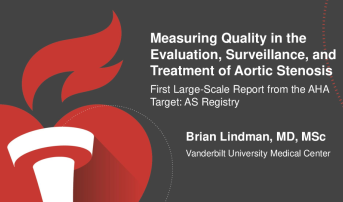
The TARGET: AS program is a quality-improvement initiative with a framework that helps capture and measure evidence-based care metrics as well as multimedia educational resources and self-management plans for patients and families. It was designed to help fill holes previously identified as impeding timely treatment. To date, 92 US centers have signed up, for a total of 17,599 patient records from 70,102 encounters.
“With respect to several other quality measures, there were significant gaps in care that were identified through these registry metrics,” said Brian Lindman, MD (Vanderbilt University Medical Center, Nashville, TN), who presented the findings here today at New York Valves 2026. “As we move forward to address additional gaps in care, there are several tools that are already being implemented and [there] will be more in the years to come.”
Discussant Dharam Kumbhani, MD (UT Southwestern Medical Center, Dallas, TX), commented on the “remarkable transformation in the care of patients with aortic stenosis” seen in the past two decades. “It has gone from a condition with about 50% 1-year mortality in the pre-TAVR era to approximately 1-2% 1-year mortality in the low-risk TAVR era,” he said, noting that registries “such as STS and TVT have been instrumental in driving many of these improvements by identifying opportunities to improve care quality, and to standardize the procedural aspects in particular.”
The new data, simultaneously published online in Circulation, provide “the first large-scale assessment of how well those measures are being implemented in clinical practice,” Kumbhani continued. Further, they suggest “that participation in a quality registry like this itself may drive improvements in care,” he said.
More Diagnosis, Similar Treatment Rates
For the study, Lindman and colleagues looked at 8,097 patients (median age 76.5 years; 47% female) who had moderate or severe AS identified on echo at one of 58 active Target: AS sites in 2023.
From 2023 to 2024, researchers saw improvements in timely diagnosis in the cohorts of patients treated at the 26 centers that enrolled a minimum of 40 patients each year (54.2% to 61.7%; P = 0.003), as well as at the 12 sites that joined the initiative before 2023 (56.0% to 66.2%; P = 0.001). Breaking this metric down, overall improvements were seen in timely symptom assessment (76.8% to 84.0%; P = 0.015), SVI on echo (64.7% to 81.6%; P = 0.011), and multimodal testing (13.4% to 24.5%; P = 0.026).
Rates of timely treatment were comparable between 2023 and 2024 for volume-qualifying and long-term sites, but there were improvements noted in the rate of multidisciplinary team evaluation in the overall cohort (77.6% to 83.9%; P < 0.001). Echocardiography reports featured key findings 83% and 85% of the time in 2023 and 2024, respectively, but clinical recommendations were only included 9.0% and 6.8% of the time, respectively. Even in the long-term sites by 2024, timely surveillance echocardiograms were not performed for 40.2% of patients with severe disease and 37.1% of those with moderate disease.
“The good news is these are highly amenable to system-level interventions, including structured echocardiographic reporting and automated referral pathways to the valve team,” Kumbhani said. “Although timely treatment exceeded 80% in eligible patients, understanding why approximately one in six patients still experience treatment delays is important, particularly given the known adverse outcomes with untreated severe aortic stenosis and the known access barriers in many situations.”
Also, he added, given the relatively short follow-up, “it remains unclear whether the observed improvements reflect specific quality-improvement interventions, a [behavioral reactivity] Hawthorne effect, or secular trends in care. Linking these processes to long-term outcomes will be an important next step.”
Overall, Kumbhani concluded, “the Target: AS registry represents an important advance in moving beyond procedural excellence towards excellence across the entire continuum of aortic stenosis care. In my mind, these findings have even greater relevance given the proposed changes to the TAVR NCD.”
Panelist Roxana Mehran, MD (Icahn School of Medicine at Mount Sinai, New York, NY), called Target: AS “such an important nationwide program, and we absolutely have to make improvements.” She questioned whether there were factors related to the patients who did not receive timely diagnosis and treatment that were different from the ones who did “because we are so concerned about access and timely treatment in vulnerable patients and women.”
Lindman said his team plans to take deeper dives in this regard but clarified that patients who preferred a delay for whatever reason and those in whom the heart team deemed AVR futile were excluded from the study population.
“I sometimes fear a little bit in how we present this that people think we’re doing too well on timely treatment,” he said. “And there are reasons why we created the algorithm as we do. But there are these exceptions such that that person who wanted some delay wouldn’t be punished.”
Additionally, Lindman told TCTMD, he’d like to see more work done examining individual sites that did see improvements in timely diagnosis and treatment to better gauge what they are doing, and how other institutions can draw lessons from them. His team is hoping to enroll at least 200 centers into the registry to further investigate how changes can be made.
“I think we’re going to see a lot more discussion with this and the role of AI in terms of timely diagnosis, and all these things are going change these measures, and we’re hopefully going to continue to improve as technology helps us identify and diagnose patients as well,” said session co-moderator Susheel Kodali, MD (NewYork Presbyterian Columbia University Irving Medical Center, New York, NY).

Yael L. Maxwell is Senior Medical Journalist for TCTMD and Section Editor of TCTMD's Fellows Forum. She served as the inaugural…
Read Full BioSources
Lindman BR, Gillam LD, Perpetua EM, et al. Advancing quality in the evaluation, surveillance, and management of aortic stenosis: a report from the AHA Target: AS registry. Circulation. 2026;Epub ahead of print.
Disclosures
- Edwards Lifesciences is the founding sponsor of Target: Aortic Stenosis.
- Lindman reports serving as a consultant for Edwards Lifesciences, Kardigan, Anteris, Medtronic, Tempus, LightHeartedAI, and Sparrow Bioacoustics; and receiving investigator-initiated research grants from Edwards Lifesciences and Kardigan.
- Mehran reports receiving consulting fees/honoraria from Novartis and Novo Nordisk; and research grants from Abbott Laboratories, Alleviant Medical, Amgen, CERC, Chiesi, Concept Medical, Cordis, CPC Clinical Research, Daiichi Sankyo, Duke University, Faraday Pharmaceuticals, Idorsia, Janssen, MedAlliance, Medscape, Medtronic, Novartis, Population Health Research Institute, Protembis, RM Global, and Sanofi.
- Kodali reports holding equity/stocks in Dura Biotech, Thubrikar Aortic Valve, MicroInterventional Devices, Supira, Admedus, TriFlow, Adona, and Tioga; receiving consulting/speaker fees or honoraria from Philips, Admedus, TriCares, and Dura Biotech; and receiving grant/research support from Edwards Lifesciences, Abbott, Medtronic, Boston Scientific, and JenaValve.
- Kumbhani reports no relevant conflicts of interest.
Related News


Comments